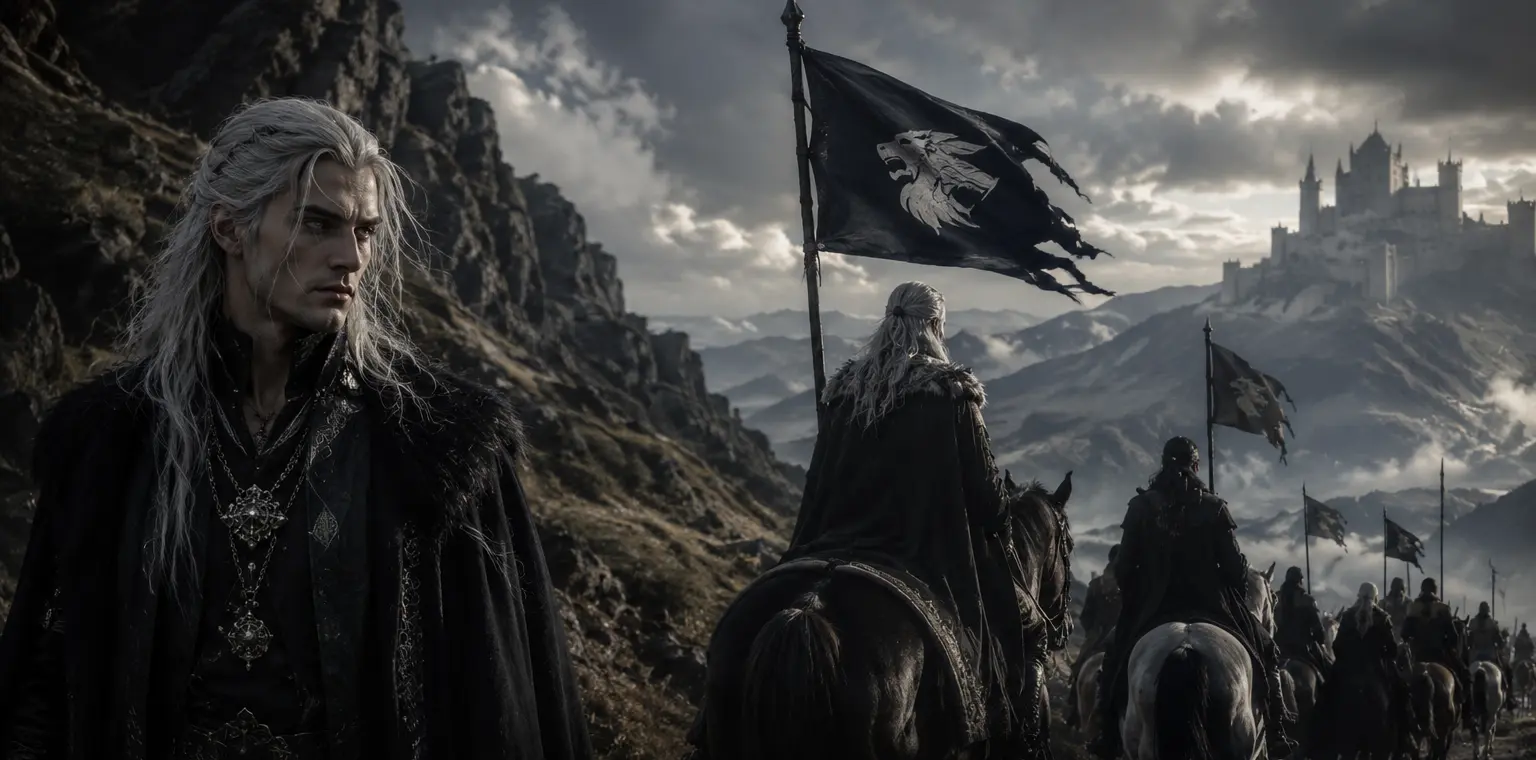
The Road Man and the King
A dead horse, a failed road, and the route-hand who taught a prince that a crown cannot command the ground beneath it.
The Road Man
The first thing Quarn Levan taught Prince Valerius Gavrion was that a dead horse did not care who owned the road.
The second was that neither did the rain.
The horse lay beneath a gray afternoon, harness twisted under its neck, one rear leg folded at an angle that made further argument unnecessary.
Around it, the royal convoy had stopped.
Twenty-three wagons.
Six mounted guards.
Four clerks.
Two officers.
One prince.
And forty-seven sacks of winter grain beginning to drink rain through canvas.
Valerius stood beneath a dark traveling cloak while three men explained why none of this was technically their fault.
“The eastern route was certified two weeks ago.”
“The shoulder failed after the storm.”
“The local roadmaster’s seal remains valid.”
“The gradient is within Crown tolerance.”
“The animal slipped.”
The young man beside the dead horse looked up.
He was twenty-four.
At least, Valerius thought he was twenty-four.
It was difficult to tell beneath the mud.
His coat had been repaired so many times that its original color had become a historical question. A knife hung at one hip. Rope at the other. No sword.
He had spent the last five minutes cutting grain sacks free from the overturned cart while everyone else discussed seals.
Now he said:
“The horse slipped because the road is gone.”
One clerk stiffened.
“The road is visibly present.”
The stranger looked at the mud beneath his boots.
Then at the clerk.
“You walk first.”
The clerk did not.
Valerius nearly smiled.
Captain Arven did not.
“This man was hired as a route-hand,” the captain said. “Not as an adviser to the Crown.”
The stranger returned to the grain.
“Good.”
Valerius stepped closer.
“What is good?”
“Advisers attend meetings.”
He cut another strap.
Valerius watched him.
The route ledger had failed to contain the man’s name.
Three sounds had been entered in one order, crossed out, then entered in another. When the clerk appealed to western order, Valerius had written the final correction himself:
QUARN LEVAN.
Beneath it, the route-hand had added only:
CLOSE ENOUGH.
Valerius had not yet learned what the original arrangement had been.
He had learned not to ask twice before the first answer had finished proving useful.
“What do we do?” he asked.
Captain Arven blinked.
“Your Highness?”
“I asked Quarn.”
Quarn pressed two fingers against the split hub.
“Unload twelve wagons.”
A clerk protested.
“We lose hours.”
“We lose grain if we don’t.”
“The remaining carts cannot carry—”
“Not into carts.”
Quarn pointed toward the slope above the road.
A narrow line ran between two wet fields.
It barely deserved the word path.
No carriage could pass.
No banner could ride it cleanly.
No military map would have bothered drawing it.
“Carry by hand.”
An officer stared.
“Forty-seven sacks?”
“Some.”
“How many?”
“Enough.”
“That is not a number.”
“Then count while carrying.”
Valerius looked up the slope.
“How far?”
“Half a mile. Dry stone barn behind the ridge.”
“You know that?”
“I slept there.”
“When?”
“Before you arrived.”
Captain Arven stepped forward.
“We cannot send the royal convoy over an unverified farm track.”
Quarn looked at him.
“Then leave the grain here.”
The captain’s jaw tightened.
Valerius looked at the dead horse.
At the wet canvas.
At the men waiting for him to restore order.
His father had taught him that command existed to remove uncertainty.
His tutors had taught him to establish information before acting.
His officers had taught him never to move the Crown through terrain that had not been secured.
All three lessons were good.
The grain was getting wet.
“Unload twelve,” Valerius said.
Captain Arven hesitated.
“Your Highness—”
“Unload twelve.”
Quarn handed the prince a sack.
Valerius stared at it.
“What?”
“You said unload.”
“I ordered it unloaded.”
“Yes.”
The sack remained between them.
Valerius became aware of every officer watching.
Quarn did not appear to notice any of them.
Or did not care.
The sack was heavy.
Not impossibly heavy.
Merely undignified.
Valerius took it.
Quarn picked up another.
They walked uphill.
Behind them, after a moment of institutional discomfort, Gavrion followed.
The barn existed.
So did the roof.
By sunset, most of the grain was dry.
The royal convoy remained stuck.
Nobody died.
Quarn sat beneath the barn eaves repairing the broken wheel pin.
Valerius sat beside him with both hands around a cup of terrible tea.
“You knew that would work.”
“No.”
Valerius turned.
“You sounded certain.”
“Sounding uncertain makes people carry slower.”
“That is dishonest.”
“No.”
Quarn tested the pin against the light.
“Efficient.”
Valerius considered this.
“Where are you from?”
“Far.”
“That is not a place.”
“It is far enough.”
“Outside Gavrion?”
“Yes.”
“Greater Gavrion territories?”
“No.”
“The southern marcher states?”
“No.”
“Drakenval?”
Quarn finally looked at him.
“No.”
There was enough offense in the answer that Valerius smiled.
“Who arranged the name in the ledger?”
“The clerk tried.”
“And failed?”
“Then you tried.”
Valerius remembered now: three sounds spoken too quickly for Gavrion grammar, a clerk waiting with two empty boxes, and his own attempt to place a personal name first and a family name after.
“Quarn Levan,” Valerius said.
“Wrong.”
“Usable?”
Quarn pushed the pin through the repaired hub.
“Close enough.”
“Does it bother you?”
“What?”
“That Gavrion calls you something that is not exactly your name.”
Quarn looked toward the rain.
“Grain is dry.”
Valerius followed his gaze.
“That was not my question.”
“It was my answer.”
The prince drank.
The tea remained terrible.
“What should I call you, then?”
Quarn looked at him.
“Quarn works.”
“That one is correct?”
“Close enough.”
Valerius laughed.
Not a court laugh.
Not the polite sound used when an ambassador thought himself amusing.
A real one.
Captain Arven looked over from the barn.
Quarn returned to the wheel.
The strange thing was that Valerius kept asking him back.
Not to court.
To roads.
Flood roads.
Winter roads.
Roads whose bridges existed only because nobody had yet told the river otherwise.
Valerius learned where grain disappeared between ledger and mouth.
Where a fortress report could say READY while four soldiers shared one pair of winter boots.
Where marcher nobles maintained beautiful gatehouses and rotten evacuation tracks.
Where people bowed because they loved the Crown.
Where they bowed because they feared what came behind it.
And where they did not bow at all because somebody had to keep both hands on the wheel.
Quarn never taught him how to be king.
Whenever Valerius asked a question large enough to sound royal, Quarn usually answered with something irritatingly small.
How do you know when a district is close to famine?
“Watch what mothers stop eating.”
How do you know when soldiers are close to breaking?
“See who starts fixing straps that aren’t broken.”
How do you know whether a road is safe?
“Safe for what?”
For an army.
“Which army?”
Mine.
“That was your first mistake.”
Valerius learned to dislike the answers.
Then to use them.
The Crown taught Valerius how to see Gavrion from above.
Quarn taught him to see what was crushed underneath the map.
Neither man knew yet how long that lesson would last.
The War That Did Not Happen
Years later, King Valerius Gavrion prevented a war by losing an argument about flour.
No historian recorded it that way.
Historians preferred treaties.
They liked seals.
They liked borders drawn in straight lines after everyone involved had agreed to stop moving.
The winter dispute at Eastmere eventually became:
THE EASTERN PASSAGE SETTLEMENT.
Three pages in the Crown archive.
No battle.
No campaign title.
No statue.
Quarn remembered the flour.
The problem began with a bridge.
It usually did.
Two marcher banners claimed passage rights over the same winter crossing.
One answered to Gavrion.
One did not.
Neither side had enough grain.
Both had enough soldiers to make the shortage worse.
By the time Valerius arrived, two thousand armed men were camped on opposite sides of a frozen river.
No one had attacked.
This was considered encouraging.
Quarn disagreed.
“They’re hungry.”
Valerius stood beside him on a low ridge.
Below, campfires marked both banks.
“Obviously.”
“No.”
Quarn pointed.
“The officers are hungry too.”
Valerius frowned.
“And?”
“Hungry officers make history.”
Valerius looked at him.
Quarn pulled his coat tighter.
“Usually bad history.”
The king was forty now.
Silver had begun to appear near his temples.
Aldren was seven.
The boy was home at Griffhold, furious because his father had refused to let him accompany a winter negotiation.
Valerius had told him:
“You are too young.”
Aldren had asked:
“How old were you when Quarn first took you?”
Quarn had left the room before the answer became politically dangerous.
Now the king watched two armies trying not to become a war.
“The eastern banner claims the crossing by ancestral charter.”
“Yes.”
“Our marcher lord claims maintenance right by current law.”
“Yes.”
“Both claims are valid.”
“Yes.”
Valerius sighed.
“You enjoy this.”
“No.”
“You sound like you do.”
“I enjoy when people find expensive words for obvious problems.”
“What is the obvious problem?”
Quarn pointed toward the nearest cooking fire.
A soldier scraped the bottom of a pot.
Nothing came free.
Valerius looked toward the opposite bank.
Different banners.
Same movement.
Spoons against empty iron.
He descended the ridge.
The council tent contained eleven nobles, three military officers, two legal witnesses and a table covered in maps.
Everyone stood when Valerius entered.
Quarn remained outside.
That lasted four minutes.
The king sent for him.
Quarn entered carrying a sack.
He put it on the treaty table.
White powder leaked through one corner.
Lord Estaran stared.
“What is that?”
“Flour.”
The foreign envoy’s face tightened.
“We are aware what flour looks like.”
Quarn nodded.
“Good.”
Valerius sat.
“Explain.”
Quarn opened the sack.
The flour inside smelled wrong.
Damp.
Slightly sour.
He pushed his hand into it.
Pulled out a gray clump.
“Your southern storage.”
The foreign envoy stiffened.
“How did you obtain that?”
“Bought it.”
“From whom?”
“Someone hungry.”
Valerius looked toward Lord Estaran.
“Yours?”
Quarn took out a second cloth pouch.
Opened it.
Black mold spotted the grain.
“His.”
Silence.
Lord Estaran said:
“Our reserve passed inspection.”
Quarn looked at him.
“Then your inspection passed mold.”
Valerius put both hands on the table.
“How much?”
Quarn looked at the two officers.
“Both armies?”
“Yes.”
“Three days before ration cuts become visible.”
The foreign envoy stood.
“That is absurd.”
“Four if you eat horses.”
The envoy sat again.
Valerius looked at the maps.
For two days, everyone had argued over the bridge.
The map made sense.
The charters made sense.
The legal positions made sense.
The armies had been assembled because each side feared losing the road by yielding first.
No one had asked whether either side could feed the men required to defend the principle.
Valerius looked at Quarn.
“What do you suggest?”
“Move flour.”
“Whose?”
“Everyone’s.”
“Across the disputed bridge?”
“Yes.”
The room erupted.
Valerius raised a hand.
Silence returned.
Barely.
Lord Estaran leaned forward.
“If their wagons cross first, it establishes practical possession.”
The envoy snapped:
“If Gavrion escorts supply across, it constitutes Crown enforcement of its own claim.”
Valerius looked at Quarn.
Quarn shrugged.
“Then nobody owns it.”
A legal witness blinked.
“That is not possible.”
“Bridge doesn’t care.”
The witness appeared personally injured.
Valerius rubbed his forehead.
“What exactly are you proposing?”
“Strip banners from the grain wagons.”
The room became quieter.
“Mixed drivers.”
Quieter still.
“Two from each side.”
Lord Estaran stared.
“And military escort?”
“None.”
The envoy said, “Bandits—”
“Too cold.”
“Deserters.”
“Feed them too.”
The envoy looked toward Valerius as if expecting the king to restore civilization.
Valerius instead asked:
“How many days?”
“Five.”
“Then?”
“Men stop being hungry enough to turn law into blood.”
A general spoke for the first time.
“And the bridge claim?”
Quarn looked at him.
“Argue after breakfast.”
No one liked the plan.
That helped.
Plans that benefited one side were usually celebrated by the beneficiary.
Plans that annoyed everyone equally possessed a different virtue.
Valerius ordered the banners removed.
The first wagon crossed at dawn the next morning.
No Crown emblem.
No marcher crest.
No foreign colors.
Only flour.
A Gavrion driver held the left rein.
A foreign driver held the right.
They disliked each other.
That was visible from a considerable distance.
At the center of the bridge, the wagon struck ice.
The left wheel slid.
Both men swore in different accents.
Then climbed down together.
By noon, twelve wagons had crossed.
By evening, both armies were eating bread baked from mixed grain.
The legal argument continued for another three weeks.
Nobody died.
The first archive copy reached Valerius’s desk three weeks after Eastmere.
Quarn read it once.
“They forgot the flour.”
Valerius sat beside a window.
The Crown rested on a table rather than his head.
“History improves everyone.”
“Dangerous habit.”
A small boy was asleep in the chair beside the fire.
Aldren had tried to stay awake through the report.
He had failed with one hand still around a wooden practice sword.
Valerius looked at his son.
“He asks about you.”
“Poor judgment.”
“He wants to know why you call me Valerius.”
“Because that is your name.”
“He says everyone else calls me Father or Your Majesty.”
“Both inaccurate for me.”
Valerius smiled.
“You could call me Majesty once.”
“No.”
“For ceremony.”
“No.”
“For Aldren.”
Quarn looked at the sleeping boy.
“No.”
Valerius laughed quietly.
“Do you know what he asked yesterday?”
“No.”
“Whether you were my knight.”
Quarn looked offended.
“What did you tell him?”
“That you would be offended.”
“Good.”
“He asked whether you were my servant.”
“Worse.”
“My teacher.”
Quarn was silent.
Valerius noticed.
“That one bothers you less.”
“I taught you roads.”
“You taught me more than roads.”
“No.”
“Quarn.”
“No.”
“You are aware this refusal becomes less convincing after ten years.”
Quarn looked toward the window.
Snow moved across Griffhold.
“I taught you where wheels break.”
Valerius followed his gaze.
“And where kingdoms do.”
“That part you learned yourself.”
The king looked at his son again.
Aldren shifted in sleep.
The wooden sword slipped from his fingers.
Quarn caught it before it struck the floor.
He placed it against the chair.
Valerius watched.
“You like him.”
“He sleeps loudly.”
“That is not an answer.”
“He is seven.”
“That is also not an answer.”
Quarn walked toward the door.
Valerius said:
“Quarn.”
He stopped.
“If he becomes king someday—”
Quarn turned.
Valerius looked at the child.
Then smiled.
“Never mind.”
“What?”
“I was about to ask something foolish.”
“First good decision today.”
Valerius laughed.
Quarn left.
Aldren opened one eye.
“Is he gone?”
Valerius looked down.
“You were awake?”
“Some.”
“How much?”
Aldren sat up.
“Is Quarn your friend?”
Valerius considered the question.
There were titles that made relationships easier to catalogue.
Captain.
Minister.
Tutor.
Vassal.
Knight.
None fit.
“Yes.”
Aldren frowned.
“He is rude.”
“Yes.”
“He doesn’t bow enough.”
“No.”
“He says your map room smells like wet paper.”
“It does.”
Aldren looked toward the door.
“Why is he your friend?”
Valerius took a long time to answer.
“Because when I became important, he did not.”
The boy did not understand.
Not yet.
Years later, he would.
The Window
Quarn knew Valerius was dying before Valerius admitted he was ill.
The king had always hated stairs.
That was not evidence.
The evidence was that he began pretending he did not.
Valerius stopped halfway up the western tower and looked through an arrow slit as though the view had summoned him.
Quarn stopped three steps below.
Neither spoke.
Snow crossed the courtyard.
After a while, Valerius said:
“The lower wall needs repointing.”
Quarn looked at his back.
“No.”
Valerius breathed once.
Too carefully.
“What?”
“You stopped.”
“To look at the wall.”
“You hate the wall.”
“It is an excellent wall.”
“You called it pompous.”
“That was fifteen years ago.”
“Still pompous.”
Valerius continued upward.
Quarn followed.
At the top, the king sat before anyone offered him a chair.
That was the second sign.
The third was a cup.
Valerius’s hand shook when he lifted it.
Only once.
Small.
Enough.
Quarn said nothing.
For three months.
Then the king collapsed during a grain hearing.
Court physicians used many words.
Exhaustion.
Fever damage.
Cardiac weakness.
Residual winter inflammation.
An inherited condition.
A complication.
A decline.
None mattered much.
The king became thinner.
Then slower.
Then very skilled at arranging rooms so fewer people watched him stand.
Aldren was twelve.
Then thirteen.
He understood everything adults tried not to say.
Quarn watched father and son perform around each other.
Valerius became stronger when Aldren entered.
Aldren became younger.
Both believed the other needed the lie.
Quarn hated it.
Eleven days before the king died, Quarn found Valerius sitting beside an open window.
No council.
No crown.
No attendants.
Only the king and the sound of rain beginning beyond the roofs of Griffhold.
“You’ll catch cold.”
Valerius looked over.
“You have become boring.”
“You’re dying.”
The king turned back to the window.
Rain touched the sill.
“That was abrupt.”
“You’ve had two years.”
“Court usually prefers softer wording.”
“Court has curtains.”
Valerius smiled.
A tired smile.
Quarn sat beside him.
For several minutes, neither spoke.
Below, wagons crossed the lower court.
A stable boy shouted.
Someone dropped a bucket.
Life continued with poor respect for royal mortality.
Valerius said:
“Do you remember the first road?”
“Which?”
“The dead horse.”
“Horse wasn’t dead when we arrived.”
“It was very dead.”
“Still warm.”
“That does not improve the story.”
Quarn leaned back.
“You wrote a report saying the road remained passable.”
“I was thirty-one.”
“You were wrong.”
“I have noticed that thirty-one-year-old princes are unusually gifted at being wrong.”
Quarn glanced at him.
“Improved some.”
“High praise.”
Valerius looked toward the rain.
Then, quietly:
“What was it?”
Quarn frowned.
“What?”
“Your name.”
“My name is Quarn.”
“No.”
Valerius shook his head.
“The one before I rearranged it for the ledger.”
Quarn said nothing.
Valerius waited.
For once, he did not fill the silence.
Quarn looked down at his hands.
Old scars.
Split knuckles.
Years of rope, wheels, winter iron and roads whose names no longer matched where they went.
Finally he said:
“Le Van Quang.”
The room remained still.
Valerius repeated it.
Slowly.
Not perfectly.
Quarn corrected one sound.
Valerius tried again.
This time it was right.
Quarn looked at him.
Valerius smiled.
“I remembered enough.”
“Took long enough.”
“I had a kingdom.”
“Bad excuse.”
The king laughed.
Then coughed.
The laugh disappeared.
Quarn waited until the cough passed.
Valerius pressed a cloth against his mouth.
When he lowered it, he folded the stained side inward.
Quarn had already seen.
“Do you want to go back?” Valerius asked.
“To where?”
“Where that name came from.”
Quarn looked toward the window.
“My road doesn’t go there anymore.”
Valerius understood enough not to ask whether Quarn meant politics, distance, geography, or something older.
In their age, roads had learned too many ways to disappear.
“What was it like?”
Quarn thought.
“Hot.”
Valerius waited.
“Food was better.”
The king laughed again.
Carefully this time.
Then his expression changed.
“Aldren.”
“No.”
Valerius looked at him.
“I have not asked yet.”
“Still no.”
“I am dying.”
“Doesn’t improve your judgment.”
A pause.
Then the king smiled faintly.
“I was going to ask you to stay with him.”
“No.”
The smile faded.
Not hurt.
Thinking.
Quarn continued:
“If I stay because you told me, he gets your man.”
Valerius looked out into the rain.
“And?”
“He needs his own.”
The words settled between them.
Valerius closed his eyes.
For a moment, Quarn wondered if the king had fallen asleep.
Then:
“He is thirteen.”
“Yes.”
“He thinks duty means standing where everyone can see him.”
“Yes.”
“He thinks being afraid of failing me is the same as respecting the Crown.”
“Yes.”
“He reads maps too well.”
Quarn grunted.
“There’s the real problem.”
Valerius smiled.
“He hates mud.”
“He’ll learn.”
“He hates being wrong.”
“Learn faster.”
“He likes beautiful horses.”
“That may be terminal.”
Valerius laughed under his breath.
Then the smile went away.
“I do not want him to become me.”
Quarn looked at him.
The king’s face had not simply aged.
It had been used.
There were decisions in it.
Orders.
Winters survived.
Names of soldiers he had sent somewhere and never received back.
Wars prevented so successfully that nobody would ever know what they had almost cost.
Valerius had been a good king.
Quarn knew that better than most.
He also knew good kings could become cages for sons.
“You taught him duty,” Quarn said.
“I taught him what I knew.”
“Then stop.”
Valerius turned.
“Stop teaching?”
“Stop finishing.”
The king frowned.
Quarn pointed toward the window.
“You keep giving him Gavrion already answered.”
“Answers keep people alive.”
“Sometimes.”
Valerius was quiet.
“He knows the kingdom from windows,” Quarn said.
“The boy has traveled.”
“Royal travel.”
“That still counts.”
“No.”
Valerius sighed.
“I knew you were going to say that.”
“Then why ask?”
“I hoped terminal illness might improve your tact.”
“No.”
Rain ran down the stone.
Valerius looked toward the lower city.
When he spoke again, his voice was very quiet.
“Do not let him learn Gavrion only from a window.”
Quarn turned.
The king did not look at him.
There it was.
Not an order.
Not yet.
Quarn could hear the shape of one trying to form.
“No.”
Valerius looked over.
“No?”
“Tell him yourself.”
“I am.”
“No. You’re telling me.”
Valerius’s jaw tightened.
For one moment, beneath sickness and gray hair and the Crown sitting in another room, Quarn saw the young prince beside an overturned grain cart again.
“You are impossible.”
“Yes.”
“I may not have time.”
“Then speak faster.”
Silence.
Valerius began laughing.
It hurt him.
Quarn could see that.
He kept laughing anyway.
When it stopped, the king wiped his eyes.
“You know,” he said, “this is why history will never make you respectable.”
“Good.”
“Quarn.”
“Hm.”
“Thank you.”
Quarn stood.
“No.”
Valerius looked offended.
“You cannot refuse gratitude.”
“Watch.”
He walked toward the door.
“Quarn.”
He stopped.
Valerius said:
“Quang.”
Only once.
The old name sounded strange inside Griffhold.
But not wrong.
Quarn looked back.
Valerius had pronounced it correctly.
Perfectly.
For the first time.
Quarn frowned.
“Now you’re definitely dying.”
Valerius smiled.
“That convincing?”
“Yes.”
Quarn left before either of them could ruin the moment.
King Valerius Gavrion died before dawn.
No battle.
No assassin.
No curse.
No leap-day.
His breathing failed while rain moved softly against the palace windows.
The bells began after sunrise.
Griffhold dressed itself in white.
Then black.
Aldren did not cry where anyone could see.
Quarn did not attend the first council.
He went to the stable.
A wheel on a supply wagon had begun to split along the hub.
He repaired it.
A groom found him there near noon.
“Master Quarn.”
“No.”
The boy hesitated.
“Sir?”
“Worse.”
“The Prince has asked for you.”
Quarn pushed a new iron pin through the wheel.
“He eat?”
The groom blinked.
“What?”
“Breakfast.”
“I don’t know.”
“Find out.”
“The council is waiting.”
“Council can eat too.”
The groom stared.
Quarn looked up.
“Go.”
The boy went.
Quarn returned to the wheel.
Four months passed.
Aldren turned fourteen.
The court taught him succession.
Protocol.
Seal authority.
Banner law.
Royal mourning.
Command precedence.
Everything a young king-line needed to know about Gavrion.
Quarn watched.
Then, in late September, a road report arrived.
A bridge had moved.
Not metaphorically.
Spring flood had cut a new channel and left three villages technically connected to a road that no longer reached them.
The report contained four seals.
Six signatures.
A map.
The map was wrong.
Quarn took it to Aldren.
The boy studied it for a long time.
Then said:
“The road is still marked.”
“Yes.”
“Then where does it go?”
Quarn looked at him.
For one moment, he heard Valerius laughing beside a dead horse.
“Good question.”
Before sunrise, Quarn rejected the royal carriage.
He rejected the second carriage too.
Then found the ugliest service wagon still capable of reaching the south gate.
One wheel had been repaired in three different woods.
The canvas was patched.
A cooking pot had been tied to the rear axle with cord.
Quarn crawled beneath the wagon.
The hub pin was loose.
Of course it was.
He pulled it free.
Above him, the palace began to wake.
Soon a fourteen-year-old prince would come down wearing mourning that no longer fit the season.
Soon chamberlains would complain.
Soon somebody would ask why the Crown could not take a proper road.
Quarn turned the iron pin between two fingers.
Somewhere far from Gavrion, in a life that no longer fit easily into its ledgers, he had once carried another arrangement of his name.
Here, he was Quarn Levan.
One king who called him Quarn was dead.
The next was not a king yet.
Good.
There was still time.
Footsteps entered the lower court.
Young.
Controlled.
Trying very hard not to hurry.
Quarn stayed beneath the wagon.
“Aldren,” he said.
A pause above him.
Then:
“Quarn?”
The road-man smiled where the prince could not see it.
The road was ready.