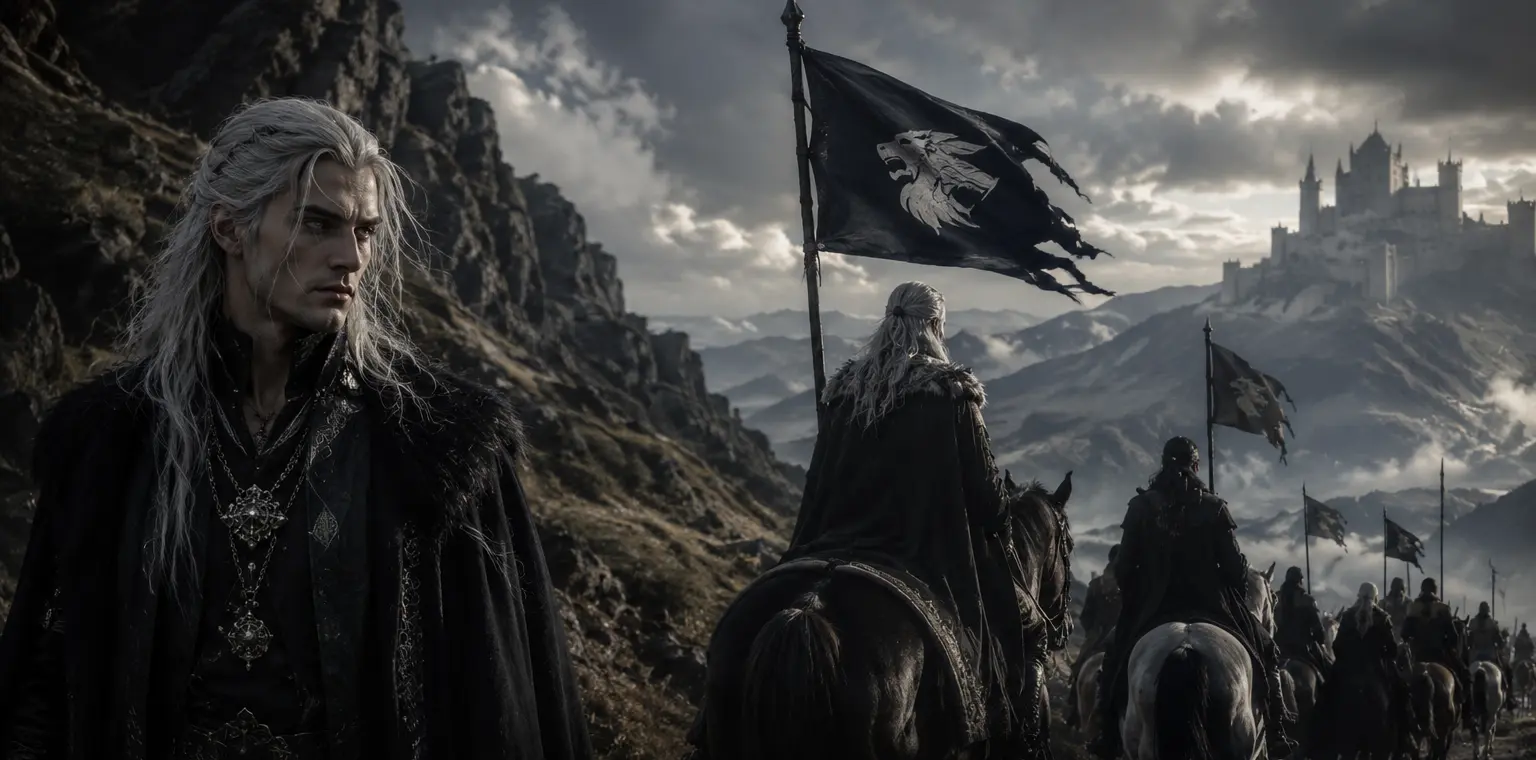
The Road Before the Crown
Before Aldren could inherit a kingdom, he had to meet the roads, houses, and men the palace had kept outside its windows.
The Kingdom Outside the Window
On the first morning of October, Aldren Gavrion learned that mourning cloth was heavier in the rain.
It had hung from the palace for four months.
White first, because Gavrion buried its kings beneath the color of oath.
Black beneath it, because grief was less interested in tradition.
By dawn the banners had drunk enough water to cling to the stone.
Aldren stood beneath them in a traveling coat that did not fit like mourning and looked at the wagon waiting in the lower court.
It was an ugly wagon.
Not old enough to be dignified. Not new enough to be impressive.
One wheel had been repaired in three different woods. The canvas was patched. Two feed sacks sat beneath the driver’s bench. Someone had tied a cooking pot to the rear axle with cord.
Aldren stared at it.
“This is the royal carriage?”
“No.”
Quarn Levan was beneath the wagon.
Only his boots were visible.
Aldren waited.
Nothing happened.
“Quarn.”
A grunt came from under the axle.
Aldren looked toward the palace doors.
Three chamberlains, six guards, two clerks, and the acting master of household were pretending not to hear.
“Quarn.”
The road-man slid out on one shoulder, holding a small iron pin between two fingers.
He was forty, though the roads had apparently disagreed with the number. Weather had already put permanent lines beside his eyes. His coat had been brown once. His beard had been cut by a knife rather than a barber. Mud occupied his sleeves with the confidence of hereditary land.
He looked at Aldren.
Then at the wagon.
Then back at Aldren.
“That,” Quarn said, “is the royal carriage.”
Aldren frowned. “You just said it wasn’t.”
“The royal carriage is in the upper court. This is what we’re taking.”
“Why?”
Quarn held up the iron pin.
“Because this exists.”
Aldren looked at it.
It was a pin.
“I don’t understand.”
“That’s why we’re leaving.”
One of the chamberlains made a quiet sound that might have been outrage.
Aldren ignored him.
He had learned, during the four months since his father’s death, that adults produced many sounds when they wanted a boy to become a king faster than boys were meant to.
His father had been dead since May.
The kingdom had not paused.
Petitions had still arrived.
Grain had still spoiled.
Two marcher lords had nearly fought over a bridge whose river had moved twenty yards east during spring flood.
A border fort had lost half a wall.
Three merchant houses had demanded tax relief.
An Oathbound captain had sent a report stating only:
WE REMAIN.
No one in council had agreed whether that was reassuring.
Aldren had sat beneath the empty place where his father used to sit and listened.
At first everyone had spoken gently.
Then carefully.
Then around him.
By midsummer, they had begun speaking as though he were a chair that would eventually become occupied.
Aldren had hated them for it.
Then hated himself for being fourteen and having no better answer.
He looked at the wagon again.
“No escort carriage?”
“Two mounted guards.”
“Only two?”
“Three if you count me.”
“You don’t look like a guard.”
“That has saved me trouble.”
One chamberlain stepped forward at last.
“Your Highness, the council approved a royal progress, not—”
Quarn turned his head.
The chamberlain stopped.
Quarn did not outrank him.
That seemed to be precisely why it worked.
The road-man wiped the iron pin on his sleeve.
“His father knew every fortress report south of Griffhold,” he said. “Still got a wheel stuck outside Northmere because nobody told him the road had moved.”
The chamberlain’s mouth tightened.
“The late king is not relevant to the condition of this wagon.”
“He was when he was pushing it.”
Aldren looked at Quarn.
The chamberlain looked horrified.
“Father pushed a wagon?”
“Badly.”
Something nearly moved at the corner of Aldren’s mouth.
Quarn saw it.
He did not reward him for it.
Instead he crouched beside the front wheel and pushed the repaired pin through the hub.
“Your father learned Gavrion from a table first,” he said. “Spent ten years correcting the mistake.”
Aldren looked at the palace behind him.
Every window was tall.
From inside them, Gavrion became lines.
The Iron March in charcoal.
Dramarch routes in blue.
Valen grain wards in gold.
Karst corridors in green.
Ironvale fortresses in black.
His father had taught him to read those colors before he had been tall enough to see across the whole table.
“What did he learn on the road?” Aldren asked.
Quarn stood.
“That maps lie politely.”
Aldren waited.
Quarn tightened the harness.
“That roads don’t.”
The rain became harder.
A guard brought Aldren’s horse.
Quarn shook his head.
“He rides later.”
The guard hesitated.
Aldren said, “I can ride.”
“I know.”
“Then why—”
Quarn handed him one of the feed sacks.
Aldren looked down.
Then slowly back up.
“What is this?”
“Oats.”
“I know they’re oats.”
“Good start.”
The chamberlain closed his eyes.
Aldren felt something hot rise behind his face.
“My father put you in charge of this journey?”
“No.”
That stopped him.
Quarn picked up the second sack.
Aldren stared.
“Then who did?”
“You.”
“I did not.”
“You signed the progress order.”
“The council wrote that.”
“You signed it.”
“That does not mean—”
“First lesson.”
Quarn threw the sack into the wagon.
Aldren’s sack remained in his arms.
“If your name makes something happen, saying someone else wrote it does not make it unhappen.”
The lower court went still.
Aldren looked at the royal seal beneath his coat.
It suddenly seemed heavier than the grain.
Quarn climbed onto the wagon.
“Put the oats in.”
Aldren did.
“Get in.”
Aldren looked toward the horse again.
Quarn took the reins.
“Your Highness?”
Aldren climbed into the wagon.
Behind him, the palace stood white beneath mourning cloth.
Ahead, the lower gate opened.
The city beyond it was waking.
Bakers lifting shutters.
Soldiers changing watch.
Servants carrying coal.
A woman shouting at a cart driver.
A child running beneath an awning with one shoe.
No one bowed because no one yet knew who sat beneath the patched canvas.
Aldren watched Griffhold descend around them in stone, stair, alley, oath-mark and rain.
For the first time in four months, nobody asked him what his father would have done.
Quarn drove.
At the south gate, a captain recognized Aldren and began to kneel.
Quarn did not slow.
The captain stepped aside quickly enough to preserve both dignity and toes.
Aldren turned around in the wagon.
“You nearly hit him.”
“He moved.”
“You knew he would?”
“No.”
Aldren stared.
Quarn shrugged.
“Would have learned something either way.”
Aldren looked forward again.
The road ran south.
By noon, Griffhold had disappeared behind rain.
By evening, the palace was no longer visible even from the highest ridge.
That night they slept beside a caravan station whose roof leaked in six places.
Aldren lay awake beneath a wool blanket listening to water strike wood.
Across the room, Quarn slept immediately.
No ceremony.
No guard outside the door.
No council waiting for an answer.
Only rain.
Aldren closed his eyes.
For one moment, he remembered his father sitting beside a fire years ago, boots wet, crown absent.
Not the king.
Just a man with tired hands.
Aldren had never understood why the memory mattered.
On the floor beside him, the repaired wagon pin caught a little firelight.
He began to.
The Shield at the Broken Ford
Three weeks later, Aldren stopped asking why Quarn chose bad roads.
The answer was usually because the good road had failed.
Sometimes politically.
Usually physically.
At Harrow Ford, it had done both.
The river had eaten half the crossing during the night.
By morning, twenty-seven wagons, forty mounted men, three grain carts, two funeral litters and one furious Ironvale heir were trapped on the wrong bank.
The heir was standing waist-deep in water when Aldren arrived.
He was broad through the shoulders, dark-haired, and young enough that Aldren first mistook him for a very large squire.
Then the man lifted the rear corner of a wagon while four others dragged its wheel out of mud.
Aldren revised the judgment.
“Who is that?”
Quarn squinted.
“Corven Ironvale.”
“The lord?”
“Not yet.”
Corven released the wagon.
It dropped onto firmer stones.
Water struck his thighs.
He pointed at two soldiers.
“You. Rope there. Not the axle. The frame.”
One soldier shouted over the river.
“The axle’s stronger!”
“The axle’s cracked.”
“It looks whole.”
Corven looked at him.
“So do you. I’m not tying a wagon to your spine.”
The second soldier laughed.
Corven did not.
He walked upstream without checking whether the order had been obeyed.
It had.
Aldren dismounted.
Quarn caught his sleeve.
“Watch first.”
“There are people in the water.”
“Yes.”
“We should help.”
“We will.”
“When?”
“When you know whether helping makes it worse.”
Aldren hated that sentence.
He hated it more because Quarn had taught him enough by then to know it was often correct.
So he watched.
The ford had three problems.
The river had risen.
The crossing stones had shifted.
And the two local lords who controlled the opposite banks were arguing over whose men had the right to redirect traffic through a private field.
The result was simple.
People were waiting in water while nobles discussed grass.
Aldren looked at Quarn.
Quarn looked back.
“Now?”
“Now.”
Aldren walked into the ford.
Cold water reached his boots.
A soldier saw him.
Then saw the clasp at his throat.
His face changed.
“Your Highness—”
“Don’t.”
The word came out sharper than Aldren intended.
The soldier froze.
Aldren pointed toward the wagon.
“What needs doing?”
The man glanced toward Corven.
Corven had already turned.
For one long second, the Ironvale heir looked at Aldren not as a prince, but as another object that had unexpectedly entered a dangerous space.
“Can you hold a rope?” Corven asked.
Aldren blinked.
“Yes.”
“Good.”
Corven threw one.
Aldren caught it.
“Brace there.”
No bow.
No title.
No hesitation.
Aldren liked him immediately.
He also nearly fell into the river thirty seconds later.
The current took his right foot.
The rope snapped tight.
Aldren’s shoulder jerked.
Then a hand closed around the back of his coat and lifted him half out of the water.
Corven set him onto a stone.
“You said you could hold a rope.”
“I can.”
“You were holding the river.”
Aldren coughed.
Corven took the rope from him and wrapped it once around his forearm.
“Different job.”
Quarn stood on the bank.
He was not smiling.
That was worse.
The next hour passed without rank.
Aldren pulled.
Corven lifted.
Quarn redirected wagons.
Soldiers stopped asking whose land they were crossing after Aldren personally ordered the first grain cart through Lord Merrow’s field.
Lord Merrow arrived red-faced.
“Your Highness, that field is winter seed.”
“There are wounded waiting.”
“The Crown will compensate—”
“Yes.”
Merrow stopped.
Aldren was cold, wet and tired enough not to care whether he sounded royal.
“You will send the assessment to Griffhold. The Crown will compensate the crop.”
“That is not the point.”
“Then tell me the point after the wounded are across.”
Merrow looked at Corven.
Corven was carrying an old woman.
Not helping her.
Carrying her.
The argument ended.
By dusk the ford had become a road again.
Not the old road.
A worse one.
Mud through barley stubble.
Broken fence.
Two temporary rope lines.
A plank bridge over the deepest cut.
Ugly.
It worked.
Aldren sat beside a fire with his boots off.
His feet were white from cold.
Corven was repairing a shield strap.
Up close, he looked younger than he had in the river.
Barely into his twenties.
Aldren noticed a thin ring on his left hand.
“You’re married.”
Corven glanced at the ring.
“Yes.”
“How long?”
“Eight months.”
“Do you like it?”
Corven stopped repairing the strap.
Quarn looked up from the fire.
Aldren realized too late that princes were perhaps not expected to ask strangers whether they enjoyed marriage.
Corven considered the question as seriously as if it concerned a fortification.
“Yes.”
Quarn grunted.
Aldren said, “That sounded painful.”
“I was deciding whether to tell you the truth.”
“And?”
“My wife says marriage improved me.”
“Did it?”
“No.”
Aldren laughed.
It escaped before he could stop it.
Corven smiled then.
A small one.
The first.
Across the fire, Quarn leaned back against a pack.
There were evenings when Aldren could almost forget the old man had known his father.
Then Quarn would look at him in a certain way.
Not comparing.
Remembering.
Aldren disliked the feeling.
“Why were you here?” he asked Corven.
“Flood inspection.”
“Your House sent you?”
“My father did.”
“To inspect?”
“To stop me interfering with estate accounts.”
“That worked poorly.”
“Yes.”
“Why did you interfere?”
Corven threaded the strap through the buckle.
“Numbers were wrong.”
Quarn said, “Halvern will like you.”
Corven looked over.
“Who?”
“Nobody you want to meet.”
Aldren filed the name away.
The fire snapped.
A messenger approached from the temporary camp.
He bowed.
“Lord Corven. The eastern retaining wall shifted again.”
Corven stood immediately.
Aldren looked at his bare feet.
Then at his boots.
Then at Quarn.
“No.”
Aldren frowned. “I didn’t ask.”
“You were going to.”
“The wall—”
“Will remain broken whether a prince stands beside it.”
Aldren’s jaw tightened.
Corven paused.
Quarn continued.
“You worked. Now learn the other half.”
“What other half?”
“When to let someone else carry weight.”
Corven went still.
Aldren noticed.
Quarn noticed him noticing.
Neither said anything.
Corven picked up his shield.
Aldren looked at the repaired strap.
“You always go when something breaks?”
Corven shrugged.
“If I’m close.”
“That cannot work forever.”
Corven’s expression was almost puzzled.
“Why not?”
Quarn stared into the fire.
Aldren remembered the question.
Not because anyone answered it that night.
No one did.
Corven simply stepped into the dark toward another broken wall.
Aldren watched him go.
A Dramarch at Supper
Teren Dramarch entered Aldren’s life through a window.
Not metaphorically.
He climbed through one.
It happened during a dinner intended to settle a dispute between three local banner families and a Dramarch route captain.
The dinner had lasted two hours.
Nothing had been settled.
Aldren sat between a widow who controlled two bridges and a baron who believed volume was a form of evidence.
Quarn had disappeared after the soup.
Corven had been placed farther down the table and was suffering visibly.
The widow leaned toward Aldren.
“Your Highness, with respect, the Crown cannot ask us to surrender road tolls simply because Dramarch failed to maintain the northern lane.”
The baron struck the table.
“Failed? They abandoned it.”
“The cliff collapsed,” said the route captain.
“The cliff had poor discipline.”
Aldren looked at him.
The baron appeared sincere.
Then the window opened.
Cold air entered.
So did a man in silver-gray traveling clothes.
He was lean, dark-haired, handsome in a way that appeared to have caused administrative problems, and smiling before both boots reached the floor.
“Good,” he said. “You started without me.”
The widow closed her eyes.
“Teren.”
The man looked delighted.
“Lady Mereth.”
“You were explicitly not invited.”
“I know.”
“That was intentional.”
“I know that too.”
The baron stood.
“What in the—”
Teren Dramarch removed a leaf from his sleeve.
“Door was occupied.”
“No, it wasn’t.”
“It would have been.”
Aldren stared.
Corven had stopped suffering.
He was now watching with interest.
Teren finally noticed the prince.
His smile changed by half a degree.
Not vanished.
Measured.
“Ah.”
Aldren expected a bow.
Teren gave him one.
Perfectly correct.
Which somehow felt more insolent than not bowing.
“Your Highness.”
“You came through a window.”
“Yes.”
“Why?”
Teren looked toward Lady Mereth.
“She told the guards not to let me in.”
The widow said, “Because you were not invited.”
“That explains the guards.”
Aldren pressed his lips together.
Teren saw.
Teren always saw the effort people hoped would remain private.
He saw everything.
“The prince is trying not to laugh,” he said.
“I am not.”
Corven looked down at his plate.
Aldren could see his shoulders move.
Lady Mereth stared at the ceiling as though asking dead relatives for patience.
Ten minutes later, Teren had somehow acquired wine, learned the names of two servants, made the route captain admit the northern lane had been neglected before the landslide, and convinced the loud baron that reopening the road through his private hunting tract would make him look magnanimous rather than defeated.
Aldren watched carefully.
Teren did almost nothing directly.
A joke here.
A question there.
A compliment placed precisely where pride wanted it.
Then a silence.
The room rearranged itself around what people were willing to admit.
By dessert, the dispute was nearly solved.
Aldren disliked how impressive it was.
Outside, he found Teren leaning against the stone balustrade with a cup in hand.
“You manipulated them.”
Teren looked offended.
“Such a terrible word.”
“You did.”
“I allowed everyone to reach the conclusion they most wanted to believe was theirs.”
“That is manipulation.”
“That is diplomacy.”
“Quarn would call it lying.”
“Quarn calls chairs unnecessary.”
Aldren looked around.
“Where is he?”
“Stable.”
“Why?”
“Horse three.”
Aldren frowned.
Teren lifted his cup.
“Lame.”
Aldren turned immediately toward the yard.
Teren watched him.
“There.”
Aldren stopped.
“What?”
“The thing you do.”
“What thing?”
“Someone says one practical problem and suddenly nothing else exists.”
“That is Quarn.”
“No.”
Teren’s smile became smaller.
“Quarn taught it. You decided to listen.”
Aldren studied him.
“You know Quarn?”
“I have survived Quarn.”
“That is not the same.”
“Ask him.”
The stable doors opened.
Quarn came out wiping his hands.
He saw Teren.
Stopped.
“No.”
Teren raised his cup.
“I haven’t asked anything.”
“No.”
“You don’t know what I want.”
“I know you.”
Corven came into the yard behind Aldren.
“What does he want?”
Quarn looked at Teren.
“A reason to avoid going home.”
Teren placed one hand over his heart.
“My brother says I have responsibilities.”
Quarn said, “You do.”
“I have several.”
“Women are not responsibilities.”
Lady Mereth’s voice came from the balcony behind them.
“In his case they are liabilities.”
Teren looked upward.
For once, he had no immediate answer.
Aldren laughed.
Quarn looked at him.
Not disapproving.
Evaluating.
Teren noticed that too.
He looked from Quarn to Aldren.
Then toward the dark road beyond Valecross.
“What exactly are you doing with him?”
Quarn said, “Teaching.”
Aldren said, “Traveling.”
Corven said, “Getting wagons stuck.”
Quarn looked at Corven.
“Once.”
Corven said nothing.
The silence was devastating.
Teren smiled.
“I’m coming.”
“No,” Quarn said.
Aldren looked at Teren.
“You have House duties.”
“I have House relatives.”
“That is not the same thing.”
“See? He understands already.”
Quarn walked past him.
“Teren.”
“Yes?”
“No.”
Teren drank.
Then turned to Aldren.
“Your Highness?”
Aldren hesitated.
This was ridiculous.
Teren was a Dramarch noble, older than him by almost a decade, with duties of his own and a reputation visible even through one dinner.
Aldren should have asked what he offered.
Instead he asked:
“Why do you want to come?”
Teren’s expression lost its humor.
Not completely.
Enough.
“Because everyone in rooms like that keeps telling you what Gavrion is.”
He nodded toward the dining hall.
“Roads. Houses. Rights. Obligations. Old wounds.”
Then he looked toward the stable where Quarn had disappeared.
“He’ll show you what breaks.”
Toward Corven.
“He’ll show you what carries too much.”
Then back at Aldren.
“And someone should show you what people are like before they start talking as though history is listening.”
Aldren said nothing.
Teren smiled again.
“I happen to be qualified.”
Quarn’s voice came from the stable.
“He is.”
Teren raised both brows.
“That sounded dangerously close to praise.”
“No.”
Aldren looked between them.
Then at the road.
“You ride behind Corven.”
Teren’s face fell.
“That is cruel.”
Corven frowned. “Why?”
“You block the view.”
Corven stared at him.
Aldren smiled.
For the first time since May, the road ahead looked less like something his father had left unfinished.
It looked like somewhere he wanted to go.
The Man Who Said No
Halvern Valen said no before Aldren finished speaking.
Snow had hardened the northern road into pale stone, and the village of Firstgrain had divided itself over an oath older than half its houses.
One family controlled the winter granary.
Another controlled the only bridge.
A third held a Crown writ giving them emergency levy authority during famine.
All three were correct.
Their correctness could not coexist.
Aldren had spent the morning reading documents.
Teren had spent the morning speaking far too pleasantly with the granary mistress, who was thirty-two, married, and entirely capable of managing him.
Corven had spent the morning moving sacks because nobody else was doing it fast enough.
Quarn had spent the morning counting children.
Halvern Valen arrived at noon.
He was twenty-four and looked as though he had already disapproved of the century.
Dark hair.
Clean coat.
Sword worn correctly.
No unnecessary ornament.
He entered the village hall, listened to Aldren’s proposed compromise, and said:
“No.”
Aldren stopped.
Teren slowly turned his chair toward the newcomer.
Corven put down his cup.
Quarn continued eating.
Aldren said, “You haven’t heard the full proposal.”
“I heard enough.”
Teren whispered, “Interesting.”
Halvern ignored him.
Aldren stood.
“Then explain.”
Halvern set three papers on the table.
“The bridge family has legal passage authority.”
“Yes.”
“The granary family has winter preservation authority.”
“Yes.”
“The Crown writ allows emergency levy.”
“Yes.”
“And your solution asks all three to temporarily surrender part of their claim.”
“Yes.”
“So that people can eat.”
“Yes.”
Halvern nodded once.
“Reasonable.”
Aldren stared.
“You said no.”
“To your wording.”
“What is wrong with the wording?”
“You called the surrender voluntary.”
“It is.”
Halvern looked at the three family representatives.
None met his eyes.
“No,” he said. “It is not.”
The room cooled.
Aldren felt irritation rise.
“They agreed.”
“They agreed in front of the heir to Gavrion.”
“That does not invalidate—”
“It changes the weight.”
Aldren stopped.
Halvern’s voice remained level.
“If the Crown stands in a room and asks three families to surrender legal claim during a famine, the Crown may be right.”
A pause.
“It may even be necessary.”
Another.
“But it does not get to call necessity voluntary because the word sounds cleaner.”
The document stayed untouched in Aldren’s hand.
Aldren looked at the document in his hand.
The compromise itself was still good.
He knew it was.
People would eat.
The bridge would stay open.
No House would lose permanent rights.
But the word sat there.
Voluntary.
Neat.
Convenient.
False.
He remembered Quarn on the first morning.
If your name makes something happen, saying someone else wrote it does not make it unhappen.
Aldren sat down.
Took a pen.
Crossed out the word.
“What do you suggest?”
Halvern answered immediately.
“Emergency Crown burden-sharing order. Thirty days. Public compensation schedule. All claims restored automatically when the winter declaration ends.”
The granary lord frowned.
“That makes the Crown responsible.”
“Yes.”
The bridge lady said, “And if compensation fails?”
“Then the Crown owes you.”
Halvern looked at Aldren.
“Not history. Not necessity. Not the weather.”
“The Crown.”
Quarn stopped eating.
Aldren looked at him.
The old man gave no sign.
That was, by then, how Aldren knew something mattered.
He rewrote the line.
The agreement passed before sunset.
Outside the hall, Teren caught Halvern by the elbow.
“Come with us.”
Halvern removed Teren’s hand.
“No.”
“You don’t know where.”
“I know you are there.”
“That is hurtful.”
“Good.”
Corven walked beside them carrying two grain ledgers and a crate someone had apparently asked him to move.
Aldren followed.
“Why are you here?”
Halvern looked at him.
“My House sent me to audit the levy.”
“Did they tell you to challenge the Crown?”
“No.”
“Then why did you?”
Halvern stopped.
Snow moved lightly between them.
“Because you were wrong.”
Teren looked almost delighted.
Aldren ignored him.
“You say that very easily.”
“It was easy.”
“You could have spoken privately.”
“Yes.”
“Why didn’t you?”
“Because the families were being asked publicly.”
Aldren disliked the answer.
Then respected it.
Then disliked that he respected it.
Teren leaned toward Corven.
“He may be useful.”
Halvern turned.
“I heard that.”
“I intended you to.”
Aldren said, “Enough.”
Both men looked at him.
For a heartbeat, Aldren felt absurdly old.
Then Quarn walked past carrying a bag of onions.
“Not even close.”
Aldren frowned.
“I didn’t say anything.”
“Face did.”
That evening, snow closed the southern pass.
They were forced to remain in Firstgrain.
The inn had three rooms and five beds.
Teren announced that he could find alternative accommodation.
Halvern asked where.
Teren looked toward the window.
Halvern said:
“No.”
“You cannot possibly know what I was going to say.”
“Yes.”
Aldren laughed into his cup.
Teren pointed at him.
“This is what monarchy encourages.”
Halvern looked at Aldren.
“Do not encourage him.”
“I said nothing.”
“You laughed.”
“That is not a royal order.”
“Yet.”
Quarn leaned back in his chair.
“You coming?”
Halvern looked at him.
“Where?”
“South.”
“Why?”
“Boy needs people who tell him no.”
Aldren frowned.
“I have you.”
“One is not enough.”
Teren raised his cup.
“An excellent principle.”
Quarn ignored him.
Halvern stood beside the fire, surrounded by men he had met less than twelve hours ago.
He looked at Aldren.
The prince was fourteen.
Still mourning.
Still learning.
Still young enough that disagreement could remain a gift instead of an act of courage.
“Until the pass opens,” Halvern said.
Teren grinned.
Quarn said, “Fine.”
Corven nodded.
Aldren asked, “And after?”
Halvern looked at him.
“We will see whether you remain worth correcting.”
Teren laughed.
Aldren smiled.
“Fine.”
On that winter night, Halvern was only a young man with too much seriousness in his face.
Teren spent the rest of the evening trying to make him laugh.
He failed.
The failure became a habit.
The habit became friendship.
Four Men and a Prince
They nearly missed the people in the trees because the abandoned carts looked too ordinary.
White road.
Low branches.
Three wagons left at angles that suggested haste but not attack.
A line of smoke too thin to be a village.
Teren stopped joking first.
That was how Aldren knew the danger was real.
“People in the trees,” Teren said.
Halvern’s hand went to his sword.
Corven turned his horse sideways between Aldren and the ridge.
Quarn looked at the road.
Not the trees.
The road.
“Not ambush,” he said.
Teren glanced back.
“You sure?”
“No.”
“That inspires confidence.”
Quarn pointed at the carts.
“Wheels still on.”
Aldren understood.
Bandits would strip iron.
Soldiers would take horses.
Desperate civilians might leave everything if leaving fast mattered more.
“Refugees?”
“Maybe.”
Then they heard a child cough.
Corven was off his horse first.
Halvern caught his arm.
“Wait.”
Corven looked down.
“There are children.”
“I heard.”
“Then—”
“Wait.”
Teren moved left, not toward the sound but around it.
Quarn moved right.
Aldren stayed where he was.
Four months earlier, he would not have.
That was the difference.
He watched.
Teren raised one hand.
Two fingers.
Then three.
Halvern saw.
Three armed men.
Not soldiers.
Not disciplined.
Corven shifted.
Quarn crouched beside one abandoned cart.
Blood on the wheel.
Old.
Aldren looked at the trees.
“People hiding from them.”
Halvern said, “Likely.”
“Can we take them?”
Corven answered.
“Yes.”
Quarn answered at the same time.
“Wrong question.”
Aldren breathed once.
Then understood.
“How many people behind them?”
Quarn looked at him.
There.
Approval.
Small enough that anyone else would have missed it.
Teren returned.
“Twelve civilians. Maybe fourteen. Three armed. One bow. Bad stance. Scared.”
“Bandits?”
“No.”
“What then?”
“Men who decided food belongs to whoever can still hold a knife.”
Halvern’s face hardened.
Aldren looked toward the smoke.
“Options.”
Corven said, “I go first.”
Halvern said, “We announce Crown authority.”
Teren shook his head.
“They run.”
Quarn said nothing.
Aldren waited.
Quarn continued saying nothing.
Fine.
Aldren looked again.
Three desperate men.
Fourteen civilians.
A bow.
Winter.
Food.
Fear.
If Corven charged, someone died.
If Halvern announced the Crown, the armed men might believe execution was next.
If Teren approached alone, he might talk them down.
Might.
Aldren looked at the grain sacks in their wagon.
“Put food on the road.”
Quarn’s eyes moved toward him.
“Where?”
“Between us.”
Halvern understood first.
“You give them a choice without surrendering distance.”
“Yes.”
Teren smiled slightly.
“Not bad.”
Corven asked, “And if they take it and keep the civilians?”
“We add another sack.”
Halvern frowned.
Aldren continued.
“Then another.”
Quarn finally spoke.
“How many?”
“Until they have to decide whether they want food or control.”
The old road-man stared at him.
Aldren felt suddenly fourteen again.
Then Quarn took a grain sack from the wagon.
“One.”
They placed it in the road.
Teren walked forward alone.
Hands visible.
No sword drawn.
The men emerged from the trees.
One held a hunting bow.
One a wood axe.
The third a sword too fine for his coat.
A dead soldier’s weapon, probably.
Teren stopped well outside bow range.
“Morning.”
The man with the sword shouted, “Stay back.”
Teren stopped.
“Fine.”
He nodded toward the sack.
“Food.”
The sack remained where it was.
“Take it.”
“Why?”
“Because you need it.”
The bowman’s hands shook.
Teren saw.
His voice changed.
Not softer.
Cleaner.
“There’s more.”
The sword-man laughed once.
“Crown trick.”
Teren looked over his shoulder.
Aldren stepped into view.
The man’s face changed.
Recognition.
Fear.
Aldren hated how quickly the two became the same thing.
He raised both hands.
“No company behind us.”
Halvern looked at him.
Aldren corrected himself.
“Two guards around the bend. No company.”
Halvern relaxed by a fraction.
The sword-man looked confused.
“Why tell me?”
“Because it’s true.”
Teren glanced toward Halvern without turning his head.
Aldren almost smiled.
The first man took the grain.
Then stopped.
“What do you want?”
“The people.”
“No.”
Aldren nodded.
“Another sack.”
Quarn placed it down.
The man stared.
Teren said, “You can keep saying no.”
The sword-man’s eyes narrowed.
“What happens when you run out?”
Quarn answered from the wagon.
“We don’t.”
That was probably false.
It sounded true.
A third sack went down.
Then a fourth.
The civilians in the trees began whispering.
The armed men heard.
That changed the balance more than steel would have.
They were no longer controlling frightened people.
They were standing between hungry people and visible food.
The bowman lowered his weapon first.
Corven breathed out.
The sword-man looked at him.
“Traitor.”
The bowman said, “I’m hungry.”
It was the most honest thing anyone had said.
The situation ended ten minutes later.
No duel.
No heroic charge.
No blood.
The three men ate beside the same fire as the civilians they had threatened.
Halvern recorded their names.
Not as bandits.
Not yet.
As men subject to inquiry for unlawful detention and coercion during winter emergency.
Teren told one of them his sword grip would eventually get him killed.
Corven gave a child his gloves.
Quarn inspected the abandoned carts.
Aldren stood beside the fire.
One of the refugee women looked at him for a long time.
Then said:
“You don’t look like your father.”
Aldren froze.
Nobody spoke.
The woman seemed to regret the sentence.
“I’m sorry, Your Highness.”
Aldren looked toward Quarn.
The old man kept working on a wheel.
Aldren asked:
“What did he look like?”
The woman blinked.
“When?”
The question struck him harder than he expected.
“When you knew him.”
She thought.
“Wet.”
Teren looked away.
The woman smiled nervously.
“He came through here during the spring floods years ago. Before you were born, maybe. His cloak was ruined. He argued with a ferryman.”
Aldren looked at Quarn.
Quarn still did not turn.
“What about?”
“The ferryman said the king didn’t know where the river wanted to go.”
“And Father?”
“Said rivers don’t want things.”
“What did the ferryman say?”
The woman’s smile widened.
“That kings say that because rivers don’t vote.”
Teren laughed first.
Corven followed.
Even Halvern looked away.
Aldren stared at Quarn.
“You were there.”
“Yes.”
“You never told me.”
“Never asked.”
“What happened?”
“Your father paid the ferryman.”
“For what?”
“Being right.”
Aldren sat beside the fire.
For a while, nobody called him Prince.
The child wearing Corven’s gloves fell asleep against his mother.
One of the armed men helped Halvern write the names of the people he had frightened.
Teren burned bread.
Quarn told him to stop touching the pan.
Corven found this funnier than it deserved.
Aldren looked at them.
Not his father’s men.
Aldren felt the distinction more sharply than he expected.
Quarn had belonged to his father once.
In some way Aldren still did not fully understand, he always would.
But Corven had not.
Teren had not.
Halvern had not.
They had each possessed perfectly good roads away from him.
Ironvale.
Dramarch.
Valen.
Duty.
Family.
House.
Future.
And yet they were here.
Not because Aldren wore a crown.
He did not.
Not yet.
Not because anyone had ordered them.
Not anymore.
He felt something then that frightened him more than obedience ever had.
Responsibility.
Chosen loyalty weighed differently.
It could not be inherited.
It could only be kept.
That evening, when the camp had settled, Aldren stood beside the road and looked south.
Corven came to stand at his left.
Teren leaned against the wagon behind him.
Halvern remained near the fire, finishing the names.
Quarn sat beneath the axle with a broken pin in his hand.
No oath had made them a unit.
No proclamation had named them.
No court yet knew what to call the shape forming around the boy-prince.
Good.
History had not reached them yet.
The road had.