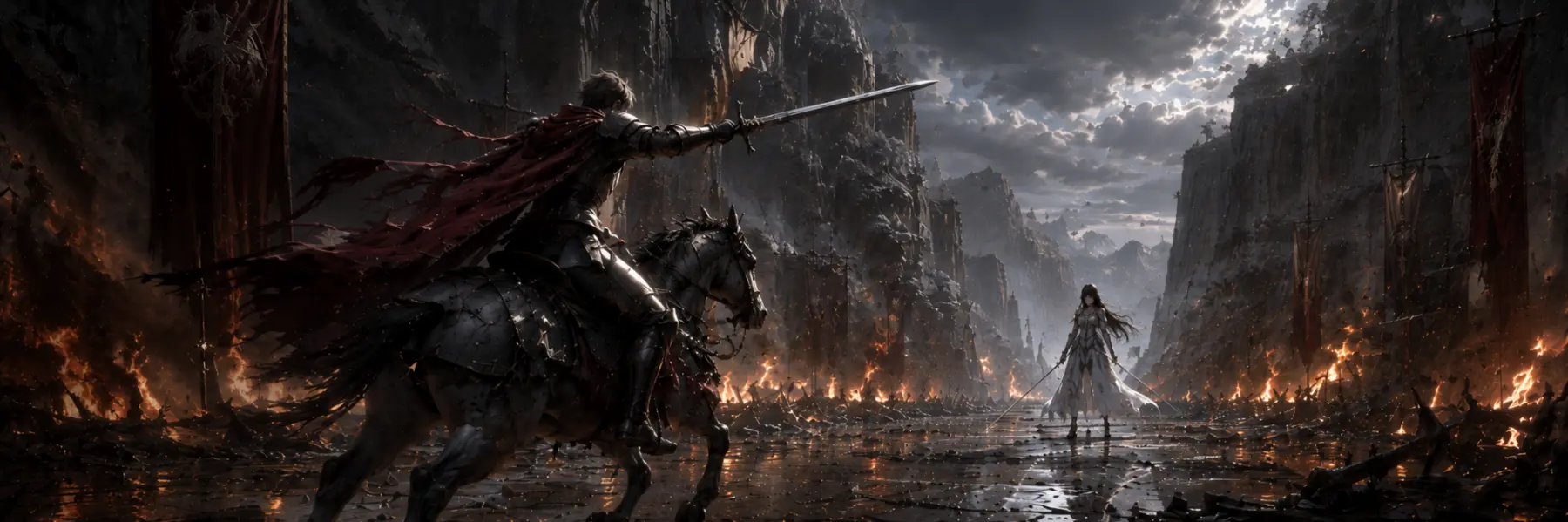
The Valley That Didn’t Empty
The western coalition prepares for every army Gevrane has already broken—and discovers why one surviving road can be more frightening than defeat.
The Woman They Sent When Armies Failed
The western coalition had learned from every army Gevrane had already broken.
The room feared what the coalition had learned—and what Gevrane would do with that learning.
Not because the report said they had three field armies.
Not because their retreat road crossed a dry valley narrow enough to burn.
Not because six crowns had agreed, temporarily and unhappily, that Drakenval should be kept east of the western ridge.
The officers around the table were afraid because the enemy had studied.
The northern campaigns had taught them not to trust one relief corridor.
The eastern crossings had taught them to duplicate couriers and separate commander from deputy.
The fortress wars had taught them to keep reserve banners away from primary command and to write retreat orders before panic could write them badly.
Now the west had assembled all those answers into one army.
Sevarin read the report twice.
He did not look impressed.
That worried everyone more.
“Strength?” he asked.
The chief western officer answered.
“Thirty-one thousand under unified field agreement. Twenty-four thousand effectives. Three cavalry reserves. Six road companies. Two independent courier chains.”
“Independent?”
“Different riders, routes, relay officers and confirmation marks.”
“Authority?”
The officer hesitated.
“Shared.”
Sevarin looked up.
The officer corrected himself.
“Separated by function. Marshal for field command. Crown council for retreat threshold. Banner deputies retain local action if signal fails.”
“Better.”
No one knew whether he meant the answer or the enemy.
Gevrane entered before the next question.
No herald.
No court announcement.
Only white armor crossing the black threshold of the campaign chamber.
She wore no helm. Dark hair had been tied behind her neck and already begun escaping. Velraken rested at her right. Velthraen at her left. The two hilts did not match, and nothing about the mismatch appeared accidental.
The room stood.
Some stood for the Empress.
More stood for the Blood Knight.
Gevrane disliked both reasons.
“Sit,” she said.
They did.
Sevarin moved one report aside.
“You are late.”
“I was told six crowns had built an army specifically for me.”
“And?”
“I changed clothes.”
One young officer almost smiled.
He stopped when Gevrane looked at him.
Not because she looked angry.
Because she looked curious about why he had stopped.
Sevarin turned the western map toward her.
The continent had been reduced to ink, pins and the assumption that borders behaved when observed.
North carried black marks from two years of failed resistance.
East carried red cuts where roads had changed hands faster than courts could rename them.
West carried six crown-signs around one long retreat line.
South remained almost clean.
Gevrane saw that first.
“Still not South?”
“Still not South.”
The officers heard only geography.
Neither sibling corrected them.
“Why this valley?” Gevrane asked.
“The coalition has abandoned the upper plateau. Their grain cannot hold another month. They are moving west before winter.”
“So let them.”
“They intend to preserve unified command, cross the lower plain, reinforce the western frontier and return in spring.”
Gevrane looked at the route.
“Then you do not want the retreat stopped.”
“No.”
“You want spring removed.”
The chief officer shifted.
Sevarin did not.
“I want the coalition to reach the lower plain as people,” he said. “Not as one military answer.”
Gevrane looked at him.
The room became quieter.
It was one thing for Drakenval officers to discuss annihilation in professional language.
It was another to hear the Emperor distinguish bodies from the army using them.
“Casualty ceiling?” Gevrane asked.
“Lower than the coalition expects.”
“That is not a number.”
“It is the constraint.”
She looked back at the map.
“You want me to cut command, not the road.”
“Yes.”
“Break banners, not columns.”
“Yes.”
“Leave enough order for the wounded to move, but not enough for the army to turn.”
“Yes.”
Gevrane’s mouth curved by less than a smile.
“That sounds like Marielle.”
“It sounds like a result.”
“Coward.”
The room stared at the table.
Sevarin ignored the insult with the patience of a man who had survived worse from the same source.
“The Crimson Wedge remains under your command,” he said. “Heavy cavalry, shock guard, pursuit riders and relay hunters.”
“No relay killing unless the line cannot be cut another way.”
The chief western officer looked up.
“Majesty, their duplicated courier system is the principal resilience—”
“I heard it,” Gevrane said.
The officer stopped.
She placed one finger on the valley.
“If we kill every messenger, they learn nothing except to hide messengers better. If messages survive and still become wrong, the army loses trust in survival itself.”
Sevarin’s gaze sharpened.
Not surprise.
Recognition.
“Use the redundancy,” he said.
“I intended to.”
The chief officer looked between them.
He had spent twenty years learning war.
For the first time, he understood why historians later struggled to decide which sibling had conquered the west.
Sevarin saw the whole machine.
Gevrane saw the joint that could no longer be allowed to belong to it.
“Anything else?” she asked.
Sevarin looked once toward the blank South.
Then back to West.
“The road remains open.”
Gevrane’s hand rested on Velraken.
“For whom?”
“Anyone no longer acting as the coalition.”
That was the closest thing to mercy the order contained.
Gevrane accepted it.
“Then send word to the Wedge.”
“I already did.”
“Of course.”
She turned to leave.
At the threshold, Sevarin called her name.
Not title.
Not Empress.
“Gevrane.”
She looked back.
For one heartbeat, the room saw brother and sister before it remembered the Empire around them.
“Come back,” Sevarin said.
No one breathed.
Gevrane looked at the map.
North.
East.
West.
The untouched South.
Then at him.
“I usually do.”
She left before either of them had to call that a promise.
The Crimson Wedge did not cheer when Gevrane arrived.
Cheering belonged to armies that needed emotion to move faster than orders.
The Hunt had orders.
Heavy cavalry in dark armor stood along the inner line. Shock guard formed behind them. Pursuit riders waited with lighter tack and no banners large enough to advertise where they intended to appear. Relay hunters wore short blades, fast horses and the expression of people trained to remove sentences before sentences became command.
At the center flew the Wedge standard.
Red-black field.
A silver-white wedge driven through a broken circle.
Gevrane looked at the unit commanders.
“No pursuit beyond the lower turn.”
One captain frowned.
“If they remain organized?”
“Then I failed.”
“If they carry standards?”
“Standards are not people.”
“If they regroup under another crown?”
“Not tonight.”
The captain understood the boundary.
Gevrane drew Velraken.
The long blade took morning without shine.
Then Velthraen.
Shorter.
Quieter.
The soldiers watched the two unequal lines open beside her.
“This is not an extermination order,” she said.
The word surprised them.
Some had expected it.
Some had wanted it.
Gevrane saw both reactions.
“We cut what lets the coalition remain one army.”
She lifted Velraken.
“Officer from unit.”
Velthraen followed.
“Banner from line.”
The blades opened wider.
“Messenger from route. Cavalry from turning space. Reserve from the moment it becomes battle.”
Then they closed.
One hard sound.
“Anyone who leaves the shape may leave the field.”
A pursuit captain asked:
“And if the field follows?”
Gevrane sheathed Velraken.
Then Velthraen.
“Then it is still the shape.”
The Wedge mounted.
No cheer.
Only steel accepting direction.
By noon, the Hunt was moving west.
The Empire had not sent another army.
It had sent the woman it used when armies had already failed.
The Army That Prepared for Her
The western coalition had started the fire.
Later histories preferred to forget that.
The decision had been sound.
A long summer had dried both slopes. Dead grass clung to stone. Brush filled the cuts where old rain had once made paths. Supply carts too damaged to continue had been broken apart and soaked in pitch. Trenches ran along both sides of the valley.
When the horns sounded, flame climbed both walls.
The fire did exactly what the coalition intended.
No Imperial cavalry could spread wide.
No flanking unit could climb the slopes unseen.
No pursuit could move without entering a road visible from end to end.
The center remained clear.
One road.
Broad enough for wagons.
Broad enough for infantry.
Broad enough for cavalry to pass in disciplined groups.
Lieutenant Renna watched the flames take hold and felt the first clean certainty she had known in three weeks.
The valley would not save them.
But it might make survival legible.
Behind her, the coalition prepared the retreat it had spent months learning how not to lose.
Two courier systems.
Two relay chains.
Reserve banners kept beyond the main command field.
Prewritten orders for loss of marshal, loss of deputy, loss of road, loss of fire, loss of banner, loss of signal.
Three cavalry rotation points.
Wounded columns already assigned by region rather than regiment so one unit’s collapse would not close the medical route.
Three champions at the rear hinge.
The west had studied North.
North had tried to fight Gevrane as if courage could compensate for one command structure.
It could not.
The west had studied East.
East had hidden deputies and duplicated messengers.
Gevrane had made both surviving answers arrive at different times until each became wrong.
So the west built redundancy around redundancy.
No single officer knew every route.
No messenger carried a complete order.
No reserve waited on one signal alone.
If the Blood Knight cut one thread, the army would remain woven.
That was the theory.
Renna had believed it when the plan was ink.
The valley made it feel true.
“Upper fire stable,” a runner reported.
“Lower?”
“Climbing. Wind remains westward.”
“Courier routes?”
“Both clear.”
“Champions?”
The runner glanced toward the road.
“Ready.”
No one used their names in the rear command.
Not because the coalition did not know them.
Because names made people easier to mourn.
The first champion waited mounted.
A heavy stallion beneath him. Armored head. Broad chest. A sword large enough to turn horse, rider and downward weight into one answer.
The second champion stood on foot with a long spear held low.
She had asked for no shield.
The third waited behind them.
Sword lowered.
No horse.
No ornament.
He had broken an Imperial heavy cavalry charge at the eastern crossings two years earlier.
He had survived the northern wars.
He had trained princes.
He had buried students.
Renna trusted him because he had not promised victory.
He had promised the road would cost Gevrane time.
That was enough.
A scout came through smoke.
“White-red standard.”
The nearest officer turned.
“Distance?”
“Beyond upper bend.”
“Strength?”
“Unknown.”
“Banner?”
The scout swallowed.
“Crimson Wedge.”
The title moved before the next question.
Not from the scout.
From someone behind him.
“Blood Knight.”
Renna turned.
“Report the banner. Not the name.”
The soldier looked ashamed.
“Yes, Lieutenant.”
The correction traveled three people.
The name traveled thirty.
Renna heard it again near the wounded wagons.
Then near the cavalry reserve.
Not loudly.
That was worse.
Names spoken loudly could be punished.
Whispers became weather.
The third champion walked past her.
“Do not let them say it,” Renna told him.
He looked toward the upper bend.
“They already have.”
“Then make it wrong.”
He considered her.
“I can make the woman bleed.”
Renna waited.
“That is not the same thing.”
Fire folded across the road.
A white figure appeared beyond it.
Still.
Too far for the face.
Close enough for the two blades.
The first champion’s horse shifted.
The rider tightened his knees.
Renna saw his hand work.
Saw the sword rise.
Saw every part of the man obey except the part beneath training.
The horse charged.
The champion did not.
Not at first.
Something inside him had reached the conclusion before pride could interfere.
If he completed the charge, he would die.
The woman in white had not moved.
That made it worse.
“Go!”
The champion screamed the word at himself.
His body followed the horse.
Thirty paces.
Twenty.
Fifteen.
Gevrane Drakenval drew both blades.
The Third Champion
Velraken moved first.
The long blade met the charge at the point where horse, steel, weight and intention had finally become one answer.
Velthraen did not join it.
The shorter blade waited.
The champion turned his sword to save his throat.
Correct.
Velraken accepted the correction.
His horse passed Gevrane.
He tried to recover.
Velthraen was already inside the recovery.
The shorter blade touched his arm.
Not deep.
Deep enough.
His grip failed.
The horse continued without him.
The rider struck stone hard enough to throw sparks from one pauldron.
He rolled once.
Stopped.
Alive.
His sword landed several paces away.
The rear line stared.
Gevrane did not.
She was looking beyond him.
At the road.
The second champion entered behind the riderless horse.
A woman on foot.
Spear low.
She had watched the first exchange and understood the danger of allowing the longer blade to choose her answer.
She used the stallion as moving cover, slipped behind its flank and thrust beneath Gevrane’s right arm before the animal fully cleared.
Good timing.
Better line.
The spearpoint entered white.
Gevrane turned half a step.
Velraken did not parry.
It touched one side of the shaft.
Velthraen touched the other.
The spear captain saw the shape too late.
Two unequal blades.
Open.
Waiting.
The jaws of shears around the weapon.
Snap.
The spearhead continued toward Gevrane.
The shaft did not.
The captain’s hands followed an attack that no longer possessed a point.
She released immediately and reached for her sidearm.
Velthraen occupied the path her hand required.
She stopped.
Velraken lay along the line her throat would enter if she turned away.
She stopped doing that too.
Gevrane walked past her.
No finishing cut.
No glance.
The captain remained between two blades that no longer needed to touch her.
Then Gevrane was gone.
“She isn’t fighting us,” the captain whispered.
The third champion heard.
He stepped forward anyway.
Behind him, Renna tasted smoke, ash and the old copper flavor of fear.
The third man entered with his sword lowered.
No challenge.
No oath.
No demand for names.
He already knew the woman.
Everyone did.
Gevrane faced him.
White armor.
Dark steel.
Velraken in her right hand.
Velthraen in the other.
Fire moved behind her.
She did not.
The third champion stopped outside measure.
His eyes ignored the longer blade.
They stayed on the short one.
“You force the first answer with Velraken.”
Nothing.
“And Velthraen waits for the second.”
Gevrane’s face did not change.
The champion breathed once.
“Then I will not give you the second.”
He attacked.
Renna heard three impacts before she saw one.
Steel struck.
Changed.
Struck again.
The champion abandoned his first line halfway through.
Velraken found nothing to finish.
Velthraen moved toward a recovery that never existed.
The champion stepped inside.
His shoulder hit Gevrane’s armor.
His sword came toward her ribs.
She turned.
Not enough.
Steel scored white plate.
The coalition rear made a sound.
Small.
Hungry.
The champion pressed.
Another cut.
Gevrane shifted back.
A thrust.
Another half-step.
Then a false retreat.
The champion refused it.
He had understood.
Do not answer the first blade.
Do not let the second know where survival will go.
He cut high.
Changed low.
Abandoned low.
Entered center.
Velthraen missed his wrist.
His sword touched white again.
Not blood.
Enough.
Hope moved behind Renna.
It traveled badly through frightened people.
It arrived too large.
The Blood Knight could miss.
The Blood Knight could be moved.
The Blood Knight was a woman.
A body.
A thing that could be solved if someone was good enough.
The third champion heard that hope.
He smiled.
That was his mistake.
Not the smile.
The belief beneath it.
He thought Gevrane was still solving him.
She no longer was.
Velraken rose.
The champion changed his attack.
Velthraen moved toward the expected recovery.
He changed that too.
Again.
Again.
Each time he refused the answer she prepared.
Each time Gevrane gave him less.
Her steps shortened.
Her shoulders went still.
The blades stopped searching.
Renna felt the change before she understood it.
The champion had prevented Gevrane from reading his sword.
So she stopped reading the sword.
She watched his shoulder.
His breath.
His rear foot.
The fraction of tension through the hip before a false commitment.
The place his weight returned whenever he intended to remain inside measure.
The champion attacked.
Gevrane was already where his third movement needed her not to be.
Velraken entered.
He caught it.
Velthraen began to close.
He withdrew before the clamp.
Perfect.
He landed three steps back.
Renna’s mouth opened.
“No.”
The champion heard.
He looked behind him.
Three cavalry companies waited in the reserve-turn.
His retreat occupied their mouth.
The first horse checked.
The second struck its flank.
A third turned sideways.
A banner dipped.
One rider fell.
Another hauled hard on the reins.
A formation prepared to rotate cleanly around the rear guard became a knot of horseflesh, steel and men trying not to crush one another.
The champion looked back at Gevrane.
She had not pursued.
She had not needed to.
The three champions had never been the battle.
They had been the hinge.
Behind the woman in white, horns sounded.
Three low notes.
Smoke rolled apart.
The Imperial Crimson Wedge entered the valley.
Heavy cavalry first.
Shock guard behind.
Pursuit riders spreading only as far as the fire permitted.
No army-wide charge.
No screaming wave.
A wedge.
Narrow.
Deliberate.
The white mark on a red-black standard drove into the smoke.
Someone behind Renna whispered:
“The Hunt.”
Another voice answered with the name no officer wanted spoken inside a frightened formation.
“Blood Knight.”
The name came again.
Farther back.
“Blood Knight.”
An officer turned in his saddle.
“Report the banner! Not the name!”
Too late.
The name had already outrun the order.
Gevrane raised Velraken.
The Wedge entered the hinge.
She Left Them One Road
The western coalition had built Gevrane a corridor.
That was the truth hidden inside the fire.
Two walls of flame prevented the Empire from spreading wide.
They also forced every surviving answer into one visible road.
The Crimson Wedge entered the wound behind the third champion.
Not deep enough to shatter the coalition.
Deep enough to require an answer.
Infantry turned toward the cavalry.
That opened space behind the infantry.
Shock guard entered.
A banner company wheeled to close the opening.
Pursuit riders struck its messenger lane.
Nothing broke.
Renna saw that clearly.
Nothing had broken.
The absence of visible collapse made the movement more frightening.
The Empire was not destroying the army.
It was cutting one controlled wound into it.
Then forcing the army to spend itself trying to close the wound.
Gevrane walked into the center.
A shield captain came first.
Velraken touched the rim.
Not hard.
Correctly.
The shield moved outward.
The captain brought his sword back to cover the opening.
Velthraen occupied the path.
He released the sword rather than lose the hand.
Good choice.
Gevrane passed him.
A lancer came from the left.
Velraken removed the lance head.
The lancer dropped the shaft and reached for his sidearm.
Velthraen was already where the draw needed to happen.
He froze.
Gevrane passed him too.
The wounded could move.
The disarmed could move.
The frightened could move.
The defeated could move.
That became worse than corpses.
Dead men left gaps.
Survivors moved into other people’s jobs.
A soldier driven backward entered a messenger lane.
A rider whose horse refused Gevrane turned into an infantry rotation.
A captain forced to defend his own throat missed the signal moving his company.
One survival became another unit’s obstruction.
One correct instinct became another person’s wrong battlefield.
Renna had been taught that armies were bodies arranged into shape.
Gevrane seemed to understand something colder.
The bodies were not the army.
The connections were.
Cut officer from unit.
Standard from line.
Messenger from route.
Cavalry from turning space.
Reserve from the instant reserve was supposed to become battle.
Cut enough connections and thousands of bodies could remain alive.
The army would still die.
“Second Banner, hold!”
The coalition marshal remained mounted near the center.
His standard stood.
Signal officers still worked.
Good.
“Wounded to the center road!”
A horn answered.
“Fourth cavalry to the south shoulder!”
Another.
Clear commands.
Correct commands.
Men obeyed.
The coalition began becoming an army again.
Gevrane stopped.
That frightened Renna more than anything she had done.
She stared through a spear group.
Not at them.
Past them.
Somewhere behind smoke.
A courier.
Renna could not see him.
Perhaps Gevrane could not either.
The spear group attacked.
Velraken touched one weapon.
Velthraen touched another.
One man lost the line.
Another lost the place he needed to recover.
The third remained functional.
Gevrane ignored him.
She shifted two steps right.
The courier emerged from smoke on the alternate route.
Three Imperial pursuit riders turned toward him.
Western cavalry intercepted them.
The courier survived.
He disappeared toward the rear.
Renna breathed again.
The duplication had worked.
A minute later, the wrong horn sounded.
Cavalry recall.
Renna went cold.
The message had survived.
That was not the problem.
Smoke had hidden one marker flag.
A relay officer received the new order beside an older command.
He interpreted both together.
Western cavalry began withdrawing from the shoulder the marshal had ordered reinforced.
Gevrane had not heard the order.
Had not intercepted the courier.
Had not touched the relay.
No sorcery gave her tomorrow.
She had seen the battlefield.
Smoke.
Duplicated commands.
Compressed routes.
Fear.
Too many correct precautions operating at once.
And she had placed herself where the most likely human mistake would become decisive.
The Blood Knight did not see the future.
She saw frightened people arriving there before they understood what they had chosen.
The south shoulder opened.
The Crimson Wedge widened the cut.
Renna drew her sword.
“Close it!”
Men moved.
Good men.
Brave men.
That was not the problem.
One company moved to close the gap.
Another stayed to protect wounded wagons.
A third turned to preserve the retreat road.
A fourth waited because two contradictory horns had sounded.
Every choice was defensible.
Together they formed ruin.
Gevrane entered between them.
Velraken forced one answer.
Velthraen removed what followed.
The blades opened.
Closed.
Opened.
Closed.
Never fast enough to become a blur.
Never wide enough to look beautiful.
A pair of shears cutting through decisions.
A swordsman attacked.
Velraken redirected the present.
Velthraen waited where he had to save it.
A cavalry officer tried to turn out.
The horse chose the opposite direction.
Gevrane touched neither.
The company behind them divided anyway.
A standard-bearer stepped back from the pressure around her.
One pace.
Five soldiers saw the standard move backward and followed.
An officer screamed at them to return.
The scream traveled farther than the correction.
Another line heard panic before it heard words.
The title moved again.
“Blood Knight!”
“Do not say it!”
“Blood Knight at the center!”
“She broke through!”
“She has not!”
“I saw white!”
“That was cavalry!”
“Report the banner!”
“Blood Knight!”
The name stopped carrying information.
It carried expectation.
Men who had never seen Gevrane reacted to places where she might be.
A group near the eastern fire shifted three paces from an empty lane.
A wagon driver saw them move and assumed the lane unsafe.
He turned.
The wagon behind followed.
Within moments an infantry route had become a wagon route.
No Imperial weapon touched it.
Gevrane was nowhere near it.
Renna watched a person become a battlefield condition.
The pressure around Gevrane was real.
Not magic.
Not illusion.
Something more primitive.
A body standing close enough to death, with enough proof behind its movements, that another body recognized danger before language did.
Ordinary soldiers paid first.
Shoulders tightened.
Breathing shortened.
Attacks became half-attacks.
Veterans forced themselves through it.
That cost attention.
Elites entered cleanly.
But even they spent one part of the mind overriding the animal beneath training.
Whenever one of them hesitated, everyone watching learned something.
The most disciplined person in the line had felt it too.
That knowledge spread farther than Gevrane ever could.
Pressure became witness.
Witness became rumor.
Rumor became movement.
Movement became geometry.
By then, Gevrane hardly needed the pressure around her own body.
The army had learned to carry it for her.
The coalition still had the road.
Renna repeated that truth until she hated it.
No bridge had fallen.
No gate had closed.
No cliff collapse buried the pass.
The fires still prevented the Empire from spreading wide.
The marshal still lived.
Thousands remained armed.
Wounded wagons moved.
Several banners had cleared the lower turn.
“There is still a road,” Renna said.
The third champion stood beside her.
Blood had dried black along his coat. He had spent an hour correcting the cavalry knot his own retreat had created.
“There is still a road,” she said again.
He watched formations enter smoke.
“That is not the same thing.”
“Then help me make it the same.”
He did.
That was the worst part.
Everyone kept trying.
No one surrendered.
No one simply ran.
The marshal sent another order.
Third Banner clear the lower turn.
Fourth follow.
Sixth hold until cavalry crossed.
Clean.
Simple.
Executable.
A staff rider returned.
“Third is moving.”
“Good.”
“Without Sixth.”
Renna frowned.
“They should.”
“They think Sixth already crossed.”
“Sixth is behind us.”
“I know.”
“Send them back.”
“They are not answering.”
“Commander?”
“Dead.”
“Deputy?”
“Missing.”
“Reserve standard?”
“With the wounded.”
Renna closed her eyes.
Not dead.
Not destroyed.
Separated.
“Fourth?”
“Waiting.”
“For Third?”
“For confirmation the lower turn is clear.”
“It is not.”
“They received a report saying it is.”
“From whom?”
“We do not know.”
Two courier systems.
Two relay chains.
Redundancy designed to survive Gevrane.
Under ordinary pressure, redundancy kept command alive.
Under enough pressure, two surviving truths reached different people at different times.
Both became wrong.
The fires sank.
Smoke stopped rising and filled the valley instead.
Orange darkness.
Gevrane appeared within it.
White.
Gone.
White again.
Sometimes Renna saw both blades.
Sometimes only Velraken.
Sometimes Velthraen seemed to remain alone for one breath after the longer blade had lowered.
That became the image Renna could not forget.
The first blade finished the present.
The second waited to see whether the future intended the same mistake.
Gevrane fought less as the army failed more.
At the beginning, Renna had seen turns, parries and cuts large enough to understand.
Now a sword came toward Gevrane.
Velraken moved three inches.
The sword ceased to matter.
A man tried to recover.
Velthraen was there.
Done.
A cavalry officer approached, looked into the opening between the blades and stopped before entering.
Gevrane did nothing.
The officer retreated.
The soldiers behind him saw their officer choose not to fight.
Their line moved backward.
Done.
She became quieter.
The Marshal saw it too.
Six royal guards formed around him.
Their shields touched.
Breaths matched.
Eyes remained on the marshal instead of Gevrane.
The pressure did not break them.
Someone had given fear a center.
The marshal raised his sword.
“On me.”
Six bodies answered.
One formation.
One intention.
One clean line.
They advanced.
Gevrane stopped.
The guards held.
Hope returned to Renna.
Smaller.
More cautious.
Better.
The marshal entered measure.
Gevrane lowered both blades.
They fought as one unit.
The first guard denied Velraken.
The second covered recovery.
The marshal shifted center.
The third filled the opening.
Velthraen found no isolated answer.
The formation moved.
One step.
Gevrane yielded.
Another.
The guards stayed together.
Three steps.
Still clean.
The marshal pressed.
Gevrane yielded again.
The formation was working.
The Blood Knight could not cut what refused to separate.
Four steps.
Five.
Then Renna saw the road.
“No.”
The marshal had not.
The formation remained perfect.
That was why it failed.
Gevrane had never tried to split it.
She had moved the entire command formation away from the retreat road.
Five steps.
Only five.
The marshal’s standard shifted to remain visible.
Signal officers shifted with it.
Runners adjusted toward the standard.
Reserve captains turned toward the new command center.
The coalition’s nervous system moved five steps off the road.
Crimson Wedge struck the connection left behind.
The road remained open.
The army’s command no longer opened with it.
The marshal saw.
For the first time, discipline left his face.
He looked at the road.
The standard.
His six perfect guards.
The Imperial wedge entering the seam.
Then Gevrane.
She had given him the battle he wanted.
He had won every step.
“What are you?”
Gevrane spoke for the first time.
“Late.”
Velraken moved.
The marshal answered.
Velthraen waited.
The blades closed.
By full dark, the coalition possessed more soldiers than orders.
There was no moment when the army visibly died.
No banner fell and declared it.
No horn announced defeat.
The transformation happened by accumulation.
Third Banner believed the center road blocked.
It was not.
Fourth believed it clear.
It had been.
Sixth waited for a commander who had joined a wounded column and no longer knew his unit lacked the same instruction.
Two cavalry companies rode west to reopen a lane already irrelevant.
An infantry regiment remained in perfect formation beside the eastern fire because no surviving authority could confirm whether the lower turn had emptied.
People kept moving.
The surviving road, not the formation, was the measure that remained.
Thousands escaped.
Wounded.
Cooks.
Smiths.
Stable boys.
Archers without officers.
Officers without units.
A prince’s household guard without the prince.
A standard carried by someone who had never belonged beneath it.
Renna saw one captain who had entered the valley with six hundred soldiers.
He walked toward the lower turn with four.
He did not know whether the rest were dead.
Ahead.
Behind.
Captured.
Or alive beneath another banner.
There were still thousands.
That was the horror.
An army had disappeared without requiring the people to disappear with it.
Renna found the third champion beside a broken wagon.
His sword rested across his knees.
Whole.
Clean.
Useless.
“How many crossed?” she asked.
He considered the road.
“People?”
“Yes.”
“Thousands.”
Relief loosened her chest.
“Then we made it.”
He looked at her.
“Did we?”
She almost struck him.
Instead she looked.
A group of a hundred moved down the road.
No standard.
Twenty cavalry followed.
Three insignia.
A wounded officer walked beside soldiers who had never belonged to his command.
A cook carried a royal banner because the standard-bearer had died and no one had told him what else to do with it.
Every person moved in the same direction.
No one retreated together.
The champion spoke quietly.
“She left us one road.”
Renna looked up the valley.
Fire had collapsed into red lines along the slopes.
Smoke drifted low.
Between the dying flames stood Gevrane.
Crimson Wedge waited behind her.
They could continue.
Everyone knew it.
“They could finish us,” Renna said.
“Yes.”
“Why don’t they?”
The champion stared at the road.
Then understood.
Because nothing remained that Gevrane needed from the battle.
The people could survive.
Scatter.
Hide.
Reach neighboring crowns.
Serve under another banner.
Go home.
The coalition could not turn tonight.
Could not re-form.
Could not produce one shared casualty count.
Could not know which units still existed.
Could not know which orders had survived.
Could not turn those thousands of bodies back into one military answer before the Empire chose what came next.
Cut.
Seal.
Erase.
Not the people.
The shape.
Gevrane turned away.
No triumph.
No salute.
No speech.
She sheathed Velraken first.
Velthraen remained in her hand.
One heartbeat.
Two.
As though the shorter blade had not yet decided whether the battle possessed another move.
Nothing came.
Gevrane sheathed it.
Last.
The Crimson Wedge withdrew.
“What do we tell the crowns?” the champion asked.
Renna looked at the road filled with living people.
“Tell them the road stayed open.”
The Name That Outran the Banner
At dawn, there was no fire.
Only smoke.
The old road ran intact from the head of the valley to the lower plains.
No bridge had fallen.
No gate had closed.
No ancient mechanism had awakened beneath the earth.
People walked.
Nine.
Twenty-three.
Three riders leading horses without saddles.
A group of wounded carrying an officer whose unit had gone somewhere else.
Renna stood beside the lower turn and tried to count banners.
She could not.
She tried to count regiments.
That was worse.
So she counted people.
People still made sense.
The valley had not emptied.
The name survived because the road stayed open after the army ceased to exist as one.
At dawn, the road remained open.
No army remained to use it.
Sevarin arrived after the battle had ceased being one.
He came with registrars before heralds.
Road engineers before court witnesses.
Grain officers before trophy clerks.
Replacement garrisons waited beyond the upper bend, but he did not send them into the valley until the wounded columns cleared.
Gevrane stood near the command stone while a physician cut one section of white armor away from her ribs.
The third champion’s blade had not entered flesh.
It had bruised enough of it to make breathing annoying.
She considered this an inconvenience.
The physician considered Gevrane an argument against royal blood.
Sevarin looked down the road.
“How many?”
A field clerk opened the casualty sheet.
“Confirmed coalition dead—”
“Crossed,” Gevrane said.
The clerk stopped.
Sevarin looked at her.
“How many people crossed?” she repeated.
The clerk changed pages.
“Current count, six thousand four hundred and nineteen through the lower turn. More still descending by side tracks. Estimate above nine thousand by noon.”
Gevrane nodded.
“Leave the road open.”
A garrison officer objected.
“Majesty, surviving officers may escape.”
“They already did,” Gevrane said.
“They may gather new units.”
“Not today.”
The officer looked toward Sevarin.
The Emperor said:
“The road remains under medical and civilian passage until the last wounded column clears. Any armed body attempting to reform above company scale is detained. Individuals cross.”
The officer bowed.
Sevarin had translated Gevrane’s battlefield result into something roads could execute after she left.
Gevrane made the wound. Sevarin taught roads how to keep it open after she left.
Gevrane looked at the campaign map an aide unfolded.
North had marks.
East had cuts.
West now carried a white pin through a broken circle.
South remained clean.
“Still not South?” she asked.
The clerks pretended to become furniture.
Sevarin did not look away from the map.
“Still not South.”
“Because of him?”
Silence.
The physician stopped cutting armor.
Gevrane looked at her brother.
Sevarin said:
“Because the Empire does not need that road.”
It was not the whole answer.
It was enough of one.
“Good,” Gevrane said.
The physician resumed.
Sevarin moved the first grain office into the valley.
Before noon, a registry existed for people who no longer knew which army had owned them the night before.
By afternoon, bread moved under neutral mark.
By evening, the lower road had guards who checked weapons without asking banners to explain the wounded.
Gevrane had killed the army.
Sevarin taught the aftermath how to live without resurrecting it.
Three months later, a western general was shown two routes.
The northern road would place his army at the frontier in four days.
The southern required ten.
A scout laid down a report.
“Unconfirmed white-red standard on the northern road.”
“South,” the general said.
His staff officer blinked.
“That adds six days.”
“I know.”
“The report is unconfirmed.”
“I know.”
“What if she is not there?”
The general looked at the shorter road.
“Then we lose six days.”
“And if she is?”
He folded the report.
“We may lose the word we.”
They marched south.
By the following spring, western field manuals had a new term.
PRESSURE AURA.
The manuals insisted it was not sorcery.
They described hostile presence, pre-initiative, killing intent, proof-conditioned fear and the way elite hesitation could infect people who had never seen the source.
They proposed countermeasures.
Anchor soldiers to visible officers.
Do not let commander and deputy share one kill-space.
Duplicate couriers, but separate authority timing.
Never concentrate the entire retreat around one road.
Do not repeat the title inside a formation unless location is confirmed.
Gevrane read the last instruction twice.
Then crossed it out.
The instructor beside her went pale.
“Majesty?”
“The title is not the problem.”
He looked at the page.
“What should it say?”
Gevrane took the pen.
Do not let fear become a command channel.
She returned the manual.
Outside the classroom, the recovery station held soldiers from four former western banners.
Some had entered Imperial service.
Some were waiting for exchange.
Some no longer knew which crown would claim them and had begun treating that as relief.
Gevrane walked through without helm or cloak.
White uniform.
No visible blades.
A young wounded man watched her approach.
One eye bandaged.
Arm in a sling.
He had fought in the valley but never seen her face.
“Are you with the medics?” he asked.
“No.”
“Registry?”
“No.”
He looked at the officers making space for her.
Then at the white-red insignia near her collar.
Understanding began.
Fear followed.
Gevrane stopped before it could finish becoming posture.
“What is your name?” she asked.
The young man swallowed.
“Perin Rell.”
“Which banner?”
He looked away.
“I do not know anymore.”
“Good.”
He looked back, confused.
“For today,” she said. “That is allowed.”
The fear did not disappear.
It changed shape.
Perin studied her.
“Who are you?”
An officer behind Gevrane began:
“The Blood—”
She raised one hand.
He stopped.
The title had crossed the continent faster than any banner.
It had changed roads, manuals, command formations and the price of mercenary contracts.
It had entered rooms before she did.
For one moment, Gevrane refused to let it enter first.
“Gevrane,” she said.
Perin waited for the rest.
There was no rest.
Only a woman in white standing inside the consequences of a battle that had made her name too large to belong comfortably to one person.
“Gevrane,” he repeated.
This time, the name carried information.