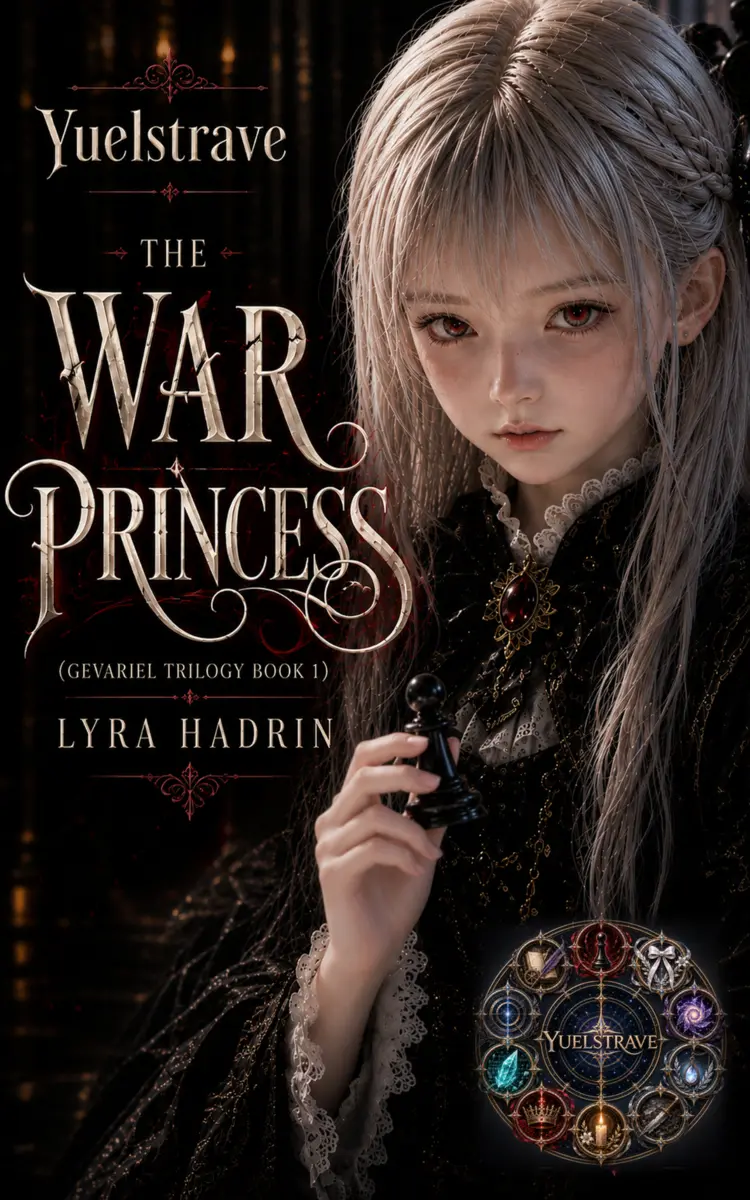
The War Princess
A public reading edition drawn from the active Book One record.
THE REAL GAME BEGINS
The ribbon refused to stay straight.
Lumi pulled the left loop. The right slipped. She fixed the right. Then the left looked wrong again.
“It doesn’t listen,” she murmured.
Maera did not look up. “It’s ribbon.”
“It’s doing it on purpose.”
“It’s cloth.”
“It’s resisting me.”
Maera stepped forward, took the box from her hands, turned her wrist twice, and tied the bow again.
Done at once.
Clean.
Precise.
“There,” she said.
Lumi leaned in.
It was perfect.
Too perfect.
“…it still looks like it might move.”
“It won’t.”
Lumi nodded. She did not quite believe her.
Late afternoons in the white room were supposed to feel like this.
Clean.
Quiet.
The last light lay across the white tablecloth, the porcelain tea set, and the small gift box tied with the ribbon Maera had just corrected. Steam rose from the teapot in thin, pale threads. Beyond the tea table, an inner table stood half in shadow. Lumi hardly noticed it. She never did on afternoons like this.
No voices came from the outer hall. No armor rang. No hurried steps crossed the corridor.
Lumi liked afternoons like this. Afternoons before anything had happened.
“Her Highness turns twelve today,” she said softly, as though the room itself were listening. “Do you think she’ll like it?”
“She will see it,” Maera said.
“That isn’t the same.”
“With Her Highness, it is close enough.”
Lumi fell quiet for a moment.
“She might say thank you.”
“…just once?”
Maera did not answer.
Lumi let out a small breath and looked at the gift box as though it had already betrayed her.
Somewhere deeper in the palace, a bell sounded.
Once.
Thin.
Then the silence returned.
Lumi had just reached for the handle of the teapot when she heard footsteps.
Fast.
Too fast for servants.
Too urgent for protocol.
Not the kind of rhythm that passed through a corridor.
The kind that cut it open.
Maera turned before the door did. It struck the wall.
A white maid stumbled into the room, one hand catching the frame as though she had run faster than the room had been prepared to receive her. Her face had gone pale. Her lips were dry. Her breath came apart in fragments.
“Maera—”
“Breathe.”
“I can’t—”
“Try.”
“I can’t—”
Lumi’s fingers tightened around the edge of the table.
“What happened?”
The maid opened her mouth. Nothing came out. She swallowed, then forced the words through a voice that had gone thin and sharp.
“The king—”
The word stopped there.
Not finished.
Not accepted.
“The king has fallen,” she said.
Maera went completely still.
Lumi blinked. “What does that mean?”
The maid looked at her.
There was something in her eyes that felt almost like apology.
“It means…” She drew a shallow breath. “The king is dead.”
No one moved.
Steam still rose.
The curtains still stirred.
The light remained what it had been.
The afternoon did not change.
That was what made it wrong.
Lumi waited. Waited for someone to correct it. Waited for Maera to say it had not yet been confirmed. Waited for another officer to come in and reduce it to rumor, or confusion, or at least something still unfinished.
No one did.
Maera only closed her hand once.
“Confirmed,” the maid said. “Iron March. Royal signal.”
The gift box slipped from Lumi’s hands.
She caught it against the table before it could fall.
Too carefully.
As though preserving that one small thing might somehow preserve the rest of the afternoon with it.
“We need mourning cloth,” she said quickly. “The chamberlain has to be told. The Princess can’t hear it like this. The outer corridor must be cleared first, and the tea should be taken away, and—”
“Wait,” Maera said.
The maid shook her head.
“There is more.”
Lumi felt that before she heard it.
Not with her ears.
With the way the room seemed to grow smaller.
“What more?”
The maid looked down at the floor.
“The Crown Prince…”
Just one short pause.
But in that pause the room became colder.
“…has been surrounded near Blackgate.”
A fine crack sounded in Lumi’s hands.
She looked down.
The teapot.
A hairline fracture ran across the white glaze.
Then it split.
Hot tea spilled over her fingers and across the white cloth.
A dark stain spread outward.
Fast.
Too fast.
“That cannot be.”
No one answered.
The tea kept spreading.
“You do not surround the Lion of Gavrion.”
Silence.
“He always breaks through,” Lumi whispered, in the language she had picked up from young officers, and hated herself for it at once, because it sounded like the kind of thing people said just before a legend failed them.
Nothing moved except the stain widening across the white.
Maera did not look at her.
That frightened her more than the message itself.
Because everyone knew what Blackgate was.
Not merely a border fortress.
Not merely stone walls.
But the place where war began to narrow.
Where roads thinned, choices hardened, and campaigns began to lose the shape they thought they had.
The king was dead. The Crown Prince had been driven toward that narrowing. The two facts did not merely add up to disaster. They fit together. Like two pieces of the same lock.
Lumi stared at the spreading tea. It looked like something that should never have been allowed to exist in this room.
A mark.
A wrongness.
A confirmation.
She could hear her own heartbeat too clearly. Not because she was afraid of what had happened. But because it felt as though it had happened too exactly.
Too early.
Too cleanly.
Something had shifted.
Not loudly.
But completely.
Lumi felt it in her hands.
In the table.
In the quiet way the room no longer felt as it was supposed to.
The inner door opened.
Soft.
Lumi turned.
Princess Momoria Gavrielle of Gavrion stood at the threshold.
Small.
Still.
Untouched by haste.
As if she had arrived before the moment itself.
Her pale hair fell across her shoulders. Her face was calm in a way that left no space for surprise to enter. Not cold with anger. Not empty with absence. Only too quiet.
Lumi dropped to her knees so quickly that pain flashed through them.
Too fast, the way children moved when fear reached them first.
“Your Highness—”
Maera bowed. The others followed.
Momo walked past them.
No pause.
Her gaze moved once across the room, not to the faces, not first, but to the ribbon, the unopened gift, the broken porcelain, and the tea spreading through white.
She did not stop.
Then she reached the inner table.
A war map lay open across it.
Iron March.
The northern routes.
The supply lines.
And Blackgate.
Beside the map, a chessboard caught the fading western light.
Lumi did not remember noticing it before.
One king lay on its side.
A black pawn rested there.
“Your Highness,” Lumi said, “the king—”
“I know.”
No tremor.
“And the Crown Prince—”
“I know.”
Still none.
Only then did Momo reach toward the chessboard.
She picked up the fallen king.
Then she placed it on the map.
Iron March.
Her hand moved again.
She took up the black pawn.
Turned it once between thumb and forefinger.
Then once more.
And set it down at Blackgate.
Click.
A small sound.
Too clean.
Too exact.
The black surface caught a thin line of fading light—
then lost it.
Lumi did not understand maps. But she understood that sound.
The way people understand a lock turning in the middle of the night.
Something had closed.
Not here.
Everywhere.
No one spoke.
The tea kept spreading.
The ribbon did not move.
The gift remained unopened.
And for a brief moment, standing in that bright white room, Lumi felt something she would not be able to name until much later.
Not fear of what had happened.
Fear of how early it had happened.
Momo said,
“When the king dies…”
“…the real game begins.”
The chessboard still caught the last of the afternoon.
The king was gone.
But the board
remained.
THE LION
The line had been told it would hold until dusk.
By noon, it was only men breathing too hard, shields out of level, and gaps where none should exist.
A Gavrion footman tore one boot free of the mud and nearly lost his spear with it. Steel rang to his left. A horse screamed to his right. Someone behind him went down with a sound too short to be a cry.
“Close ranks!”
A shield came up.
Another did not.
The boy beside him could not have been older than sixteen. Rain ran from his lashes as he stared at the opposite ridge.
Black banners waited there.
Too many.
Waiting was worse than charging.
A trumpet cut across the field. On the ridge, imperial cavalry began to form.
One rank.
Then another.
Then a third behind it.
Lances lowered in slow, terrible unison.
The veteran on the footman’s other side planted his boots wider.
“If they hit us here, we fold.”
“Then what do we do?”
The veteran looked north, toward an empty road.
“Pray the Prince gets here first.”
The cavalry started down.
Not at full speed.
Not yet.
That was the worst part. The certainty of it.
The line had not broken all at once. It had simply forgotten how to remain a line.
“Where is the prince?” someone asked.
No one answered.
The boy whispered, “We’re done.”
Then two imperial riders near the front turned uphill.
A third followed their gaze.
At first the footman saw only dust.
Then something pale cut through it.
A banner.
Silver.
A lion worked in bright thread, descending through mud-brown rain.
The effect reached the field before the rider did.
One enemy horse checked too early. Another veered to close the gap and made it worse. The descent lost a heartbeat.
Only one.
It was enough.
Leonric Gavrion came down the slope beneath the Silver Lion.
White surcoat darkened by mud. A bright helm where nothing else was bright. Too young for the field, too clean for the ruin around him, and still made for men to look at first and understand later.
Mud marked him. Distance reduced him. Neither made him easier to ignore.
His face carried the hard, bright calm of someone born to be followed before fear had finished speaking. The kind of beauty war should have ruined first, and somehow had not.
He did not look untouched by war.
He looked like the reason men believed war had not touched everything yet.
Someone said the name softly.
“…the Lion.”
It passed faster than an order.
A man on one knee heard it and rose. The boy beside the footman dragged a fallen shield into place. Another soldier locked beside a stranger because the space was there and because Leonric was coming toward it.
Not courage.
Recognition.
The line remembered itself.
Fox watched from a low rise with mud drying on his boots.
He raised a silver-bound black tube to one eye. An imperial skyglass. No living maker knew how to build another, and the lens had one use left.
Through it, distance confessed.
The imperial cavalry still held the slope. Their spacing remained sound. Their weight should have broken Gavrion.
Instead, one rider had checked too early.
Another had turned uphill.
A third had corrected the wrong gap.
The formation was still strong.
Its certainty was gone.
Collapse followed rules. A line lost spacing, then breath, then permission to believe it might recover. Fox knew those rules well enough to hear when the field disobeyed them.
“Our cavalry will break them,” a young officer said.
Fox lowered the skyglass. The ancient lens had gone blind.
“No.”
The officer stared. “One prince cannot change the numbers.”
“He is not changing the numbers.”
Below them, the Silver Lion dropped lower through the haze.
“He is stealing the heartbeat in which they break.”
Fox listened to the field as another man might listen to music: not for the loudest sound, but for the place where rhythm failed.
“Recall the descent.”
“But we still have the slope.”
“They have lost it already.”
The horn sounded.
Once.
Then again.
Imperial riders began to turn.
At the broken edge of Gavrion’s front, Leonric struck.
A wedge of white, silver, and mud entered the gap. Shields rose behind him. Men who should have broken a heartbeat earlier stepped forward instead.
Voices returned in fragments.
Then as commands.
Then as something harsher and more useful than hope.
Formation.
From below came a cry.
“The Lion rides north!”
Another voice answered.
“And the war rides with him!”
Fox understood why armies made stories around such faces. Victory liked beauty. Soldiers liked a shape they could remember before the blood dried.
“Was it truly that close?” the officer asked.
Fox watched the silver banner move through the line.
“No,” he said. “It was already over. Just not for the side you thought.”
By the time Lyra Hadrin reached the field, victory had gone quiet.
What remained was survival.
Carts in mud. Men groaning beneath canvas. Horses alive.
She swung down and felt her boots sink at once.
That was how battlefields greeted those who arrived after glory.
Not with spectacle.
With weight.
A wounded soldier near the road watched her with one eye swollen shut.
“Courier,” he said. “You’re late.”
“Glory usually is by the time it reaches the road.”
That won half a breath from him.
Lyra crouched beside a broken shield and unfolded her campaign sketch across it.
“Who won?”
“We did.”
She waited.
The soldier looked toward the northern rise, where silver-marked cavalry were reforming.
“Strange victory,” he said. “Every battle keeps opening the same road.”
Lyra traced the last three engagements, correcting the official lines where they had been drawn too clean.
Different fields.
Different losses.
The same ending in every report.
Then he came.
A veteran passing on foot saw the Hadrin satchel at her side and stopped.
“Write this right,” he said. “He didn’t save the field.”
“No?”
“He made us remember it was still ours.”
Lyra wrote the sentence beneath the map.
That was more dangerous than victory. A kingdom might survive one lost field. It might not survive learning to place every answer inside one beautiful rider.
A young standard-bearer stopped beside her.
“Did the Prince ride through the center?” Lyra asked.
“No. Where the line bent worst.”
Of course.
At the top of the map, the northern roads tightened around one name.
Blackgate.
“That’s where the Prince is pushing them,” the standard-bearer said.
Lyra caught the map before the wind could lift it.
“No,” she said.
Her eyes remained on the fortress name.
“That’s where the story is taking him.”
Three days later, the cost would reach a white room before the birthday did.
THE WAR NARROWS
By dusk, Leonric’s victory had already left the battlefield.
It had entered Ashford as priority.
Lyra Hadrin saw it in the relay yard before anyone admitted it aloud.
Northern dispatches were opened first. Fresh horses were turned toward Blackgate. Southern packets waited beneath wet ribbons and dim lamps.
No written order named the Prince’s road more important.
That was the part worth writing down.
The sentence Lyra had carried from the field had reached Ashford before she had.
Now it was no longer describing a victory. It was deciding which messages moved.
Orders. Food. Fear. Permission.
By nightfall, the pattern was visible.
A clerk slit the wax on a packet because the first line named the Prince. Another packet, marked for a washed bridge south of Ashford, remained beneath his hand while he read the northern report twice.
Road to command.
Command to pressure.
Testimony to priority.
Lyra opened her notebook beneath the yard lamp.
In the left column, she added:
No formal priority issued.
In the right:
Everything is going north.
A relay clerk saw the line and mistook it for a question.
“Blackgate first tonight.”
“Who ordered that?”
The clerk looked toward the northern racks, where packets were already being tied to fresh saddles.
No one, his silence said.
Everyone.
Victory should have widened the war.
This one had narrowed it.
South of Whiteford, Fox stood over a map built to keep war legible.
Stone walls.
An oak table.
Three low candles.
One travel lamp.
Everything in the room had been placed in order.
The war had not.
Fox wore one glove. The other lay beside a line of black markers.
“The Crown Prince won again,” an officer said.
Fox moved one marker the width of a fingernail.
“Our generals say he cannot be beaten.”
That earned the officer a glance.
Defeat liked absolutes. It turned every horse into a miracle and every bad hill into betrayal.
Fox studied three engagements, one recovery route, and the messenger delay between southern warning and northern response.
An entire kingdom was beginning to lean toward the same answer.
Men and carts followed the road Leonric reopened. Supply followed the carts. Rumor followed supply. Command followed rumor. Even success had begun to do labor on Fox’s behalf.
“What failed today,” he said, “was not force.”
The officer waited.
“Timing.”
“He shattered our descent.”
“Lines shatter.”
“Their men would have broken without him.”
“That may even be true.”
Fox crossed to a black violin case.
The instrument inside had come from the Drakenval court and was old enough that no living maker could repeat its finish. He lifted it as another man might lift a familiar blade.
The bow crossed one string.
A thin note measured the room.
Not music.
Tension.
Where the campaign had tightened.
Where it had slipped.
Whether anyone present had the courage to hear the difference.
Silence returned sharper than before.
“Heroes win fields,” Fox said. “I prefer tempo.”
He set the violin beside the northern roads.
“The Prince is not their strength. He is where they place the fantasy of endless strength.”
The officer frowned.
Fox touched the latest battlefield mark, then slid two fingers toward Blackgate.
“If he wins, they believe the kingdom still has a future. If he rides, supply and rumor move faster to keep pace with the story. If he survives, authority delays its harder decisions one more day.”
“He is a blade, then.”
“A lever.”
Outside, boots crossed a corridor. A message was shouted. Somewhere in the dark, a horse screamed once and went quiet.
Fox listened not to the sound, but to the sequence.
“Do we reinforce the pursuit?”
“No.”
“Do we harry the Prince?”
“Let him win again.”
The officer stared.
Fox placed one finger on the royal road.
“Beautiful things are dangerous in war. Men protect them long after they stop being useful.”
He looked past the prince’s route to the line binding field victory to the throne.
“Do not chase the Lion.”
The officer waited for the real order.
Fox’s hand closed over the road leading south.
“Make the king move.”
The room seemed to contract around the sentence.
Battle had ended.
Royal movement had begun.
Fox closed the violin case with one quiet click.
North of them, another name was already rising into shape.
Iron March.
IRON MARCH
Iron March had not been built on the mountain.
It had been built inside the dragon.
Ribs older than Gavrion arched over the valley, black-plated where ancient white bone had cracked. The Royal Road descended along the dragon’s spine beneath wagon grooves and iron rails. Between the ribs stood barracks, shield courts, forge roofs, and marrow wells breathing gold vapor into the cold.
The old songs said seven griffin knights had brought the dragon down.
Iron March did not sing about it.
Iron March used what remained.
At dawn, the Royal Road ceased to be a road. It became a kingdom in motion.
Grain wagons ground over iron plates. Horses snorted steam. Smiths hammered cracked buckles back into shape while officers counted roads. At the marrow wells, soldiers washed mud from shaking hands in water warm enough to make them flinch.
A chant rose through the rib courts.
“Who do we ride for?”
“For the Crown.”
“Who do we stand for?”
“For the realm.”
“When the line breaks?”
“We hold.”
The words passed into wheels, harness chains, shield rims, and hollow bone until the valley answered in pieces.
Iron March had always done its cleanest work this way.
It took fear, baggage, broken rank, and exhausted flesh, then forced them back toward sequence.
House banners moved beneath the crowned griffin.
Grain. Wall. High watch. Bow. Four old burdens forced onto the same road beneath one Crown.
For one brief moment, inside the ribs of a dead dragon, Gavrion looked magnificent enough to mistake itself for unbreakable.
The illusion lasted until the rear-command lane locked upon itself.
Wagon tongues crossed. Escort riders blocked messengers trying to turn downslope. Signal poles lay spilled in the mud. A surgeon shouted for passage while two oxen lurched sideways and nearly crushed a boy carrying dispatch tubes.
Confusion spread fastest where everyone believed they were too important to yield.
Mirina Malkiera Gavrion entered before anyone announced her.
She wore a riding coat over light command armor, her red hair pinned back too severely for ornament. She caught a panicking horse by the bridle and forced its head down.
“You,” she said to the escort captain blocking the turn. “Move your men left.”
“We were told to guard the wagon.”
“You were told to think before obeying. Left.”
Something in her voice cut through the noise cleanly enough to shame him into action.
Mirina was already pointing elsewhere.
“That grain wagon does not go uphill. It goes beneath the terrace and waits. If it cannot wait, unload it. If it cannot be unloaded, burn the axle and drag the grain free.”
“The axle, yes. The campaign, no.”
She lifted one hand.
“Vaelene.”
A pale-armored girl stepped into the wagon’s path and caught the panicking team by the harness. Her gauntlets closed like gate-teeth finding stone.
“Avelis.”
A moon-pale bow flashed. One arrow cut the fouled rope pinning the signal poles under a wheel.
“Selka.”
The third girl did not run.
She drew.
For half a heartbeat, the blade looked less like steel than black water opening. The trapped traces fell clean.
The lane breathed.
They were not yet a famous order.
Only three girls moving where Mirina had already decided the war must breathe.
“Medical carts first,” she said. “Do not thank me. Move.”
A relay rider came hard up the slope.
“Dispatch from the northern mast!”
Mirina broke the wax, read once, and passed it to an aide.
“Three copies. Royal ridge. Lower map wagons. Reserve lane.”
“Which seal, Your Highness?”
“Mine.”
The aide hesitated only long enough to understand.
Gavrion still had its prince at the front.
Now the officers around Mirina understood it also had a princess who could make chaos remember it was meant to serve an order.
On the royal ridge, allied standards had already begun to dip.
Some at once.
Some a heartbeat later.
Only a heartbeat.
Yet King Aldren saw it.
He rode into view without spectacle. The ridge changed before he dismounted. Standard-bearers corrected their grips. Officers lowered arguments into silence.
Around younger men, war could feel like appetite.
Around Aldren, it felt like obligation.
He laid one gauntleted hand on the war table.
“Blackgate?”
“Holding, Your Majesty.”
“Barely,” Mirina said.
The prince had won ground, but every victory consumed usable road behind him. Messenger times lengthened. Supply still moved, though no longer cleanly. The north throat tightened around Leonric’s markers.
Aldren shifted one marker south by the width of a finger.
“That road narrows more than I was told.”
“Passable still,” said the relay master.
“For now.”
Wind struck the ridge. Standards snapped above them.
Then Aldren said, “The Griffhold packet.”
Mirina’s gaze moved once from the road to him.
“Sent before dawn.”
“Momo’s?”
“The small one. White ribbon. It should reach before tomorrow if the west lane holds.”
Aldren looked north.
“Her true birthday comes only once every four years,” he said. “The other years, we ask the twenty-eighth to lie for us.”
Mirina’s hand stilled beside the map.
“The first true one, we lost her for a day. The second, your mother did not come home.”
“Majesty.”
He accepted the title like a gate closing.
“And now the third comes with her brother at the front, her sister in the rear, and her father riding farther from her.”
“If the lane holds,” Mirina said, “the gift reaches Griffhold before tomorrow.”
“Then make it hold.”
The order looked like a small campaign correction.
Far away, it belonged to a white room and an unopened gift.
Aldren studied the northern roads once more.
“The Crown cannot remain behind this war.”
No one answered.
Too much of Gavrion now moved because the king could still be seen moving with it.
Far beyond the ridge, three imperial withdrawals bent toward the same design.
One road gave ground too quickly.
Another yielded just enough to invite pursuit.
The third vanished and returned in fragments, as if confusion rather than command had shaped it.
A single violin note crossed the cold.
To those inside Iron March, the roads still looked open.
To the Fox, they had already begun to close.
WHEN LEGENDS BEGIN
Rain had turned the rear into motion no command could fully read.
Mirina had almost forced one relay lane back into order when a rider came hard through it.
“Your Highness. The king requests you. At once.”
Good.
At last.
She thought she knew what that meant.
Leonric held the north, but too far north now and too brightly. Brightness always demanded payment from those forced to stand behind it. Aldren had seen the same thing. He would pull the prince back. He would shorten the line. He would choose the kingdom over the legend.
Mirina found him on a rise above the churn of men and wagons.
The Griffin banner snapped overhead.
“You will take the command core south,” Aldren said.
She stared at him.
“No.”
“My place is here.”
“Your place is where Gavrion survives this day.”
“I can hold here.”
“I know.”
That hurt more than refusal.
Aldren drew something from beneath his cloak.
The Kingdom Seal.
Rain ran over the metal and did nothing to soften its edges. Mirina’s thumb touched her signet ring without thinking.
He placed the Seal in her hand.
“Take the relay officers. The messengers. The standards that still carry command. What remains of the map wagons.”
He looked south.
“Hollowmere.”
The word struck harder than the Seal.
Hollowmere Cut was too narrow to save everyone. It might be wide enough to save what still counted as a kingdom.
“You ask me to leave you.”
“No.” Aldren looked toward the ridge. “I ask you to outlive this hill.”
His hand almost reached for her shoulder.
Almost.
Then it fell.
“If the road demands a choice,” he said, “make it.”
He did not say what that choice would cost.
Mirina closed her hand around the Seal.
For one furious heartbeat, she wanted to throw it back.
Instead she said, “You ask much.”
“The kingdom is asking more.”
Aldren turned his horse toward the forward ridge.
Mirina watched him go until rain and banners took the shape of her father away.
Then she gave the first order of the next part of the war.
“To Hollowmere.”
The rear began to turn.
By late afternoon, the lines held because the king could still be seen.
An officer rode up through the rain.
“Majesty. The southern bend will split if they press once more.”
Aldren looked south, where the field had gone ragged.
He looked north, where the war still stretched toward Blackgate.
Where Leonric remained.
His son held the line.
His daughter held the rear.
What remained was his.
A younger commander swallowed.
“Should we withdraw?”
No one turned to see who had asked.
Aldren’s horse shifted beneath him.
“Where the line breaks,” he said.
The answer returned rough through rain and iron.
“We hold.”
“If the standard moves first, the field will learn from it.”
That ended the question.
He drew his sword.
“My son holds the line.”
Men nearest him straightened.
“My daughter holds the rear.”
One breath.
“Then I hold the alliance.”
He went downhill.
The Griffin dipped with him.
What followed was too wet and too close to be legend yet. The first impact struck crooked. A rider disappeared under his horse. Another took a spear in the throat and kept moving one impossible stride before falling into the mud.
Aldren did not ride like a man trying to survive the hour.
He rode like a man spending what remained of himself on minutes.
A road opened behind him.
Not a road of earth.
A road of panic forced apart. Bodies driven wide. Men who believed that if the king rode there, passage must exist.
Wagons lurched south. Messengers broke through. Standards tilted, recovered, passed.
That was Aldren’s last gift.
Not victory.
Direction.
Then the price came due.
His guard thinned. The slope worsened. Blood joined the rain. Something struck hard beneath his ribs.
He did not look down.
He looked north.
Still there.
Still alive.
For one impossible breath, he remembered Marielle’s white sleeve and her hand at his collar, returning him to the shape of a man before the shape of a king.
“Then the line still holds.”
He fell one heartbeat later.
His horse ran two strides without him before the world remembered gravity, mud, and kings who bled like other men.
The Griffin dipped.
Half-rose.
Disappeared in the crush.
But the road stayed open.
For a little longer, that was enough.
Hollowmere was no longer a road.
It was a throat clogged with the living.
Rain poured through the cut. Wheels had churned the path into deep ruts. Wagons leaned at impossible angles. Men fought simply to remain upright long enough to move forward or be pushed aside.
Mirina entered with the Kingdom Seal hidden beneath her cloak.
She saw everything at once.
Command wagons.
Messenger horses.
Three standards intact enough to carry chain.
Rear wounded.
Refugee carts.
Broken teams.
“Command goes first,” she ordered. “Messengers after. Standards next.”
A relay officer pointed into the dark.
“And the others?”
Mirina looked past him.
The wounded too broken to move quickly.
Civilians trapped between military wheels.
Rear guards still dragging duty behind the dead.
Her fingers closed around the Seal.
“Those who can walk move south. Move those who cannot out of the lane.”
No one answered.
No one misunderstood.
The first wagons ground through the center of the cut. One veered around a dead horse, snapped sideways, and jammed across the throat.
Then fighting reached it.
Not in noble lines.
In short, filthy collisions. Steel in rain. Boots on hands. Panic pressing from both directions.
A wheel spun until the rut beneath it filled with red water.
Lightning struck the pool before Hollowmere.
For one white, terrible instant, the whole cut stood exposed.
The broken wagon.
The tilted standards.
The press of bodies.
The red line drawn through the water.
No one had meant to draw it.
No one had named it.
At the far edge, where the cut should have broken and still had not, someone remained standing.
Mirina leaned forward.
“Who holds that section?”
A mud-streaked guard looked toward the line.
“No banner, Your Highness.”
Mirina saw the girl then.
Too young for the work being done.
Rain-soaked. Mud-covered. One blade in her hand. No crest, no lion, no noble cloth.
Only a body that had not moved when others had.
A messenger rider slipped past her.
Then another.
One of the surviving standards followed.
The girl did not turn to claim any of it.
She only shouted, “Move!”
Mirina gave one more order.
“Keep that section standing.”
Men broke toward the line.
It did not become legend then.
Not fully.
But lightning came again, farther away and weaker, and the red in the water returned for one dim breath before the rain took it back.
The king had fallen.
The road had not.
Lumi entered carrying a silver tray.
She had changed the tea three times.
The first had gone untouched.
The second had gone cold.
The third trembled in her hands before she reached the door.
Inside, the room looked too unchanged.
The white cloth remained stained.
The gift box remained unopened.
The broken teapot lay in two clean halves beside the dark spread of tea.
Momo stood at the map table.
She had not cried.
That frightened Lumi most.
“Your Highness?”
No answer.
The obsidian pawn remained at Blackgate.
Momo set one finger beside it, close enough for the candlelight to vanish along its edge.
The candle should have moved in the draft from the door.
It did not.
The white ribbon at Lumi’s collar stirred.
The candle did not.
For half a heartbeat, Momo’s shadow lay at the wrong angle.
Then Lumi saw the other maid.
She stood behind Momo’s chair, where no one had stood a breath before.
Black sleeves.
Black gloves.
A black ribbon at the throat.
Every servant in Griffhold wore white.
The girl in black lowered her eyes.
Momo did not turn.
That was what frightened Lumi.
Her Highness had seen the maid.
And had chosen not to see her.
Momo touched the pawn.
“First move,” she said.
The words were small.
Too small to fill the room.
Lumi heard them three times.
Once from the child at the map.
Once from somewhere ahead, where the war had not yet learned her name.
And once from so far away that it no longer sounded like a child’s voice at all.
The black maid did not raise her head.
No command passed.
The pawn did not move.
The room did.
Only slightly.
As though the white stones had accepted a rule no living person had agreed to hear.
Then came the number.
Five percent.
Too exact to belong to grief.
It crossed the room like a thread drawn through cloth.
The first voice was almost a whisper.
The second was older.
Deeper.
As if something beneath the world had opened one eye, confirmed the mark, and closed it again.
Lumi blinked.
The space behind Momo’s chair was empty.
Only the map remained.
The candle remained.
The pawn remained.
Momo’s finger rested at Blackgate.
The gift remained unopened.
The ribbon remained white.
But none of it belonged to a birthday anymore.
Outside, the world crossed into the first of March.
Inside the White Room, February twenty-ninth did not end.
Midnight moved on.
The girl kept the wound.