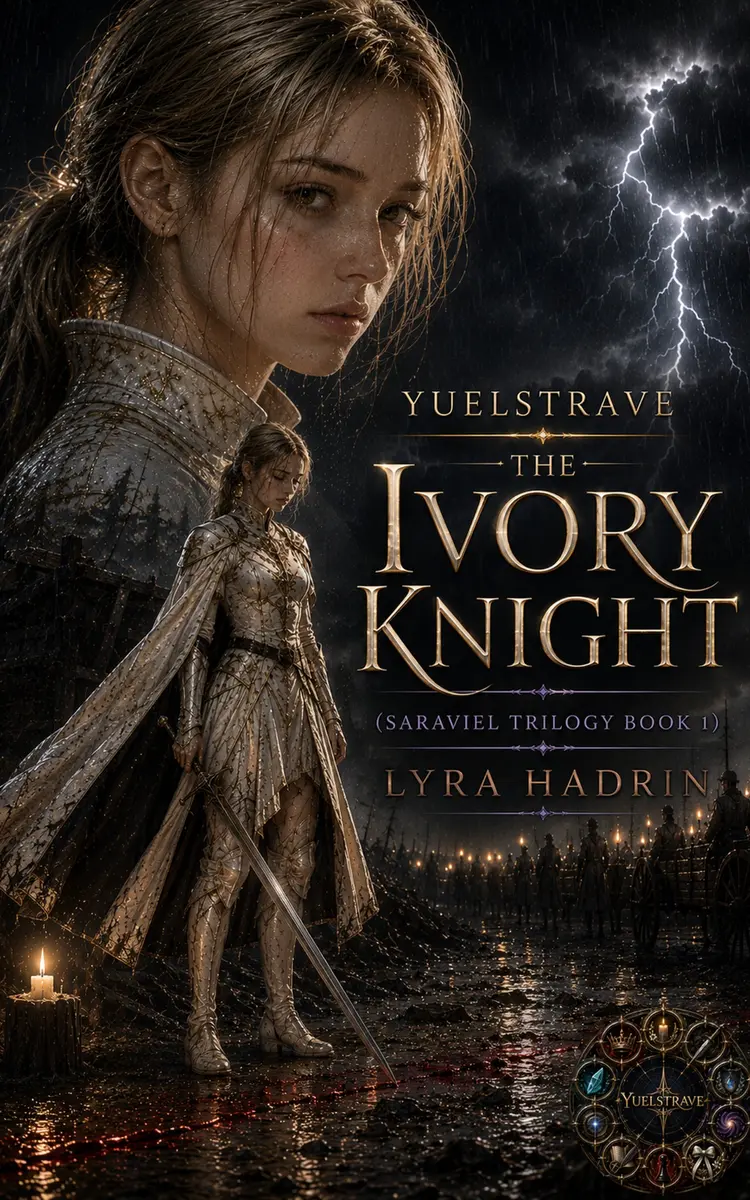
The Ivory Knight
A public reading edition drawn from the active Book One record.
ONE NIGHT SHORT
The wagon went sideways before Milla understood it was dying.
One wheel had sunk into red mud and never came back out. The axle screamed. Grain sacks slid. A wounded man vanished between boots. Rain struck wood, iron, skin, canvas. Everything heavier. Slower. Harder to hold.
A child seized the back of Milla’s coat.
To her left, stone.
To her right, blood-dark mud.
Ahead, someone screamed an order no one heard whole.
The road through Hollowmere had ceased to be a road.
Broken standards. Frightened horses. Dropped shields. Stretcher poles. Bodies jammed into a space too narrow for panic. A man clung to a snapped staff. Retreat calls broke apart in the rain.
It was not an army anymore.
It was a weight.
And it was about to grind its own children into the cliff.
Milla caught a smaller girl by the shoulder and shoved her into the slit of space behind the wagon. Tovan was already there, soaked through, dragging another child backward by the wrist.
“Lower,” Milla snapped.
“I am low.”
“Lower.”
He crouched. The child beside him began to cry, then swallowed it when a horse slammed sideways and nearly kicked the wagon into them all.
Milla looked once up the lane and knew three things.
The wounded would jam first.
The wagon would break next.
Then the pocket behind it would burst, and the children would die there.
A voice cut through the crush.
“Half with the children!”
The shout came from the sanctuary escort captain in a dark wet cloak, one arm red to the elbow, sword still bare.
“The rest buy the road!”
Not flee.
Not save yourselves.
Buy.
People turned. Some moved. Others froze until an escort seized a sleeve and shoved them toward the children.
The split happened by need, not formation.
Some folded back toward the wagon, the wounded, the children. The rest pushed toward the mouth of the cut, already being counted in lives, not numbers.
One held a shield like a cart board. Another had a blade and a medic’s face.
But the pocket did not move.
It only took shape.
Yori stepped out of it before any grown soldier could.
No entrance.
No speech.
No banner.
She simply moved first.
The captain caught her by the arm.
“Not you. You’re still one night short.”
For one beat, even inside the crush, there was stillness.
One more night.
One more night until sixteen.
Yori looked at his hand. Then at the lane ahead.
“But I’m the strongest one here.”
No plea. No pride. No anger. Only fact.
The captain did not deny it.
Rain hissed on steel. A horse shrieked. Somewhere ahead, a man died hard and loudly.
Then the captain drew out a short chapel candle wound once with white thread.
“At sixteen, Saraviel gives a child one candle.
To keep. To carry. To pass on.
It was meant for tomorrow.”
Tovan stared at it as if it were absurd.
Yori took it like it weighed more than a sword.
An older escort bent close and shielded the tinder while she lit it. For one second the flame trembled blue.
Then it steadied.
Yori drove the candle into a crack in the stone just behind where the road narrowed to slaughter.
The small light leaned in the rain.
It did not go out.
She looked at it once.
“Then let it witness me grow up tonight.”
Behind her, the retreat had stopped being people.
It was whatever part of the kingdom could still move.
Milla felt the child clutching her coat go utterly still.
The next rush came fast.
Empire shapes through rain. Five at first. Enough.
Enough to kill the escorts at the mouth of the cut. Enough to tumble the half-made pocket into itself. Enough to turn every child behind the wagon into something trampled and unfinished.
Yori stepped into the gap before the captain gave the order.
Milla saw it in pieces.
A boot sliding over mud.
A blade coming up too late.
Yori cutting first. Short. Ugly. All purpose.
A man striking stone on the way down.
Another lunging past her, trying only to get through her.
That one died with his hand still reaching for the pocket.
The line did not open.
It only held.
Tovan pushed himself high enough to see. Milla dragged him down by the belt, but not before he caught the next exchange: steel on stone, Yori pivoting too close to the cliff, rain flashing white from a sword edge. One of the escorts dropped to one knee beside her, rose badly, and held because there was no room left to fall.
The five became three.
Then two.
They did not fight like soldiers.
They only refused to open.
Milla understood it then.
Yori had not saved anyone.
Not yet.
She was only keeping the pocket from dying immediately.
Another escort staggered backward with blood running through his fingers. The captain shoved him toward the wagon without looking away from the lane. The children stayed pressed into stone, eyes fixed on the candle burning behind Yori’s back.
Then lightning tore the night open.
For one white instant, the whole cut was shown exactly as it was.
The tilted wagon.
The bodies in the mud.
The broken staff.
The children crushed into stone.
The candle.
And the girl standing between all of it and the dark ahead.
When the world went black again, no one in the pocket spoke.
But nobody wanted to be the next thing to touch the road in front of her.
Behind Yori, one small candle held.
Ahead of her, the road did not.
Where the candle is lit…
…the child must grow.
BUY THE ROAD
The mistake began behind them.
Not at the line.
Not where Yori stood with steel in her hands and rain striking her shoulders like thrown gravel.
It began farther back, where people could not see clearly and hope moved faster than truth.
Someone shouted that the gap had opened.
Someone else repeated it as if repetition could make it real.
A wounded man dragged at his brother. A teamster lashed a panicked horse and drove the cart blind. Broken standards dipped and rose in the rain, half banners and half surrender.
Milla heard the change before she saw it.
Not in words.
In pressure.
Bodies leaned the wrong way.
Wheel rims ground stone.
A child drew breath to scream.
“Down,” she snapped, and caught Neri by the back of her soaked tunic before the little girl could vanish between a stretcher pole and a mule flank.
Tovan had Lysa by the hand. He lost her for half a heartbeat when a wounded man swung sideways and crashed into them all. Milla drove her shoulder in, took the blow meant for the children, and shoved them back against the cliff.
The wagon behind them groaned like an animal ready to break.
Ahead, Yori did not move back.
The people behind them saw one girl still standing, one narrow section not yet filled with enemy steel, and decided a road had been born out of it.
Then the crush hit from the rear.
Milla shoved Neri to the ground and flung herself over both girls as a wheel lurched past her shoulder close enough to tear cloth. Mud sprayed into her mouth. A boot missed her hand by an inch.
Tovan dropped late, curling around Lysa just as a snapped spear shaft flew through the place his face had been.
The horse on the left went wild. White eyes. Rope foam.
It slammed against a cart already tilted wrong, and the whole load shifted with a cracking groan.
Milla saw three deaths at once.
The horse would come down.
The cart would roll.
The pocket would be crushed by its own survivors before the Empire ever touched them again.
She went for the horse first because it was largest.
A knife flashed in her hand. Not to kill. To cut trace leather.
The strap gave. The beast tore sideways with the remains of its harness thrashing behind it, clearing a slice of space no wider than a grave.
It was enough.
“Move the children into it,” she barked.
Nobody listened until one sanctuary volunteer slammed his shield into a man’s chest and roared, “Children low! Wounded wall-side!”
Then panic heard itself.
Then panic changed shape.
The rider came out of rain and noise like part of a sentence spoken too far away.
His horse was gray with lather and red to the knees. He nearly died at the mouth of the cut because nobody had room to let him through. A volunteer seized the bridle. Someone else dragged him half out of the saddle.
“By order of Her Highness—keep that section open!”
He pointed, not at the road as a whole, but at Yori’s section. That narrow wound of space. That place where people were not yet dead only because death had been forced to arrive one body at a time.
“Rear chain through first! Children low! Cut the load! Leave the dead wheel!”
The words moved through the crush.
Not like courage.
Like remembered authority.
Milla did not see the princess who had given the order. She did not need to. The command arrived with her shape missing from it, and that made it hit harder.
Somewhere behind the rain, someone had already chosen what the kingdom would lose first.
Rear chain through first.
Not the loudest.
Not the strongest.
Not the proud.
The part of the column still capable of becoming movement.
The order spread.
“Rear chain first!”
“Cut the grain!”
“Leave that wheel!”
“Children lower!”
A man stared at the sacks lashed to his cart as if they were his whole life made visible.
Maybe they were.
Wheat. Dried beans. Salt wrapped in wax cloth.
Milla grabbed the knife again.
“Choose,” she said.
He did not.
So she did it for him.
The bindings snapped. Grain sacks hit mud and split open, pale kernels pouring into blood-dark water. Men cried out to see it. The cart rose a fraction when the weight left it.
Enough.
The road was not opening.
It was being turned into passage by force.
A horse with a broken foreleg had to go next. Its driver kept saying no as if refusal could mend bone. A volunteer put one hand on his shoulder, then drove a blade up under the jaw and took the animal clean.
The carcass became bulk. Wall. Something that kept the next surge from folding inward too fast.
Everything became utility.
Milla hated that most when it worked.
She looked once toward the front and saw the candle still burning behind Yori.
Small.
Steady.
Ridiculous.
And in front of it, the girl herself.
Not winning. Not shining. Not freeing anyone.
Only preventing the world from ending there for one more moment.
“Take her.”
Tovan blinked. “What?”
Milla thrust Neri toward him, then dragged Lysa up by the wrist. “Both if you have to.”
He took Neri awkwardly. She was past crying now. Too cold. Too frightened. She buried her face against his neck and clung like dead weight.
A volunteer staggered backward, clutching his side. Another passed him, shield first, to fill the hole before it widened. Tovan saw that too.
“I can help there.”
Milla seized his collar and dragged him low until his face was level with hers.
“Hero later,” she said. “Hold her now.”
He looked like she had struck him.
Good, Milla thought.
Better wounded pride than a dead boy.
Lysa stumbled. He caught her with his free hand. Neri slipped and he hauled her higher against his chest. The movement was ugly, untrained, desperate.
Useful.
That was all Milla needed.
They began to move.
Not out.
Never out.
Only forward by fractions.
One step when a body fell.
Another when a stretcher passed.
A third when a volunteer shoved his own dying friend sideways to open enough width for a child to slip through.
Yori remained where the lane narrowed hardest.
The line held.
The pocket moved because of that, but not by miracle.
People were paying for every inch with things that could not be replaced.
The captain began to fail where all pillars fail.
Not at once.
By subtraction.
One volunteer vanished from the shield knot and the gap became one child through. Another went down on his knees and turned his body into a brace so a stretcher could slide over him. A third took a blade high in the shoulder, stayed upright long enough to slam his attacker against stone, then never rose after.
Each death purchased something small.
A breath.
A turn.
A burden passing.
A little more motion than there had been before.
The captain had given the order back when there were still enough bodies to pretend the road might be saved.
Now there were only enough bodies to price it.
At the mouth of the cut, one volunteer fell crosswise in the mud. The captain shouted, “Leave him there!”
Not because he was cruel.
Because the dead man had become part of the road.
His body caught the slide of one wheel and turned it just enough to keep it from crushing Neri where she stumbled.
Blood bought motion.
The captain staggered next. One hand pressed hard to his middle. His sword hung low. He looked once past Yori, once back toward the pocket, and understood exactly how much had been purchased and how little remained.
He gave no speech.
He only lifted his blade toward the girl and the candle behind her.
Then he bellowed one last order into the rain.
“Buy them ten more heartbeats!”
The volunteers answered like men already dead.
And for ten heartbeats, maybe twelve, the road moved.
A stretcher through.
A child through.
Two wounded.
Tovan with both girls.
Milla last among that cluster, turning only once to see what they had paid.
Yori was still there.
The captain still stood.
The candle still burned.
The road had not opened.
It was being bought.
THE BIRTHDAY CANDLE
The candle was smaller now.
Milla noticed that before she noticed the rain, the road, or the way the living had begun moving like one broken thing that still refused to fall apart.
The flame had gone from a child’s boast to a survivor’s proof.
Still alive.
Lower than before.
She hated it for that.
It made the night too exact.
Ahead, the road bent through black pines and slick stone, no longer the narrowest point of the cut but not yet anything kind enough to be called escape. Wagons still scraped too near the drop. The wounded still made the road heavier simply by breathing on it.
Tovan staggered beside the children with his shoulders drawn tight and his jaw set too hard for his age. Neri half-slept on one foot. Lysa kept waking as if the dark had a hand and kept touching her face.
Ahead, Yori held the candle low beneath her left hand while the sword rode in her right, wet with rain and whatever the road had already asked of it.
The torn-ear volunteer had taken command without anyone granting it.
That was how nights like this worked.
The world tore rank off men until only function remained.
“Children low,” he said. “Wheels straight. Outer edge with me. No stopping.”
A driver repeated the last order farther back.
“No stopping.”
Milla shifted her shoulder under the nearest litter pole and looked again at the candle.
It should have belonged to tomorrow, not this road.
War had stolen even the shape of the word birthday.
The road warned them before the enemy did.
One mule lifted its head and showed the whites of its eyes. A horse gave a short, ugly snort and tried to sidestep the drop. Rain changed shape against the trees to the left.
Not lighter.
Wrong.
Milla’s hand went at once to the broken sword fragment tucked into the cloth at her waist.
She scanned the slope above the road. Black trunks. Wet brush. Thin places between branches where nothing should have fit and yet something did.
The torn-ear volunteer saw it a heartbeat after she did. His shield came up.
“Close the gap.”
The line obeyed faster now. The children were shoved lower. One wagon dragged inward until its wheel ground sparks from hidden stone. Tovan put himself where the girls would have to hit him before they could run.
Then a boy fell out of the dark.
Barefoot on one foot and wrapped in somebody else’s torn cloak, he hit the road chest-first and would have gone under the next wheel if Milla had not seized his collar and yanked him sideways.
“How many?” she demanded.
His mouth opened. Closed. Opened again.
“More,” he whispered. “More than five.”
“Which side?”
The boy pointed toward the left slope above the road.
A pursuit file. Enough men to break the road in the right places.
The boy’s eyes found the candle in Yori’s hand and stayed there.
“They followed the light,” he said.
Not because it was bright.
Because it marked the only place the road still obeyed.
One of the drivers hissed through his teeth.
“Extinguish it.”
Yori did not answer.
The driver looked to the torn-ear volunteer instead.
“Extinguish it.”
Still no answer.
If they came for the candle, they came for meaning.
Yori looked at the trees at last.
“Keep moving,” she said.
Only that.
The first order came from the slope in clipped Empire cadence.
“Break the front.”
Not bandits, then.
Soldiers.
The torn-ear volunteer did not answer with a charge. He tightened the road instead.
“Children low. Wheels in. Keep moving.”
The first attacker went for the lead mule. Yori reached him before the blade reached the rope. One short cut opened his hand; her shoulder sent him down into the black brush.
Another came from the outer edge and found Milla instead. Her broken sword fragment was too short to duel with, so she used it for the only thing it was good at.
To ruin.
She struck his forearm, bought the limping volunteer one breath, and shoved a litter sideways before a third blade could enter the children’s gap.
Behind them, somebody said, “Keep your feet.”
Another voice answered, “Keep the light.”
Not sung.
Not beautifully.
Only kept in time.
The words passed backward through the column. A driver took the next wheel-turn on them. Then a stretcher team. Then Tovan, whispering the second line because the girls had begun to shake again.
Yori heard it. She did not look back. She only moved half a step toward the center and made the road narrow around her.
The pursuit tried twice more to make panic do the killing for them. Twice the line bent without scattering.
By the time the dark shapes withdrew into the trees, three people were bleeding, one mule had been cut free, and the road had moved another twenty paces.
No victory.
Only continuity.
Rain filled the space violence left behind.
The candle burned under Yori’s hand, smaller than before and no brighter than it had any right to be.
Tovan looked up.
“Is it over?”
“No,” Milla said.
Because that was always the right answer.
Yori stood in the road center. Blood slid from two fingers. In her palm, beneath her sheltering hand, the broken candle burned lower.
Shorter now.
Ugly at the break.
Still lit.
The torn-ear volunteer looked at it and laughed once through blood and exhaustion.
“Stubborn little thing.”
Yori looked at the flame. Then at the children. Then at the road ahead, which had not become safer, only longer.
“It still witnesses,” she said.
Neri looked up at the flame and whispered, “Is it still her birthday?”
No one answered at once.
Then Milla said, because children deserved at least one clean thing in a night like this:
“No.”
Neri blinked.
Milla looked at the candle once more.
“It’s something else now.”
The girl did not understand.
That was all right.
Milla barely did.
Ahead, the road kept moving.
So did the light.
It was no longer a birthday candle.
It was proof.
THE LINE NO ONE CROSSED
The line had fewer people now.
That was how midnight approached.
Not by bells.
Not by stars.
By subtraction.
One volunteer no longer answering when spoken to.
One cart left behind because both wheels had split.
One horse cut free in the trees.
One wounded man dying so quietly the blanket over him never moved.
The road kept them because the road had to keep something. If it could not keep the dead, it kept the shape their absence made.
Milla walked inside that shape with mud drying black on her shins. Tovan stumbled behind her with Lysa and Neri still in frame, smaller now only because everything around them had become too large and too dark to measure by human size.
Hollowmere loosened, but did not release them.
The retreat looked like a wall being carried uphill by the dying.
It moved in pieces.
Wheel. Boot. Breath.
Wheel. Boot. Breath.
Then the road closed again.
A dead cart leaned half-overturned across the next bend. One wheel had sunk into a rut of mud and blood-dark water. The other jammed against stone. Behind it, the lane pinched down to one body and one bad decision.
The road had lost width.
One step.
One body.
One breath at a time.
The torn-ear volunteer saw it and did not swear.
“Children low. Wounded wall-side. Wheels left.”
Men moved at once. Not quickly. Just obediently.
Yori went ahead of them all and stopped at the choke.
Not stopped, Milla corrected herself.
Measured.
The next break in the line came from within.
A man in a Gavrion half-cloak dropped to his knees beside the ditch and would not rise again. Not because he was torn open. Not because he had bled out. Because something inside him had ended first.
His daughter—Milla knew her by the little braid of blue thread tied at her wrist—pulled at him with both hands and said his name over and over until it stopped sounding like a name and became an animal noise.
The volunteers could not spare four men to lift both.
Could not spare one.
Love and available hands no longer matched.
For one moment, the line lost its count.
No wheel turned.
No order moved.
“Get him up,” Tovan whispered.
Nobody moved.
“Get him up.”
Milla caught his arm before he could lunge and lose the girls in the dark.
“Not you.”
“He has a child.”
“So do you.”
The man tried once to stand for the girl’s sake. Got halfway. Folded. The child cried out. Everyone looked toward Yori.
Yori stepped back down the lane. The broken candle burned low beneath her hand, ugly at the break, stubborn in the rain.
No promise.
No prayer.
No lie.
Only one question.
“Can you stand for ten more steps?”
The man’s mouth shook before any words came out.
“No.”
His daughter made a sound like the world had ended in secret.
Yori nodded once. Then she looked over his shoulder toward the wounded, the children, the dead cart, the choke.
And made the choice.
“Take the girl.”
The father understood before the child did.
He gripped Yori’s wrist once. Hard. Not begging her to save him. Begging her to do it fast enough that the child would not understand until movement had already taken her away.
Tovan moved before Milla could stop him. He took the girl under the arms and dragged her into the living line while she screamed the only name she still had.
The father did not call back.
He only leaned into the ditch wall with one hand over his mouth and kept his eyes on his daughter until the road took her away.
Then Yori rose.
The line had lost another person.
But the line still had its shape.
Panic did not return as a rush.
It returned as understanding.
You could hear it in the silence after each order, in the delay before wheels turned, in the way men stopped wasting curses on the Empire and saved breath for their own feet.
They had crossed beyond fear into labor.
That was when a rider reached them from the rear, his mount staggering more than running.
“What section is this?” he demanded.
“One that still moves,” the torn-ear volunteer answered.
The rider saw Yori, the candle, the children, the wounded, the dead cart.
He turned in the saddle and shouted into darkness.
“This section holds!”
It spread too fast.
There is a line.
Stay behind the light.
“They’re pushing through the rear,” the rider said. “If the lane folds there, all of it comes down.”
Not enough men.
Not enough shields.
Only one answer.
Yori turned to the choke.
There were no bodies to spare for breadth.
So the line would survive by becoming smaller.
She stepped to the dead cart, drove the candle into the split timber beside the sunk wheel, and set herself between the flame and the road.
The flame did not brighten the road.
It counted it.
One breath.
One step.
One life bought at a time.
One body.
One light.
One place the night still could not cross.
The torn-ear volunteer whispered, “No banner.”
From farther back, a command came again.
“Keep your feet.”
Another answered.
“Keep the light.”
Somewhere behind the carts, a thin voice held to the pace of the wheels. Not loud enough to lead. Only steady enough that the children stopped crying between steps.
Not song.
Not yet.
Only rhythm.
The pressure came just before midnight.
Not a cavalry charge.
Not a horn.
Only the last kind of killing: the kind that believed exhaustion had already done half the work.
Empire skirmishers found the road at both ends of the choke almost at once. One pair struck from the rear to scatter the column. Another tested the front for width. A third climbed the slope to throw down into the pocket.
Milla saw the three deaths before they finished happening.
Rear panic.
Front breach.
Children cut loose in between.
She dropped beside Tovan and the girls.
“Whatever happens, do not run unless I drag you.”
At the choke, the first skirmisher lunged in low.
Yori cut him across the face and kicked the falling body into the second man’s knees before the first blood struck the wheel-rut. The torn-ear volunteer drove his spear through the gap beneath a collarbone. The man fell against the dead cart and jammed the lane for one precious heartbeat.
A heartbeat was time.
Time was road.
Road was life.
The rear nearly ruined it in the same moment. Survivors pushed forward too fast. A wounded soldier tried to swing around the outer edge and nearly took two children with him when the mud gave under his boots.
Milla hit him with all the weight she owned.
He slid against stone, saw the girls, and stopped fighting the wrong battle.
At the front, more skirmishers came.
Three at once.
Yori gave ground by half-steps only, each one forcing them into the same narrow kill space.
Not retreat.
Placement.
Sword on steel. Shoulder into wood. Rain flashing white off the edges. One man tried to come over the cart side. She slashed his calf open without turning fully toward him. Another got inside her first swing and paid for it with the hilt before the blade found him on the return.
A third reached for the candle.
Yori saw it too late to cut the arm before the fingers closed.
So she chose the hand.
Her sword came down hard enough to split knuckles from grip. The candle rocked, bent almost flat in the rain, then somehow stayed lit.
And then the sky broke.
Lightning tore the night open from above the treeline to the black mud road and held it there for one impossible white instant.
Milla saw everything.
The choke.
The dead cart.
The children crouched under torn cloth.
The wounded against stone.
The volunteers with too little left inside them.
The Empire pressure folding in from front and slope.
The broken candle burning at the fixed point.
And Yori.
Not turning beautifully.
Not moving freely.
Steel rose. Steel met steel. Her shoulder struck wood. A half-turn opened because it had to. The next body entered the count and died inside it.
From the wrong distance, it looked like a dance.
Up close, it was steel and survival.
Through the pooled water by the wheel-rut, fed by every cut and every dragged body, a narrow red line appeared.
No one had meant to draw it.
The road had made it from the price of being held.
The lightning showed the truth so cleanly that nobody could mistake it afterward.
The road did not hold because an army held.
It held because one girl did.
Darkness slammed back down.
Too late.
Everyone had seen it.
From the rear of the line and the wounded carts, the words began to travel before thought could slow them.
No one crossed.
Then again, farther back.
No one crossed.
The last shove came.
Yori did not advance.
That mattered.
She only refused to let them through into the children.
The whole road narrowed into labor again.
Hold.
Shift.
Pass one through.
Hold.
Children low.
Hold.
At some point midnight arrived.
Not by heaven.
By endurance.
The broken candle burned into the first minute of the new day.
And the last enemy at the choke broke first.
He looked at Yori, at the bodies around her, at the light that still had no right to live, and stepped back.
Just one step.
That was all it took.
Pressure broke.
Not everywhere.
Enough.
The rear shove lost belief. The front assault lost nerve. The column began at last to slide through the choke in motion no longer purchased one death at a time.
Not free.
Never free.
But real.
Milla grabbed Tovan by the sleeve and dragged the children forward.
“Now.”
They passed the candle. Passed Yori. Passed the bodies that had priced the road into existence.
The blue-thread girl twisted once to look back.
“So they really didn’t?”
Milla followed her gaze.
At the choke.
At the dead.
At the girl still standing there with rain running red down her fingers.
“No,” she said.
“No one crossed.”
Near the end, Yori stepped away from the point at last.
The candle remained in the broken timber behind them, burning over the line the rain had not yet washed away.
The dead cart.
The split wood.
The little flame.
The red line fading in pooled water.
The Line No One Crossed.
THE GIRL WITH NO BANNER
They did not leave Hollowmere clean.
They left it in pieces.
The pocket of the living slid out of the choke one broken part at a time, as if the road no longer believed in whole things. A child first. A stretcher next. A driver without his cart. A horse without its pair. A volunteer carrying a spear that belonged to a dead man. A girl with blood drying black over one hand and no banner anywhere above her.
Milla counted because counting was the only honest thing left.
Two girls still breathing.
Tovan still upright.
The blue-thread girl still in frame.
Three volunteers where there had been more.
The captain was missing.
The torn-ear volunteer was gone.
The father in the ditch was already behind them.
Tovan kept turning back until Milla caught the back of his collar and yanked him forward.
“Don’t.”
He looked at her over his shoulder, rain shining on a face that had become older in less than one night.
“She’s still there.”
“No,” Milla said. “She’s moving.”
Ahead, Ashford was still only a name.
By dawn, it would also be a mouth.
From farther back in the broken line, a girl’s voice began so softly Milla almost mistook it for breath.
Not pretty. Not meant to be. Only steady enough to keep the children from breaking with the road.
“Soft now, soft now,
don’t wake the fear.
Step close, step slow,
the dark can hear.”
The voice stayed low enough that the rain could almost hide it. Somewhere in the mist, the older girl with something pale at her throat kept the rhythm under the wheels, not leading, not asking to be heard, only giving the road something smaller than panic to obey.
“Hold your hand,
don’t lose your name.
Rain comes down,
but we remain.”
The blue-thread girl did not sing. She only listened. But somewhere ahead, a woman with a split lip took the next breath on time. Then a limping volunteer. Then one of the stretcher boys under his breath.
“Keep the light.
Keep your feet.
Night is long.
We are still here.”
By the last line, it no longer belonged to one voice. The children were no longer crying on different counts. They breathed together. They stumbled together. They kept moving.
That was enough.
Behind them, Hollowmere had already begun becoming something else.
The candle went missing.
Milla did not notice at once. She only felt that something had changed when the road seemed darker than it should have been.
She turned.
Yori was still there.
The blood was still on her hand.
The sword was still low at her side.
But the broken candle was gone.
“Tovan.”
He was already looking past her. Not at Yori. Back toward the choke.
For one instant Milla thought she would have to strike him to stop him.
Then she understood.
The candle left in the split wood.
The witness still burning where the line had held.
“Stay with them,” she said.
Tovan did not move.
“Stay with them,” she said again, shoving Neri toward the older girl. “One turn. Fast.”
His whole face changed. Fear. Want. Resolve too small for a battlefield and too real to mock.
“You’ll keep them low?”
“I said fast.”
That was permission enough.
Tovan ran the way children ran when they knew surviving badly could still be punished.
Milla hated letting him go. Hated it more because she knew exactly why she had.
The living needed something to carry.
She kept the girls low and watched the dark behind them until it opened and gave the boy back.
He came stumbling through rain with both hands cupped around the candle stub as if carrying heat through winter. Wax had run over his fingers. Mud striped his knees. His breath came ragged and high.
But the flame was there.
Smaller than before.
Meaner.
Harder.
He reached Yori and held it out without a word.
For the first time since Hollowmere, Yori’s expression moved.
Not into gratitude.
Not into softness.
Only into recognition.
She took the candle. Looked at the wax twisted by rain and rough handling. Looked at Tovan’s burned fingers. Then she wrapped the white thread once more around her hand and said the smallest thing she had said all night.
“Good.”
Tovan swallowed like the word hurt him.
Now the living carried it.
By the time they reached the lower road to Ashford, the rain had thinned into a cold mist that made everything look unfinished.
The first outpost did not recognize them as a column.
A watcher on the rise blew one short warning and another man shouted down for names, units, and count, as if the broken thing crawling toward the gate could still be answered by categories.
No one answered at once.
Not because they refused.
Because the questions no longer fit.
They came closer and Ashford saw them properly.
Children wrapped in cloaks too large for them.
Wounded men looking offended to still be alive.
A rider leading a horse without saddle or command.
One girl at the front with no banner over her and a candle burning in her hand as if the night had tied itself to her and refused to be put out.
The gate detail hurried then.
“Water here.”
“Get the children down.”
“Careful with that one.”
“Hollowmere?” someone said, too stunned to keep rank in it. “There were people left in Hollowmere?”
Milla helped lower the first stretcher and nearly dropped with it when her knees forgot what standing was for. She caught a boy before he slipped under a wagon tongue, found a pulse weak enough to count as trouble but not yet death, and pulled Neri away from staring at a corpse under borrowed canvas.
A stable hand took one look at the blue-thread girl and asked, very gently, “Where is your father?”
The child stared at him with such empty exhaustion that Milla stepped between them before kindness could demand an answer.
“Find blankets,” she said.
The stable hand obeyed.
A woman crouched in front of the child with a tally board already blackening under names.
“What’s your name?”
The child took too long to answer.
“Maren,” she said at last.
The woman wrote it down and led her toward the wall with the other children.
Rumor began before the wounded were fully down.
No banner.
They never crossed.
That was all Ashford needed.
The rest would be cleaned later by mouths that had not paid for it.
A woman from the gate detail took the candle long enough to light a lantern from it, handed it back, and asked, “What do they call her?”
No one answered.
Tovan opened his mouth.
Closed it.
Because the strangest part was true: the road had followed the line, the line had reached Ashford, and still the name had not arrived with it.
Before dawn, the report had already begun moving uphill.
Rear chain through.
Losses severe.
Hollowmere held longer than expected.
Held by whom?
The question climbed with the rest, because if Hollowmere had failed there, Ashford would be counting dead, not arrivals.
In the first field-room where fragments became names, the basin commander listened without interrupting.
“The rear chain came through,” the limping rider said. “The cut held.”
“Held by whom?” the gate officer asked again.
The rider had seen her. Half the road had seen the lightning frame and the candle and the place where the war had broken itself against one body and failed.
But names belonged to a different kind of knowing.
He looked at the tally board that wanted a unit, a rank, a banner—something clean enough to live on a line.
Then he answered with the only truth he had.
“No banner, commander.”
Outside, Ashford murmured with the first rough shape of the story.
No banner.
They never crossed.
The name was missing.
The story was not.
Down in the yard, Milla sat with the children against a wall that did not move. Tovan slept sitting up, one hand curled near the candle as if even in sleep he meant to keep it from being lost again.
Yori stood a little apart, unnamed, the broken flame lowering toward dawn.
They had reached the city.
The road had reached Ashford.
The girl had not.
Not yet.