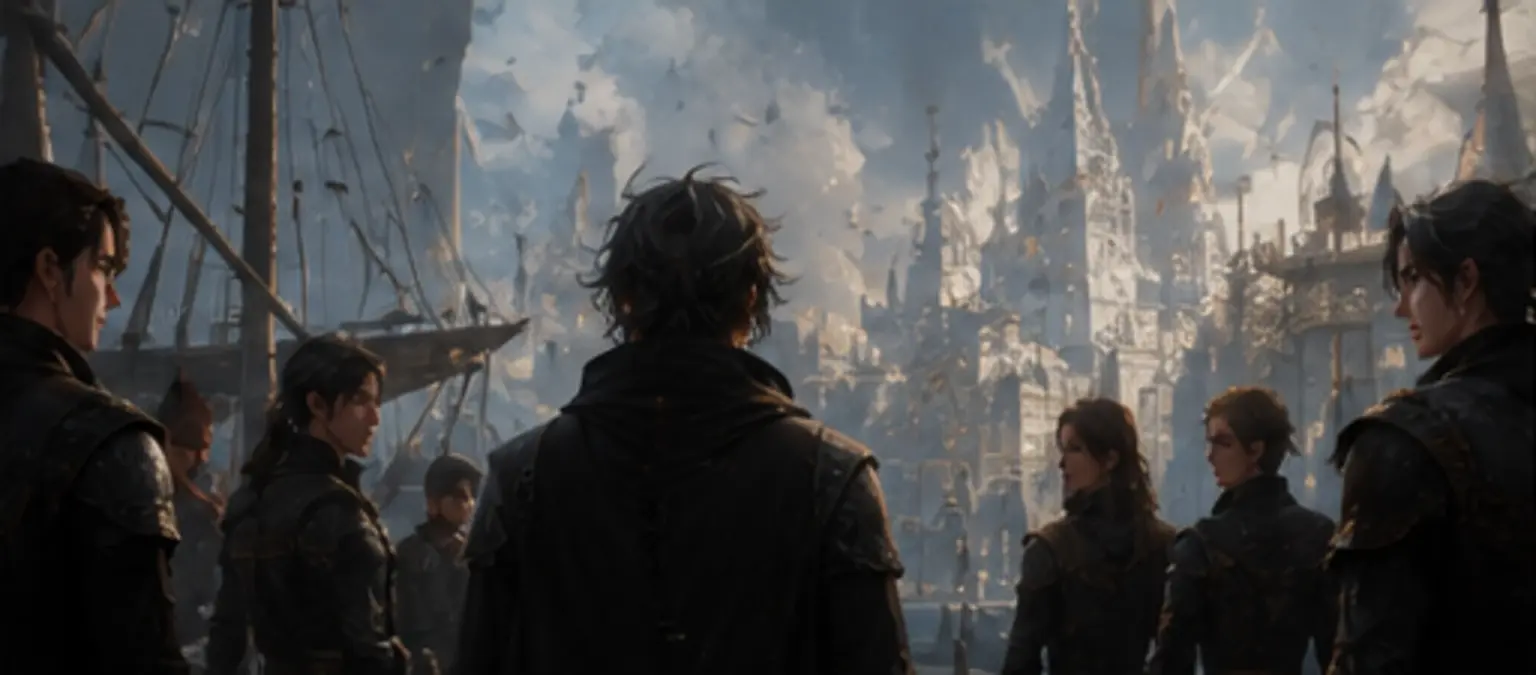
The White Years
Four futures cross one white bridge and mistake survival for a promise.
Before the court turned red, four futures crossed one white bridge and mistook survival for a promise.
The Empire That Counted Footsteps
Drakenval counted the Gavrion embassy before it welcomed them.
Wagons first.
Then horses.
Then guards.
Then sealed cases, medical chests, grain reserve, formal gifts, spare axles, feed weight, water barrels, weapons declared, weapons worn, names carried and names left blank until verified.
Nothing stopped moving.
That was the strange part.
At a Gavrion gate, inspection created a knot. People waited, complained, shifted, negotiated, found somebody who knew somebody, and eventually became a line again.
At Drakenval, the line entered already knowing where it would leave.
Aldren sat his horse beneath a sky the color of unwritten steel and watched an imperial clerk measure the cracked rim of a Gavrion medicine chest.
The clerk did not accuse anyone of damage.
He marked the fracture, assigned a replacement strap, redirected the chest to the third wagon where the road shook less, and moved to the next item.
Aldren looked at Quarn.
The road-man was staring at the drainage channel beside the gate.
“What?” Aldren asked.
“Too straight.”
“The drain?”
“Yes.”
“It works.”
Quarn watched rainwater run exactly where stone had decided.
“That is what worries me.”
Teren rode on Aldren’s other side in a silver-gray coat that had been brushed for diplomacy and had already attracted the attention of two imperial aides.
He followed Quarn’s gaze.
“Drakenval does not trust water to improvise.”
Halvern said, “Water does not improvise.”
Quarn looked at him.
Halvern corrected himself.
“Not deliberately.”
Teren smiled.
“Excellent. The Empire has made you flexible.”
Corven rode behind them with one hand near the medical wagon.
He had checked its wheel six times since dawn.
Aldren suspected the wheel was now safer than any person in the embassy.
Ahead, Marielle Varyel Vale dismounted before the procession had been formally released.
A groom had stumbled while lowering a baggage step. His ankle folded under him. He caught the side of the wagon before falling, but the horse beside him startled and pulled the lead line through his hand.
The injury was small.
Protocol treated the injury as small enough to ignore.
Marielle did not.
She crossed between two clerks, took the groom’s wrist before he could hide the blood, and said:
“Sit.”
“My lady, the line—”
“Will continue.”
The nearest imperial officer looked toward the gate captain.
The captain looked toward the procession.
Aldren expected irritation.
Instead the captain raised two fingers.
The next wagon changed lane without stopping.
A medical orderly appeared from somewhere behind the registry wall.
Marielle glanced up.
“Clean water. Cloth. Not wine.”
The orderly did not ask who she was.
He moved.
Drakenval absorbed the interruption.
Aldren found that more unsettling than if it had resisted.
Teren leaned slightly toward him.
“Your face.”
“What about it?”
“You are doing the thinking one.”
“I am always thinking.”
“No. Sometimes you are wet.”
Halvern looked ahead.
“Do not provoke him at an imperial border.”
“Where, then?”
“Preferably nowhere.”
Quarn said, “Gate opening.”
The iron leaves ahead moved inward.
No trumpet sounded.
No herald shouted.
One bell struck.
Every imperial guard along the inner road changed posture on the same beat.
The embassy entered Drakenval.
The road widened beyond the gate.
Then widened again.
The first stretch could take two wagons abreast.
The second, four.
The third could receive a cavalry column without breaking civilian flow.
White stone markers divided supply traffic from military traffic. Dark red standards hung high enough not to catch cart roofs. Western dragons were worked into the iron brackets, wings folded, jaws closed.
Not decorative beasts.
Contained ones.
Aldren had expected Drakenval to look angry.
It looked prepared.
That was worse.
A woman carrying bread crossed the road under a guard’s signal. A physician’s cart received priority over an officer’s carriage. A wagon with a damaged axle was pulled aside before the driver realized the wheel had begun to lean.
Road.
Bread.
Medicine.
Order.
None of it was false.
Quarn watched the repaired wagon disappear into a service lane.
“Useful place,” he said.
Aldren looked at him.
“That sounded almost approving.”
“No.”
“Then what?”
“Useful.”
Aldren understood the distinction.
He would remember it much later.
The Imperial Palace did not rise from the land so much as command it to stop.
Terraces of dark stone stepped upward behind walls broad enough to carry mounted patrols. White banners marked the central ascent. Crimson hung beneath them, deep enough to appear nearly black where the winter light failed.
The Gavrion embassy entered through a court large enough to deploy a regiment and found it empty except for the people required to receive them.
That emptiness was deliberate.
Every boot sounded important.
Sevarin Draeven Drakenval waited at the head of the court.
Eighteen years old.
No crown.
No armor.
A black formal coat cut with white at the collar and deep red only inside the folds.
He stood beside his father’s appointed ministers without looking diminished by any of them.
His stillness did not resemble fear or ceremony.
It resembled a young man who had already discovered that movement gave information away.
Aldren dismounted.
Marielle stepped down beside him.
The three young men followed.
Quarn remained near the wagons until an imperial officer tried to place him with the servants.
“He stays,” Aldren said.
The officer looked toward Sevarin.
Sevarin’s eyes moved once over Quarn’s road coat, rope, knife, boots and unbowed posture.
“Then he stays,” he said.
No challenge.
No favor.
A category adjusted.
Aldren disliked how quickly it happened.
He respected it too.
Sevarin descended three steps.
“Prince Aldren Valerius Gavrion.”
“Aldren is enough in private.”
Sevarin’s gaze shifted to the three men behind him.
“Is this private?”
Teren’s mouth moved.
Halvern’s elbow prevented the answer.
Aldren said, “Not yet.”
Something almost like interest entered Sevarin’s face.
“Then welcome to Drakenval, Your Highness.”
He turned to Marielle.
“Lady Marielle Varyel Vale.”
She inclined her head.
“Your Highness.”
The groom she had treated at the border had reached the court on a rear wagon. Sevarin noticed the fresh binding before he looked at the formal gift cases.
“Your party sustained injury?”
“Minor,” Marielle said. “The border orderlies responded quickly.”
“They should.”
It was not pride.
It sounded like specification.
Marielle looked at him more carefully.
“Then they were well taught.”
For the first time, Sevarin seemed uncertain whether a sentence was praise or evaluation.
Before he could answer, a horse entered the reception court at speed.
Every imperial guard moved.
Not toward panic.
Toward positions already assigned.
The rider reined in hard enough to throw pale grit from the stones.
A girl in white training clothes swung down before the horse had fully stopped.
Her dark hair had escaped its binding. One knuckle was bleeding. A wooden practice blade remained in her left hand.
Gevrane Vaelisse Drakenval looked at the Gavrion embassy.
Then at Aldren.
Then at the sword at his hip.
“You are smaller than the reports.”
Aldren looked at Sevarin.
“Is this private now?”
Teren coughed into one hand.
Sevarin did not look away from his sister.
“No.”
Gevrane walked closer.
The guards relaxed only after she passed them.
That told Aldren more about her than the blood on her hand.
“What reports?” he asked.
“The ones that call you a king-line.”
“I am fifteen.”
“So?”
“So the reports are impatient.”
Gevrane smiled.
Brightly.
Not the smile of the Blood Knight.
Not yet.
The smile of a sixteen-year-old girl who had found something interesting enough to interrupt protocol for.
“Good,” she said. “Then they will not mind when I beat you.”
Corven stepped half a pace closer.
Halvern’s eyes went to the guards.
Teren looked delighted.
Quarn looked at the horse’s left foreleg.
Sevarin closed his eyes for one brief moment.
“Gevrane.”
“What?”
“You are bleeding.”
She looked at her hand as though it belonged to someone else.
Marielle held out a folded cloth.
Gevrane looked at her.
“Who are you?”
“Marielle.”
Gevrane took the cloth.
“You are not afraid of me.”
Marielle glanced at the wooden blade.
“Should I be?”
Gevrane considered.
“No.”
She wrapped the cloth badly.
Marielle took her hand back and did it properly.
The reception court watched a princess of Drakenval stand still because a girl from Gavrion had told her to.
Sevarin watched too.
Aldren saw him see it.
Gevrane flexed her fingers.
“Tomorrow.”
Aldren looked at the practice blade.
“What tomorrow?”
“The duel.”
“No duel has been agreed.”
“It has now.”
Halvern said, “That is not how agreements work.”
Gevrane turned.
“Who are you?”
“Halvern Valen.”
“You look exhausting.”
Teren made a sound of immediate affection.
Halvern ignored both of them.
Sevarin said:
“The duel will be formal, witnessed, and scheduled for the nineteenth.”
Gevrane frowned.
“That is two days.”
“Yes.”
“I could beat him tomorrow.”
“I know.”
Aldren looked at Sevarin.
The future Emperor’s face remained calm.
But the sentence had contained something human.
Not indulgence.
Not embarrassment.
An older brother who had spent years building structures around a sister who preferred doors open.
Gevrane turned back to Aldren.
“Nineteenth.”
Aldren nodded.
“Nineteenth.”
She walked away with Marielle’s cloth around her hand.
Halfway across the court, she looked back.
“Bring a better sword than your face.”
Teren waited until she had gone.
Then said:
“I like Drakenval.”
Halvern replied:
“No one asked.”
Quarn pointed toward the horse.
“Left shoe loose.”
The imperial stablemaster turned immediately.
Sevarin looked at Quarn.
Quarn looked back.
“Your road-man?” Sevarin asked Aldren.
“No.”
Quarn answered at the same time.
Aldren smiled.
“He is Quarn.”
Sevarin’s eyes rested on the old road-man for one second longer than courtesy required.
Then the reception began again.
Drakenval had counted every person who entered.
By sunset, it had not yet decided what to do with all of them.
The Hand After Defeat
Gevrane defeated Aldren in eleven exchanges.
The first three taught her his reach.
The next four taught her his habits.
The last four taught him that she had been learning while he had been trying to win.
The duel court was circular, white stone under a winter sky, with no sand to soften a fall and no ornament that could be blamed for distraction.
Drakenval witnesses stood on the eastern tier.
Gavrion on the west.
Sevarin watched from the center balcony beneath a dark imperial banner.
Marielle stood below him with Teren, Halvern, Corven and Quarn.
Quarn had asked whether the court kept spare wheel pins.
No one had answered.
Gevrane entered without ceremony.
Training white.
Dark boots.
A narrow practice sword in each hand.
Aldren looked at the second blade.
“That was not in the agreement.”
Sevarin said from above:
“The agreement permits the combatant’s customary form.”
Aldren looked toward Halvern.
Halvern gave one small nod.
Correct.
Teren leaned toward Corven.
“He checked.”
“Of course he checked.”
“He checked before we arrived.”
“Of course.”
Teren looked upward.
“I may like the brother too.”
Halvern said, “Quiet.”
The witness called the start.
Gevrane did not rush.
That surprised Aldren first.
Everything about her arrival two days earlier had suggested speed before permission.
Her fighting did not.
She stood centered.
The longer practice blade low in her right hand.
The shorter in her left.
Not crossed.
Open.
Aldren advanced.
His first cut tested distance.
She let him learn it.
The second asked whether she preferred retreat.
She stepped inside instead.
Wood struck wood.
Her shorter blade touched his wrist without force.
A warning.
He recovered.
The court remained silent.
Gevrane smiled.
Aldren hated that he enjoyed it.
Fourth exchange.
He drove her toward the outer line.
She yielded ground.
Not balance.
Fifth.
He changed rhythm.
She let the long blade meet his current line and placed the short one where his next turn wanted to exist.
He stopped before stepping into it.
Gevrane’s smile sharpened.
Sixth.
Aldren feinted high.
She ignored the lie and struck the hand that had to become true.
His fingers went numb.
Seventh.
He used weight.
She used angle.
Eighth.
He forced contact and nearly took her shoulder.
A sound moved through the Gavrion witnesses.
Hope.
Too early.
Gevrane heard it.
Her eyes changed.
Not color.
Attention.
Ninth exchange.
The long blade found his sword.
The short blade found the recovery.
He broke away before the trap closed.
Tenth.
Aldren stopped trying to solve the two blades separately.
He attacked Gevrane.
For one breath, that worked.
He entered close enough to deny the second blade its space, struck her shoulder with the guard, and forced her left foot across the line.
The Drakenval tier went still.
Gevrane looked at the white mark beneath her boot.
Then at Aldren.
She laughed.
Eleventh exchange.
She abandoned the outer line entirely.
The longer blade drew his guard where it needed to be.
The shorter blade did not strike.
It waited.
Aldren saw the opening.
Took it.
Realized it had been built for him.
The short blade touched the inside of his elbow.
His arm opened.
The long blade stopped at his throat.
Done.
No spectacle.
No humiliation.
Only a future action removed before it became present.
The witness called the duel.
Gevrane stepped back.
Aldren remained where he was, breathing hard, one hand still around a sword that no longer mattered.
The court waited to learn what defeat would make of him.
He looked at Gevrane.
She expected anger.
He could see it.
Perhaps not from him specifically.
From every noble boy who had ever needed victory to remain larger than a girl.
Aldren lowered his sword.
Then held out his free hand.
Gevrane looked at it.
The entire court seemed to move farther away.
“You won,” Aldren said.
“I know.”
“Then stand.”
“I am standing.”
“On the line.”
She looked down.
Her heel still touched the outer mark where he had forced her in the tenth exchange.
A technical irregularity.
Not enough to reverse the duel.
Enough that a lesser loser might have tried.
Gevrane looked back at his hand.
Then took it.
Aldren pulled her one step inward.
No claim.
No concession.
Just completion.
Something in Gevrane’s expression failed to become the thing she had expected.
Sevarin saw it.
Marielle saw him see it.
Teren whispered:
“Oh.”
Halvern said nothing.
Corven’s shoulders lowered.
Quarn looked at Aldren’s right wrist.
“Swelling,” he said.
The moment ended.
Marielle wrapped Aldren’s wrist beside a window overlooking the court.
“You are tightening it too much,” he said.
“No.”
“Quarn has corrupted everyone.”
“He would use rope.”
“That is not comforting.”
Marielle adjusted the cloth.
Her touch was careful without being timid.
She had spent the morning helping the embassy’s medical attendants reorganize supplies after Drakenval’s inventory office moved half the chests for efficiency. She had learned every orderly’s name before the imperial quartermaster had learned hers.
Aldren looked toward the empty court below.
“She planned the last exchange from the fifth.”
“Probably.”
“I should have seen it.”
“Probably.”
He looked at her.
“You are not very sympathetic.”
“I am extremely sympathetic.”
“You have agreed with every reason I lost.”
“That is not the same as agreeing that losing made you smaller.”
Aldren went still.
Marielle tied the final knot.
“Most people are taught how to look like themselves while winning,” she said. “Very few learn how to remain themselves after.”
He looked at the cloth around his wrist.
“Did I?”
“You offered her your hand.”
“She had won.”
“Yes.”
“What else was I supposed to offer?”
Marielle smiled.
“That is why.”
Aldren looked away before she could read too much from his face.
“You enjoyed the duel,” she said.
“No.”
“You did.”
“She hit me eleven times.”
“Ten. The last was only a threat.”
“That is worse.”
Marielle laughed.
The sound made the corridor feel less imperial.
Gevrane appeared at the far end carrying both practice swords.
No escort.
Of course.
She saw Marielle’s hand on Aldren’s wrist.
Then Aldren’s face.
Then the bandage.
“I did not break it.”
Marielle said, “I know.”
“You wrapped it.”
“Yes.”
“Why?”
“Because it hurts.”
Gevrane considered this as though pain and treatment had not always belonged in the same sentence.
Then she held out her left hand.
A shallow split had opened across one knuckle.
Marielle looked at it.
“You already had that.”
“It opened again.”
“During the duel?”
“Yes.”
Aldren said, “You could have stopped.”
Gevrane looked at him.
“So could you.”
He had no answer.
Marielle took Gevrane’s hand.
The war princess stood still again.
Aldren watched her watch Marielle work.
Not bored.
Not impatient.
Curious.
“You do this often?” Gevrane asked.
“Enough.”
“You are a noble.”
“Yes.”
“You touch blood.”
“Yes.”
“Why?”
Marielle looked up.
“Because it is there.”
Quarn would have approved of the answer.
Gevrane smiled.
“Come to the training court tomorrow.”
Marielle raised one brow.
“I do not duel.”
“I know.”
“Then why?”
“Because everyone who watches me fight asks how I won.”
Gevrane looked at the clean cloth around Aldren’s wrist.
“I want to know what you see.”
Marielle finished the bandage.
“Tomorrow.”
Gevrane nodded.
Then to Aldren:
“Rematch in three days.”
“No.”
“Two.”
“No.”
“One.”
Halvern’s voice came from behind her.
“No.”
Gevrane turned.
“How long have you been there?”
“Long enough.”
Teren leaned around the corner behind him.
“He has adopted Quarn’s worst habit.”
Gevrane looked at the gathering of Gavrion men.
Then at Marielle.
“Your country is strange.”
Marielle smiled.
“So is yours.”
Gevrane laughed.
The sound reached the stair above them.
Sevarin stood there unseen for one moment longer than necessary.
Then walked away before anyone could ask what he had heard.
Twelve Days in White
The first thing Gevrane learned from Marielle was that blood became less impressive after the fifth basin.
The first basin had come from a kitchen boy who had cut his palm on a broken jar.
The second from a cavalry groom kicked above the knee.
The third from an imperial clerk whose nose had not survived an argument with a storage beam.
By the fourth, Gevrane had stopped asking which wound belonged to a soldier.
By the fifth, she was holding the water.
Marielle worked opposite her at a long white table beneath a row of narrow windows. The service ward was not ceremonial. No saint-glass. No polished altar. No noble family emblems large enough to compete with the injured.
Only cots.
Cloth.
Boiled instruments.
Ledger boards.
Water carried in and blood carried out.
Gevrane had arrived in training white and announced that she had come to watch.
Marielle had handed her a basin.
That had been an hour ago.
“You did not say it would be heavy,” Gevrane said.
“It is water.”
“It becomes heavier when people put parts of themselves into it.”
Marielle glanced at the basin.
“That is generally how burden works.”
Gevrane looked at her.
“You sound like Halvern.”
“I do not know whether to be offended.”
“You should.”
The next patient was a girl of perhaps nine whose forearm had been burned by a steam valve in the palace laundry.
She entered without crying.
Then she saw Gevrane.
Her body stopped.
Not her feet alone.
Everything.
The girl knew the princess.
Or knew what servants said when they thought children were asleep.
The Drakenval daughter who broke practice swords.
The girl who returned from riding with blood on white sleeves.
The future blade of the imperial house.
Gevrane saw the fear.
Her expression hardened from surprise into something more familiar.
Distance.
Marielle said:
“Sit.”
The child obeyed.
Gevrane put the basin down.
Marielle looked at her.
“Not her.”
Gevrane frowned.
“You.”
The war princess stared.
Then, slowly, sat on the floor.
The child blinked.
Gevrane was still taller than her from the floor.
Less so.
Marielle unwrapped the burned arm.
“What is your name?” she asked.
“Eda.”
“Eda what?”
“Orven.”
“Good. Eda Orven, this will hurt.”
The girl nodded.
Marielle cleaned the burn.
Eda’s free hand closed around the edge of the table.
Gevrane watched.
Marielle said without looking up:
“Give her your hand.”
Gevrane looked at her own fingers.
Then at the child.
Eda looked even more alarmed.
“I may crush hers,” Gevrane said.
“Then do not.”
This appeared to offend Gevrane on technical grounds.
But she held out her hand.
Eda took two fingers.
When Marielle lifted the burned cloth, the child squeezed.
Gevrane did not move.
The grip was small.
The discipline required not to answer it with force was not.
Marielle finished the dressing.
“There.”
Eda released Gevrane and stared at the clean bandage.
“Can I work tomorrow?”
“No,” Marielle said.
The girl looked frightened again.
“My mother—”
“Will receive your name on the ward list and your ration will not be reduced.”
Eda looked toward the imperial clerk at the end of the room.
The clerk had already begun writing.
Drakenval was useful that way.
The child left.
Gevrane remained seated.
Marielle began washing her hands.
“She was more afraid of me than the burn.”
“Yes.”
“You could have lied.”
“Yes.”
“Why did you not?”
“Because you saw it.”
Gevrane looked at the door through which Eda had gone.
“What do I do with that?”
Marielle handed her a clean cloth.
“Next time, sit sooner.”
Gevrane looked at the cloth.
Then laughed.
Not loudly.
Not like the girl who had challenged Aldren in the reception court.
Something quieter.
She stood and took the next basin before Marielle asked.
Gevrane beat Aldren again.
This time it took fourteen exchanges.
Teren counted seventeen.
Halvern corrected him twice.
Corven stopped counting when Aldren’s left shoulder began to drop.
Quarn had not attended.
A wagon in the outer court had made an untrustworthy sound.
The duel was informal enough that no witness announced victory.
Gevrane simply hooked Aldren’s practice sword out of line, placed the shorter blade beneath his guard, and stopped with the longer one resting against his chest.
“Better,” she said.
Aldren breathed hard.
“That is not the same as good.”
“No.”
She stepped back.
He lowered his sword.
Then held out his hand.
Gevrane looked at it.
“Again?”
“You won again.”
“I am aware.”
“Then stand.”
“I am standing.”
“Correctly.”
She looked down.
During the final turn, one boot had crossed the practice line.
Not enough to change the outcome.
Enough for him to notice.
Gevrane took his hand.
This time, when he pulled her inside the mark, she did not look surprised.
She did not release him immediately either.
Teren looked at Halvern.
Halvern looked directly ahead.
Corven found the training rack extremely interesting.
Gevrane let go.
“You enjoy losing to me.”
Aldren stared.
“No.”
“You keep coming back.”
“That is called practice.”
“In Drakenval, we call it evidence.”
Aldren turned toward the water bench.
Gevrane followed.
“You changed on the ninth exchange.”
“I stopped watching the short blade.”
“Why?”
“Because you wanted me to.”
She smiled.
“Good.”
“You still won.”
“Yes.”
“That is becoming irritating.”
“It was irritating the first time.”
Teren came closer.
“I can confirm this.”
Neither looked at him.
He placed one hand over his heart.
“I am invisible in two kingdoms.”
Halvern said:
“A remarkable improvement.”
Teren turned slowly.
Corven laughed.
Gevrane looked between them.
“You travel like brothers.”
“No,” Halvern said.
“Yes,” Teren said at the same time.
Corven looked at Aldren.
Aldren drank water.
Gevrane’s expression changed.
Not envy.
Recognition of something Drakenval had not given her a word for.
“Do they always disagree with you?” she asked Aldren.
“Yes.”
“Why keep them?”
Aldren lowered the cup.
“They are not mine to keep.”
The answer came too quickly to be polished.
Gevrane went still.
Across the court, Sevarin had entered through the upper passage without escort.
He heard it.
Aldren did not see him.
Gevrane did.
For one moment, brother and sister looked at each other across the white stone.
Something passed between them.
Then Gevrane turned back to Aldren.
“Tomorrow,” she said.
“No.”
“Morning.”
“No.”
“After supper.”
Aldren sighed.
Teren said:
“He means yes.”
Halvern said:
“He does not.”
Gevrane smiled.
Drakenval had found a game it could not schedule cleanly.
The road that did not exist appeared in three separate ledgers.
Three ledgers agreeing on the same impossible road were enough for Sevarin.
One ledger listed drainage maintenance beneath an abandoned eastern imperial road.
One listed replacement labor for a bridge-control station that no current map contained.
The third listed food allocations for twelve workers whose names had been removed from the registry eighty years earlier.
All three entries had been approved.
None explained where the supplies went.
Sevarin stood over the record table with the pages arranged by date.
Quarn stood opposite him with one hand on an old route map.
Marielle sat at the end of the table, copying ward names into a Gavrion medical report.
Aldren had been summoned because the missing route crossed an embassy survey boundary.
Gevrane had come because no one had invited her.
Teren, Halvern and Corven waited outside under an imperial officer’s increasingly unsuccessful definition of privacy.
Sevarin placed one finger on the map.
“The drainage line ends here.”
Quarn looked at the paper.
“No.”
“The mark ends.”
“Water doesn’t.”
Halvern would have objected to the phrasing.
He was outside.
Sevarin looked toward the stone wall beyond the table as though he could see through it.
“The current eastern road is thirty feet higher.”
“Current road.”
“You think an older one survives beneath it.”
“Something does.”
Gevrane leaned over the table.
“Can we go?”
“No,” Sevarin and Aldren said together.
She looked pleased by the harmony.
Marielle finished one name and sanded the ink.
“Why were the workers removed?”
Sevarin turned to her.
“Unknown.”
“Dead?”
“Possibly.”
“Transferred?”
“No receiving records.”
“Punished?”
“No court entry.”
Marielle looked at the twelve blank spaces in the oldest ledger.
“Then the archive knows what was delivered and not who carried it.”
Sevarin’s eyes rested on her.
“That is the archive’s function.”
“No. That is the archive’s failure.”
The room became very quiet.
Aldren looked from one to the other.
Sevarin did not become offended.
That made the moment more dangerous.
“Drakenval records function because function survives personnel,” he said.
Marielle touched the first empty line.
“People do not become less dead because the flour arrived.”
“No.”
“Then both facts belong.”
Sevarin looked down at the page.
He had spent years learning how systems preserved what individuals forgot.
Marielle had spent days proving systems could forget people while preserving everything around them.
“Both facts cost space,” he said.
“Then use more paper.”
Aldren looked away before his face betrayed him.
Gevrane laughed openly.
Sevarin’s mouth almost moved.
Almost.
He took a fresh sheet from the side of the table and wrote twelve temporary numbers in the margin.
Marielle watched.
“What are those?”
“Places for names.”
“You do not have them.”
“Not yet.”
It was not agreement.
It was worse.
It was Sevarin changing the shape of the problem because she had entered the room.
Quarn tapped the map.
“Road.”
The young prince looked at him.
Quarn pointed to a line of maintenance marks that should have followed the drainage channel.
Instead they veered toward a section of blank stone east of the palace grounds.
“Too clean,” Quarn said.
Sevarin studied the curve.
“You say that often.”
“World gives reasons.”
Gevrane had stopped smiling.
She touched the oldest ledger.
“There is a mark here.”
Beside the supply number was a symbol nearly erased by age.
A thin white arch above a double curve.
Marielle leaned closer.
“That is a Vale form.”
“Varyel Vale?” Aldren asked.
“Older.”
She traced the air above it without touching the paper.
“Shelter over crossing water.”
Sevarin pulled another ledger from the stack.
The same mark appeared beside a dead command notation: a narrow ring broken by vertical lines.
Two symbols.
One entry.
One road no current map admitted existed.
Gevrane looked at her brother.
“Can we go now?”
Sevarin closed the ledger.
“No.”
She frowned.
“We inspect under seal at first light on the twenty-ninth.”
Gevrane smiled.
Aldren looked at the date.
The extra day.
A day the calendar did not always possess.
Quarn looked at it too.
He did not like roads that appeared only because someone had found more time.
The final clue was behind a practice-sword rack.
Gevrane found it because she had broken the rack.
Not deliberately.
She had attempted to show Marielle why Aldren’s shoulder dropped after repeated right-side pressure.
The rack had been in the way.
Now it lay in two pieces across the floor.
Behind it, set into the wall, was a strip of material no current smith had made.
Black beneath dust.
White along one fractured edge.
A dead ring at the top.
A shallow Vale Arch cut through the center.
Marielle knelt beside it.
“This was not decoration.”
Gevrane crouched.
“It was hidden badly.”
“It survived well.”
Aldren entered with Sevarin behind him.
Teren looked at the broken rack.
“Training?”
Gevrane said:
“Yes.”
Halvern looked at Marielle.
She shook her head once.
No one asked further.
Sevarin examined the strip without touching it.
“Bridge-control marking.”
Quarn stood in the doorway.
“Road marker.”
Sevarin looked back.
“Both.”
For the first time, Quarn nodded before disagreeing.
The young prince noticed.
So did Aldren.
Sevarin turned to the imperial officer behind him.
“Seal the gallery. No removal. No public registry.”
The officer bowed.
“Prepare the survey party.”
Gevrane stood.
“Finally.”
Sevarin looked at her.
“You remain within the line.”
“What line?”
“The one I assign.”
She smiled.
“That sounds temporary.”
Marielle rose, dust on one knee.
Aldren offered his hand.
She took it.
Gevrane watched.
Not unhappily.
Not yet.
Outside, the palace bells marked the end of the ordinary day.
Midnight would give the year one more.
Beneath the old road, something had been waiting through years that did not always contain it.
The Forbidden Road
Sevarin did not sneak out of the palace.
He issued an order.
That distinction mattered to him.
The survey sheet lay on the table beneath four sealed lamps.
The party was small enough to move and large enough not to be foolish.
Sevarin.
Gevrane.
Aldren.
Marielle.
Quarn as route specialist.
Teren for field sight.
Halvern for oath and witness control.
Corven for line, rope and physical extraction.
Six imperial guards selected from the palace route detail.
Two engineers.
One medical orderly.
No heralds.
No court spectators.
No minister whose primary skill was surviving the report afterward.
Halvern read the survey order from beginning to end.
Then again.
“The withdrawal condition is vague.”
Sevarin looked at him.
“It states immediate withdrawal upon structural instability.”
“Who decides instability?”
“The survey commander.”
“You.”
“Yes.”
“Then the order permits the person with the greatest interest in continuing to define when continuation has become unsafe.”
Teren leaned toward Aldren.
“He has found his natural enemy.”
Aldren whispered:
“An imperial document?”
“Redundant authority.”
Halvern ignored them.
Sevarin considered the objection.
Then wrote one additional line.
Route specialist or line captain may compel withdrawal if the survey commander cannot verify a safe return.
He signed it.
Halvern read the new line.
“Acceptable.”
Gevrane stared at him.
“You made him change an imperial order.”
“Yes.”
“Can you do that often?”
“No.”
Teren said:
“We are working on frequency.”
Sevarin looked toward Quarn.
“You understand the old route least badly.”
“Probably.”
“Is that confidence?”
“No.”
“Good.”
The answer surprised Quarn.
Sevarin continued:
“Confidence without a verified return line is theater.”
Quarn looked at Aldren.
“Keep this one.”
Sevarin’s eyes narrowed.
Aldren smiled.
“He does not belong to me.”
Quarn nodded once.
The lesson had remained.
The forbidden road began under ice.
Not snow.
Ice laid flat across black stone, clear enough to show a second surface beneath the first.
The old road ran below the current ground at an angle no road should have survived.
White ribs crossed it.
Black metal continued through them.
Neither structure had been built with the other in mind.
They had met violently enough that centuries later the collision still looked unfinished.
The survey party descended by rope through a maintenance cut no current engineer recognized.
Corven went first.
He tested every anchor twice.
Quarn tested the third time.
Corven did not complain.
Teren entered next, stopped halfway down and looked not at the road but at the empty air above it.
“No birds,” he said.
Halvern looked upward.
“There are no openings.”
“There were.”
“How do you know?”
Teren pointed to white scoring across the upper stone.
“Something used to descend.”
Quarn looked.
“Or leave.”
Gevrane touched the hilt of her ordinary practice sword.
“This is better than the court.”
Marielle said:
“That depends on what died here.”
They reached the buried road.
The black surface under the ice held dead grooves too precise to be decoration.
Along one side stood white arches shaped for riders too tall or mounted on something current history had lost.
Arcane geometry had been forced through command architecture.
A road from one dead civilization had entered the spine of another.
Aldren looked at Quarn.
“Which side is the road?”
“Both.”
“That is not useful.”
“World often isn’t.”
Sevarin lifted one hand.
The line halted.
Ahead, two passages appeared to continue east.
One was straight.
Clean.
Unbroken.
The other bent through white debris and vanished behind a fractured arch.
Quarn looked at the clean passage.
“No.”
The lead engineer frowned.
“It has the strongest supports.”
“No dust.”
“There is ice.”
“Still no dust.”
Teren’s humor disappeared.
“The air moves through the broken side.”
Sevarin looked between them.
“Broken passage.”
They turned.
The clean road lit behind them.
Not brightly.
One thin line beneath the ice.
Then another.
The engineers stopped.
A sound moved through the structure.
Too low to hear as a tone.
High enough to feel through teeth.
Every dead groove in the black road became visible for one breath.
The white arches answered.
The structure shifted.
“Back,” Halvern ordered.
Sevarin said the same word.
The guards moved immediately.
No confusion.
No collision.
Corven caught the medical orderly by the harness and pulled him clear as the floor between two arches dropped a foot.
Teren shouted:
“Ceiling left.”
The first guard obeyed before looking and avoided a white beam that fell through the space his head had occupied.
Quarn pointed toward the entry rope.
“Not that one. Second.”
The first rope went slack.
The second held.
The outer line began withdrawing exactly as ordered.
Then the road folded.
Not like stone.
Like a map forced into the wrong crease.
The black passage rotated behind a white arch.
Aldren saw Marielle on the far side of the forming break.
He caught her wrist.
Gevrane caught Aldren’s coat.
Sevarin reached for his sister.
Four bodies crossed the shifting line together.
Corven lunged after them.
Halvern seized the back of his harness.
A black wall drove upward between the groups.
Corven’s shoulder struck it hard enough to shake the arch.
The rope in his hands remained taut for half a second.
Then something inside the wall cut it without fraying a single strand.
The loose end fell at his feet.
“Aldren!”
No answer.
Teren pressed one ear against the new surface.
“Movement.”
“Where?” Halvern asked.
“Everywhere.”
Quarn looked at the clean passage they had refused.
It was gone.
The broken one had become three.
The imperial guards formed around the engineers and medical orderly without being told.
Nobody had panicked.
Nobody had failed.
The site had simply changed the question faster than trained people could answer it.
Sevarin’s voice came faintly through the wall.
“Hold position.”
Halvern answered:
“We hold.”
Quarn struck the wall once with the flat of his knife.
“Sevarin.”
The guards looked at him.
Quarn continued as though no protocol had been broken.
“Do not follow the clean road.”
A pause.
Then Sevarin answered:
“I know.”
He did not correct the name.
Inside the wall, Aldren released Marielle’s wrist.
Gevrane released Aldren’s coat.
Sevarin stood behind all three.
The passage ahead opened into darkness crossed by white ribs and dead black lines.
Marielle looked back at the wall.
“They are alive.”
Sevarin listened to the measured strikes Halvern had begun sending through the stone.
“Yes.”
Gevrane drew her sword.
Aldren did the same.
The four principals of two kingdoms turned toward the interior.
The Broken Convergence had closed around them.
The Broken Convergence
The Broken Convergence had no single age.
A black corridor continued forward beneath a ceiling made for a civilization that had trusted measurement more than stone.
White arches passed through it at impossible angles, their surfaces carved with rider forms, spell lattices and the worn traces of a language Marielle could almost recognize as ritual.
The two structures had not merged.
They had died inside each other.
Sevarin walked first.
Not because he was strongest.
Because he remembered the route behind them after every turn.
At the first junction, the black corridor divided into six identical passages.
The white arches ignored all six and continued through a wall.
Aldren looked at the choices.
“Quarn would hate this.”
“Quarn hates roads that pretend to be certain,” Marielle said.
Gevrane touched the nearest black groove with the tip of her practice sword.
The groove answered with one pale line.
Sevarin caught her wrist.
“Do not.”
She looked at his hand.
Then at him.
“You touched it first.”
“I touched you.”
“Less dangerous?”
“No.”
Aldren looked away to hide a smile.
The pale line ran beneath the floor toward a narrow recess.
Something stood inside it.
A rod longer than a court sceptre and thinner than any ceremonial staff.
Dead rings surrounded its head.
A crown-shaped frame without a jewel.
Black grooves ran its length.
It looked like authority stripped of every decoration except function.
Sevarin did not reach for it immediately.
The hesitation earned Sevarin one degree more of Aldren’s trust.
“What is it?” Marielle asked.
“Not a sceptre,” Sevarin said.
Gevrane smiled.
“Then it is probably his.”
Sevarin ignored her.
The six passages changed.
Not visibly.
The sound inside them altered.
One became silent.
The others began carrying a low mechanical pulse out of sequence with the white structure around it.
Sevarin took the rod.
The metal near it became quiet.
No light flared.
No forgotten system woke.
But the six passages stopped feeling equally possible.
One line settled.
Sevarin looked down it.
“This one.”
Aldren studied the dead rings at the rod’s head.
“You know that?”
“No.”
“Then why?”
“The others are answering us.”
“And this one?”
“It is waiting.”
Gevrane looked pleased.
“Definitely his.”
They entered the silent passage.
The rod did not give Sevarin knowledge.
It gave the room less noise.
For him, that was nearly the same temptation.
The second relic tried to kill Gevrane before she touched it.
The corridor narrowed around a row of black frames suspended from the ceiling.
Each frame held a metal arm ending in an edge too thin for current forging.
Most were broken.
One was not.
When Gevrane crossed the center line, the arm moved.
Aldren saw only the beginning.
Gevrane saw the place where the movement intended to finish.
She stepped inside it.
The edge passed behind her shoulder.
Her practice sword struck the frame.
Wood broke.
The arm returned.
Not to where it had begun.
To where her recovery wanted to be.
Gevrane abandoned the recovery.
Dropped low.
The edge missed again.
A shorter blade lay locked inside the frame’s control cradle.
Not decorative.
Not ceremonial.
A tool built to remove the next valid movement from whatever stood before it.
Gevrane reached through the returning arm and closed her hand around the grip.
The blade came free.
The frame stopped.
She remained crouched, breathing hard.
Aldren moved toward her.
She raised one hand.
“Wait.”
The shorter blade did not shine.
It made the air around its edge feel structurally wrong.
Gevrane tested one small turn.
The broken wooden practice sword fell from her other hand in two clean pieces.
Marielle looked at the cut.
“That should not be possible.”
Sevarin held the command rod away from the blade.
“Then do not test it on anything alive.”
Gevrane stood.
Her eyes had changed again.
Not blood.
Recognition.
She had spent years knowing where a person’s second movement would have to go.
The weapon had been built for the same cruelty.
Aldren saw how naturally it fit.
That frightened him.
Gevrane saw the fear.
For once, she did not challenge it.
She lowered the blade.
“Not alive,” she said.
A promise small enough to keep for the next few minutes.
The white quarter had once been a shelter.
That was obvious even after its death.
Beds had been fixed to the walls in stacked rows. White channels ran beneath the floor toward a chamber whose ceiling had collapsed into black command metal. Broken staffs lay beneath the rubble, their long cores shattered.
The air was full of voices.
Not ghosts.
Records.
Fragments caught in dead systems that no longer knew how to finish speaking.
Names without bodies.
Instructions without patients.
Last words repeated because no witness remained to tell the mechanism it had been heard.
Aldren entered first and stopped.
His breathing changed.
So did Gevrane’s.
The voices did not become louder.
They became nearer.
A child asking whether her mother had crossed.
A soldier trying to give a name no surviving language could hold.
Someone repeating the same direction until direction lost meaning.
Marielle walked between them.
Not untouched.
More practiced at carrying pain without making it the only thing in the room.
At the center of the chamber, beneath a broken white arch, lay the surviving core of one restoration staff.
Oval.
Ivory beneath dust.
Pale gold around the edge.
The Vale Arch marked across its face.
Marielle picked it up.
The voices did not vanish.
They separated.
One from another.
Near from far.
Past from present.
The passage became readable again.
Aldren drew a full breath.
Gevrane lowered the short blade.
Sevarin looked at the object in Marielle’s hand.
“What did it do?”
“Not enough,” she said.
He waited.
“It did not heal anyone.”
Marielle looked at the dead beds.
“It kept the room from becoming slaughter before the people inside could be moved.”
The old system was gone.
Only residue remained.
Enough to soften panic one beat.
Enough to let a threshold still feel as though it belonged to the wounded rather than the thing hunting them.
Gevrane looked at Marielle.
“You held the ward that way.”
“No.”
Marielle closed her fingers around the core.
“I tried.”
Sevarin heard the difference.
He would remember it.
The longer blade waited beneath a white rider arch.
It had fallen beside the shape of something that had once carried a knight through the air.
No body remained.
Only armor fused to pale structure and one long sword laid across the line where the rider had tried to hold passage open.
Gevrane stopped before it.
The short black blade in her left hand seemed colder near the white steel.
Opposites.
Not designed as a pair.
The two dead civilizations had met here anyway.
Aldren said:
“You already have one.”
Gevrane looked at the long sword.
“One is not the same as two.”
“That is usually how numbers work.”
She smiled.
Then reached for the hilt.
The blade came free with impossible balance.
No flare.
Only a brief softness in the air, as if everyone present remembered light arriving before they saw it.
Gevrane turned once.
The long blade found the present line.
The short one settled where the next movement would have to survive.
Her body understood the geometry before any of them understood the weapons.
Aldren saw the beginning of something that would later terrify armies.
Here, it was only a sixteen-year-old girl standing beneath a dead rider arch, astonished that the world had once made tools as exact as her instincts.
Marielle said:
“They were not made together.”
“No,” Sevarin said.
Gevrane looked at both blades.
“They are now.”
That answer was young.
History would make it expensive.
They found Cauric where the road narrowed to one body.
The black command spine had torn through a white gangway and left the surviving section suspended above darkness.
At the approach stood the remains of a line-holder.
One knee fixed to the deck.
One arm locked around a support.
The other hand still closed around a sword.
Not ornate.
Not jeweled.
A broad battle blade made for a ruler who had expected to stand where a line could not afford to end.
Aldren knelt.
The dead hand did not release easily.
He did not force it.
He placed his own hand over the armored fingers.
“May I?”
Gevrane looked at him.
“You ask the dead?”
“Yes.”
“They cannot answer.”
“No.”
Aldren looked at the bridge beyond.
“But I can.”
He eased the sword free.
The weight settled through his arm into his stance.
No glory.
No call to conquest.
Only the sensation that standing one more beat might allow someone else to cross.
Aldren rose.
The gangway ahead was white beneath black fractures.
Beyond it, an opening showed daylight.
Or something close enough to make hope dangerous.
Sevarin lifted the dead command rod.
“The exit is across.”
Quarn’s warning returned to all four of them.
Do not follow the clean road.
The White Bridge was the cleanest line they had seen.
And it was already broken.
The White Bridge
The bridge failed after Marielle crossed the first fracture.
Aldren had gone before her, Cauric low in one hand, testing each white plate with the weight of his heel.
Gevrane followed behind with the long blade and the short.
Sevarin came last, holding Sceptrum away from the rails as though the dead command rod might hear too much if allowed to touch them.
Halfway across, the black spine beneath the gangway moved.
The bridge did not collapse.
It changed what it was connected to.
The far end shifted three feet left.
One support broke.
A white plate dropped into darkness without making a sound.
Marielle slid.
Aldren caught her forearm.
Cauric struck the deck between two fractures.
The blade held.
Not by magic.
By weight, angle and a metal that had been made for a line-holder before their kingdoms had names.
Gevrane cut the falling support with the long blade.
The present failure separated cleanly.
The short blade entered the place where the next plate had begun to turn.
It stopped that movement before it completed.
For one breath, the bridge remained a bridge.
“Move,” she said.
Marielle regained her footing.
Sevarin looked toward the far end.
The opening had divided into three.
All showed daylight.
Only one carried sound.
Faint.
Measured strikes through stone.
Halvern’s signal.
Sevarin closed his eyes.
Sceptrum quieted the dead noise around him.
One opening waited.
Two answered too eagerly.
“Left,” he said.
Aldren looked.
“The left is broken.”
“Yes.”
“Quarn would approve.”
“No,” Sevarin said. “He would complain less.”
The bridge shifted again.
The fracture beneath Cauric widened.
Aldren’s arm shook.
Gevrane saw it.
“You cannot hold that.”
“I am.”
“That is not the same.”
Aldren looked at her.
Quarn’s lesson in another voice.
Marielle moved to the far side of the break.
Valesnow lay against her palm.
The object did not mend the bridge.
It did something smaller.
The white plates stopped feeling like separate traps long enough for the four of them to see the same passage.
“Sevarin,” she said. “How much do you remember?”
“All of it.”
“Then lead.”
He looked back at Aldren.
The prince of Gavrion was holding the only stable point.
At Gevrane.
His sister was cutting each failure before the next one could close.
At Marielle.
The girl in white had made a dead threshold human enough to cross.
Sevarin hated leaving first.
He understood why he had to.
He stepped toward the broken left exit.
The opening tried to become a wall.
Sceptrum settled one degree in his hand.
The dead grooves around it went quiet.
The wall remained an opening.
“Now,” he said.
Marielle followed.
Gevrane moved next.
Aldren remained.
The support under Cauric began to tear free.
Gevrane turned back.
“Aldren.”
He looked at her.
For the first time, she called him by name without challenge in it.
“Let go.”
“If I do, the plate turns.”
“Then let it turn after you.”
“I need one more—”
Gevrane crossed the gap before he finished.
The long blade locked beneath Cauric’s guard.
The short blade entered the next fracture.
Two dead weapons took the weight for half a heartbeat.
She held out her hand.
He looked at it.
The court returned between them.
His hand after defeat.
The line beneath her heel.
This time she was the one standing inside the safe side.
“Take it,” she said.
Aldren did.
He pulled Cauric free.
The bridge turned beneath them.
Gevrane dragged him across as the last plate folded into darkness.
They reached the far side together.
For several seconds, none of them spoke.
The White Bridge was gone behind them.
Not destroyed.
Rearranged beyond return.
Marielle looked at the three others.
“If the road breaks,” she said, “the one who still remembers it must lead the others through.”
Gevrane breathed hard.
“That is a terrible rule.”
“Why?” Aldren asked.
“Because the one who remembers may be wrong.”
Sevarin looked back at the absence where the bridge had been.
“Then the others must remember too.”
Marielle nodded.
The four stood in the half-light of the dead exit, carrying five relics from two civilizations that had failed to survive their own answers.
Aldren repeated the line.
“If the road breaks, the one who still remembers it must lead the others through.”
Gevrane said it next.
Not solemnly.
Testing whether the words could carry weight.
Sevarin followed.
Marielle last.
No witness.
No court.
No god.
Only four young people making a survival compact because the road behind them no longer existed.
The wall ahead opened.
Corven had been holding the extraction rope for thirty-six minutes after it stopped being attached to anything.
Halvern had told him twice to release it.
He had not.
Teren stood with one hand against the black wall, eyes closed, following movement no one else could read.
The imperial guards held three possible exits.
The engineers had marked two as structurally false.
Quarn had rejected the third because dust was falling outward.
Then Halvern’s signal came back through the stone.
Three strikes.
Pause.
Two.
Not from where they had sent it.
Teren opened his eyes.
“Left.”
“There is no opening left,” the lead engineer said.
“Not yet.”
Quarn looked at the white arch beside the wall.
“Rope.”
Corven moved before the word finished.
He shifted the line to the left anchor.
The wall opened where solid stone had been.
Sevarin came through first carrying the dead command rod.
Marielle second, Valesnow in one hand.
Gevrane and Aldren emerged together.
Corven caught Aldren by the back of his coat.
Halvern took Marielle’s wrist and checked her pulse before asking permission.
Teren looked at Gevrane’s two blades.
His expression lost every trace of humor.
Quarn looked only at their feet.
“All four?”
“Yes,” Sevarin said.
Quarn nodded.
Then looked at the road behind them.
“Closing.”
Sevarin turned to the imperial guards.
“Withdraw.”
No one argued.
The survey party left the scar in formation.
Behind them, black grooves went dark.
White arches lowered into ice.
The forbidden road disappeared beneath a surface that would later be mapped as unbroken stone.
Drakenval would record five relics.
The four would remember a bridge.
The relic inventory required nine pages.
The truth required less.
The objects would remain with the hands that had carried them out until Drakenval and Gavrion could establish safer custody.
That was the official decision.
The practical decision was that nobody else could touch Sceptrum without making every metal fitting in the room hum.
Velthraen had cut through two testing clamps.
Velraken balanced incorrectly for everyone except Gevrane.
Valesnow made a frightened clerk stop shaking long enough to finish his own name.
Cauric refused ornament by looking heavier whenever someone called it ceremonial.
So the four kept them.
For now.
The Gavrion wagons waited in the court.
Marielle stood beside Gevrane near the first carriage, the wrapped Valesnow core secured inside her traveling case.
The bandage from the duel had been replaced twice.
Gevrane’s knuckle had finally closed.
“You are leaving,” Gevrane said.
“Yes.”
“You could stay.”
Marielle looked at her.
It was not Sevarin’s question.
Not politics.
Not court.
A sixteen-year-old girl asking whether a friendship had to obey the road.
“I could return,” Marielle said.
Gevrane considered that.
“Better.”
She held out the folded white cloth from the reception court.
Washed.
Not perfectly.
One pale mark remained.
Marielle took it.
“Keep the next one,” she said.
Gevrane smiled.
“There will be one.”
Across the court, Aldren fastened Cauric low at his side.
Gevrane looked toward him.
“Rematch.”
Aldren looked at the two unequal blades she now carried.
“That seems increasingly unreasonable.”
“So you agree.”
“No.”
“Next visit.”
He smiled.
“Next visit.”
Sevarin stood at the upper step with the imperial ministers.
Marielle approached to give formal farewell.
He looked at the traveling case beneath her hand.
“You said both facts belong.”
She glanced at the record case beneath his arm.
“Did you find the names?”
“Four.”
“Of twelve.”
“Yes.”
“Then use more paper.”
Something almost warm entered his expression.
“Drakenval has western shelters whose records you would dislike.”
“That sounds like an invitation to work.”
“It is.”
“Then send the records.”
“I expected you to come.”
Marielle looked at him.
For one breath, the court around them became less certain of its categories.
Then she smiled.
“Send the records first.”
Sevarin inclined his head.
“First.”
It was not a proposal.
It was only the first time he imagined a future in which she returned because he had asked correctly.
Quarn was inspecting the third Gavrion wagon when he looked up at the imperial line.
“Sevarin.”
The court went still.
Aldren closed his eyes.
Teren looked delighted.
Halvern looked prepared to define the offense precisely.
Sevarin turned.
Quarn pointed at the wagon.
“Too heavy on the left.”
The imperial quartermaster frowned.
“We balanced it under standard—”
Sevarin raised one hand.
The quartermaster stopped.
“Redistribute the rear medical chests,” Sevarin said.
The officer obeyed.
No correction of title.
No demand for apology.
Quarn returned to the wheel.
Aldren watched Sevarin.
Sevarin watched Quarn.
Between them passed the beginning of a respect neither kingdom had planned.
The Gavrion embassy departed before noon.
White palace stone receded behind them.
Marielle carried the wrapped Valesnow core.
Aldren carried Cauric.
Gevrane remained beneath the imperial banners with Velraken and Velthraen crossed at her back.
Sevarin stood above the court holding Sceptrum like a question that had mistaken itself for command.
Four futures still appeared possible.
They still believed the White Bridge had given them a rule for surviving broken roads.
They did not yet understand that one day each of them would remember a different road.