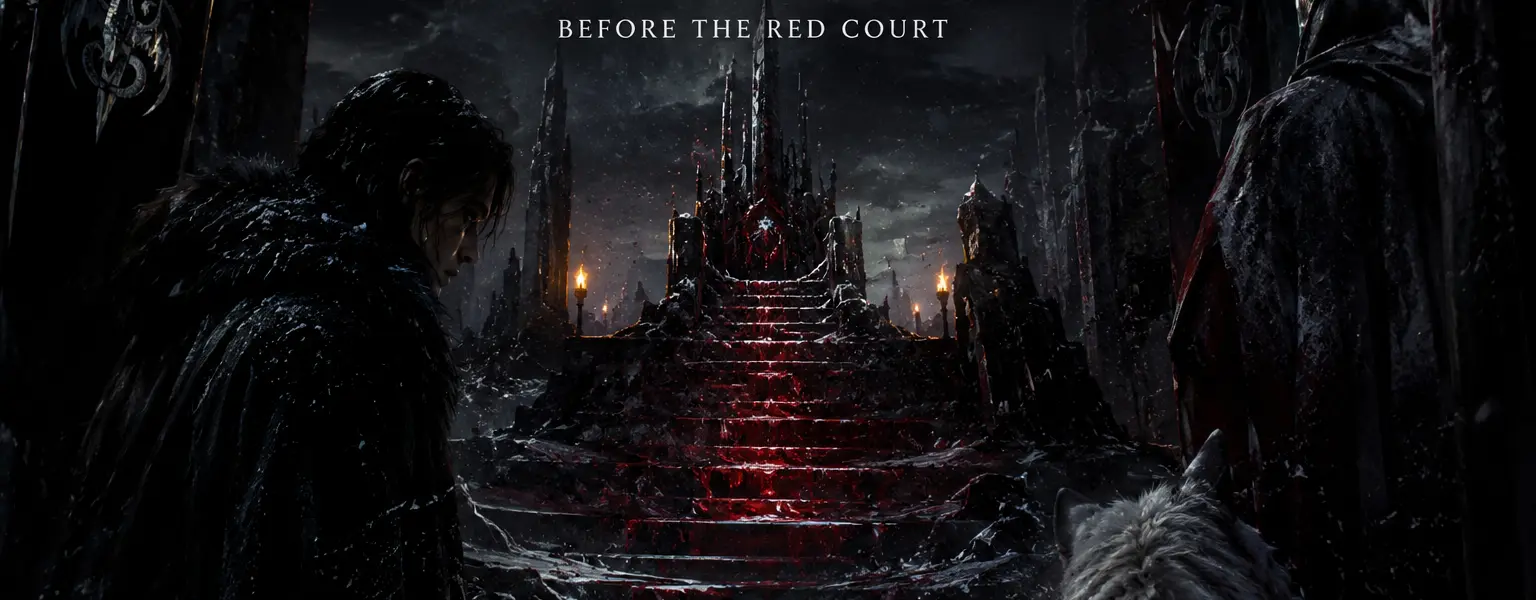
Kings Always Are
Two seals share one wounded road. The men who can still say no discover what kings always are before war names them.
The Road Under Two Seals
The road had two seals and nowhere to put the wounded.
Two seals on one road usually meant no one owned the failure between them.
One seal belonged to Gavrion.
The other belonged to Drakenval.
Both were stamped into a white-painted board above the crossing house, separated by enough empty wood to suggest cooperation without implying affection.
Beneath them waited fourteen wagons.
Six traveled north.
Eight traveled south.
Three carried grain.
Two carried medicine.
One carried a woman whose leg had been splinted so badly that Corven had stared at it for five seconds and then walked away before saying something undiplomatic.
The other eight carried the ordinary machinery of a border pretending winter had not made all politics stupid.
Quarn stood in the middle of the road.
Aldren stood beside him.
Sevarin stood on the other side.
No one had planned the symmetry.
That made Quarn dislike it more.
“Move,” he said.
The Gavrion clerk looked offended.
“Master Quarn, the crossing is under joint review.”
“Road isn't.”
“The Drakenval seal has not been countersigned.”
Quarn looked up at the board.
Then at the white wagon directly beneath it.
“Woman bleeding?”
The clerk glanced at the wagon.
“Stable.”
“Means bleeding slowly.”
“The physician said transport remains safe.”
“Then transport.”
The clerk looked toward Aldren.
Aldren looked toward Sevarin.
Sevarin looked at the clerk.
“Why is the seal incomplete?”
The Drakenval officer answered before the clerk could.
“The northbound medical passage grants protection from ordinary search, levy, requisition and military delay. Under current imperial law, protection cannot attach to an enemy combatant without classification.”
Aldren frowned.
“There are enemy combatants in the wagons?”
“Two.”
“Whose enemy?”
The officer paused.
Teren, behind Aldren, smiled faintly.
Halvern did not.
Sevarin said:
“Exactly.”
The officer turned.
Sevarin wore no imperial crown.
At twenty-two he had learned how to make a uniformed man remember future consequences without raising his voice.
“One wounded man fought under a Gavrion marcher banner three months ago,” the officer said.
“The other?”
“Drakenval auxiliary.”
“So each side is delaying one of the other side's wounded.”
“Yes, Your Highness.”
“Efficient.”
The officer could not tell whether that was praise.
It was not.
Aldren walked toward the white wagon.
The door stood open.
Inside, a physician was trying to work around a brazier, two wounded soldiers, a coughing child and an old woman who had decided the physician was too young to understand blankets.
Marielle was not there.
That was the point.
The first medical crossing had existed because Marielle needed a road.
This one existed because she could not stand on every road herself.
White cloth hung from the wagon rail.
No crown.
No dragon.
No House crest.
Only a line stitched across the center: a small arch above running water.
Aldren recognized the older Vale shape.
Shelter over crossing water.
“Names?” he asked.
The physician looked up.
“All recorded.”
“Conditions?”
“All recorded.”
“Weapons?”
“Bound outside the treatment compartment.”
“Then what are we waiting for?”
The physician pointed toward the two men lying opposite each other.
One wore a Gavrion undercoat.
The other had Drakenval black beneath his blanket.
Neither looked capable of invading a stool.
“Them,” she said.
The Gavrion soldier opened one eye.
“I object to being a diplomatic problem.”
The Drakenval man said:
“You object badly.”
“You were unconscious.”
“I improved.”
“Regrettable.”
The physician pressed both of them back with one hand each.
“If either of you begins a war in my wagon, I will end it medically.”
Aldren stepped back.
“They seem integrated.”
Sevarin had come up behind him.
He studied the compartment.
Not the men first.
The straps.
The medicine shelf.
The patient list.
The position of the brazier relative to the axle.
Aldren noticed.
Sevarin always read the room as though the room had made choices before the people arrived.
“Who wrote the passage rule?” Sevarin asked.
“The sanctuary office,” Aldren said.
“Who approved it?”
“Both sides.”
“That was not my question.”
Aldren looked at him.
Sevarin pointed toward the white board above the crossing.
“Who made the sentence executable?”
Halvern answered from behind them.
“No one.”
Sevarin turned.
Halvern had three copies of the passage agreement under one arm.
“The document says wounded under neutral treatment are protected,” Halvern continued. “It does not define when a soldier stops being a combatant for the purpose of crossing.”
Teren leaned against the wagon.
“So the road has discovered philosophy.”
Corven said:
“Road has discovered lawyers.”
Quarn looked at Halvern.
“Worse.”
Halvern ignored them.
Aldren read the relevant line.
“Can we define it now?”
Sevarin said:
“Yes.”
Halvern said:
“Not carelessly.”
Sevarin looked at him.
Four years earlier, Halvern had made him amend an imperial survey order before entering a dead road.
Sevarin had apparently not forgotten.
“Then carefully,” he said.
They moved into the crossing house.
The room contained one long table, four chairs, a stove, two jurisdiction ledgers and an argument already waiting for them.
Quarn refused the chair.
Corven stood because Quarn had refused the chair.
Teren sat in both their places by putting his boots on one rung and his coat over another.
Halvern removed the coat.
Sevarin spread the documents.
Aldren watched him work.
Most people read agreements from top to bottom.
Sevarin read the parts that could fail first.
Definitions.
Transfer of responsibility.
Emergency authority.
Disputed ownership.
Withdrawal.
Death.
“This is a favor,” Sevarin said.
Aldren frowned.
“It is a treaty.”
“No.”
Sevarin tapped the page.
“It functions because everyone currently involved wants it to function.”
“That is generally considered useful.”
“It is fragile.”
Quarn looked toward the window.
Outside, the white wagon remained still.
“Road works when people hate each other too.”
Sevarin nodded once.
“Exactly.”
Aldren looked between them.
“Then what survives us?”
Sevarin's eyes moved to him.
There was the real question.
Not who was correct today.
Who would still be correct after the people in the room were dead, absent, angry or replaced by fools.
“A category,” Sevarin said.
Halvern's expression tightened.
“Careful.”
“I am.”
Sevarin took a blank page.
“A wounded person enters neutral medical standing when three facts are recorded.”
He wrote as he spoke.
“Name, if known.”
Marielle's influence.
“Condition requiring treatment.”
The physician's.
“Removal from active command and weapon access for the duration of passage.”
The border's.
Aldren read the line.
“And if the name is unknown?”
Sevarin stopped.
The question lasted longer than it should have.
Quarn noticed.
Aldren did too.
Sevarin crossed out two words.
“Identity trace if name unknown.”
Halvern said:
“Define trace.”
“Object, witness, unit mark, family relation, place of recovery.”
“And if none exist?”
Sevarin looked at him.
“Then someone has failed before the patient reached the road.”
Halvern did not blink.
“The patient still reached the road.”
Silence.
Teren stopped smiling.
Corven looked toward the wagons.
Quarn said:
“Mud doesn't need papers.”
Sevarin's pen remained above the page.
Aldren knew the expression.
Not indecision.
Recalculation.
Marielle had once told Sevarin that an archive which knew what was delivered but not who carried it had failed.
Sevarin had made room for names.
Now the road had delivered someone who might not have one.
He wrote again.
“Temporary standing may be granted by the receiving medical authority until identity is established.”
Halvern read it.
“Who may revoke it?”
“The same authority, upon evidence of active threat.”
“Not the military?”
“The military may present evidence.”
“May it compel?”
Sevarin looked toward the white wagon.
“Not inside medical standing.”
Aldren smiled slightly.
Sevarin saw.
“What?”
“Nothing.”
“You are doing the Teren thing.”
Teren looked pleased.
“I have become a verb.”
Halvern said:
“Unfortunately.”
Aldren leaned over the page.
“Add one more.”
Sevarin waited.
“The patient keeps the right to refuse transfer once medically able to understand the choice.”
The Drakenval officer at the wall stiffened.
“Your Highness—”
Aldren did not look at him.
Sevarin did.
“Why?”
“A neutral road that can deliver a person into custody without asking them is only a cleaner prison.”
Sevarin's gaze sharpened.
Not angry.
Interested.
“And if refusal creates military risk?”
“Then the risk becomes a new problem.”
“That is expensive.”
“People are.”
Quarn grunted.
Approval from him remained annoying because it sounded like indigestion.
Sevarin wrote the line.
Then another beneath it.
“Refusal does not erase criminal or military standing after medical passage ends.”
Aldren read it.
“Fair.”
“Necessary.”
“Those are sometimes the same.”
“Rarely.”
They signed nothing.
Not yet.
Halvern insisted the language be copied and reviewed by both legal offices before formal adoption.
Sevarin insisted the road needed an interim rule now.
Aldren agreed with both.
Teren announced this was the kind of leadership that produced headaches.
Corven carried the revised sheet outside.
The two border officers read it.
Neither liked it.
That helped.
At 10:05, both seals were pressed beneath the temporary passage clause.
The white wagon moved.
Quarn watched the wheels cross the border line.
One seal on the left.
One on the right.
The wagon did not care.
Neither did the wounded.
That evening, snow blocked the upper road.
They stayed.
Aldren sat near the stove with Quarn.
Sevarin stood at the table rewriting the temporary clause for the sixth time.
“You know scribes exist,” Aldren said.
“Yes.”
“You employ many.”
“Too many.”
“Then why are you doing that yourself?”
Sevarin did not look up.
“Because if I cannot state the rule clearly, I have no right to ask someone else to execute it.”
Quarn turned a cup in his hands.
“Good.”
Sevarin looked over.
“That sounded like approval.”
“No.”
Aldren smiled.
Sevarin returned to the page.
On the corner of the table lay a supply manifest.
Aldren recognized the format.
Drakenval inventory.
Needles.
Antiseptic salts.
Linen thread.
Heating stones.
Winter alcohol.
Replacement clamps.
Destination: Varyel Vale sanctuary network.
Aldren touched the top sheet.
“You sent these.”
Sevarin's hand stopped.
Only for a moment.
“Drakenval had surplus.”
Quarn looked at the list.
“Twelve pages of surplus?”
Sevarin ignored him.
Aldren turned one page.
Every item had weight, route, replacement date and fallback source.
No personal note.
Of course.
“Marielle knew it was you.”
Sevarin capped the ink.
“The supplies were correctly inventoried.”
“That was not my sentence.”
Sevarin looked at him.
Aldren let the silence remain.
Four years ago, he might have tried to protect himself from whatever answer came next.
Now he only waited.
Sevarin said:
“A personal note would not make the needles sharper.”
“No.”
“Or the road shorter.”
“No.”
“Then it was unnecessary.”
Quarn drank.
Aldren said:
“People sometimes need unnecessary things.”
Sevarin's expression became faintly impatient.
“That is why they are unnecessary.”
Aldren laughed.
Sevarin almost did.
Almost.
Outside, the medical road remained open under two seals.
Inside, three men who understood roads for completely different reasons listened to snow press against the shutters.
For one night, neither kingdom needed to win.
It only needed the road to still work in the morning.
A Favor That Could Survive Us
Three weeks later, the rule met a woman with no papers.
Quarn considered this progress.
The woman did not.
She stood in the passage station with a sleeping boy tied against her chest beneath a brown shawl.
No House token.
No travel seal.
No village letter.
No military mark.
No witness willing to cross the border with her.
Only a burn across one hand and a child whose breathing whistled badly enough that the station physician had already ordered both of them inside.
The Drakenval duty captain blocked the treatment door.
Not with a sword.
With the new protocol.
That was worse.
“Identity trace,” he said.
The woman stared at him.
“I told you my name.”
“You gave a name.”
“It is mine.”
“I have no proof.”
“My son is sick.”
“I am aware.”
“Then move.”
The captain looked pained.
Not cruel.
Pained.
He had been given a rule designed to protect strangers and had found the part where protection required him to decide whether a stranger existed correctly.
Aldren arrived in time to hear the woman say:
“If I had papers, I would not need your road.”
He stopped.
Sevarin stood near the registry table.
He had arrived before Aldren.
That was becoming irritating.
Quarn stood beside the stove.
That was becoming inevitable.
“What happened?” Aldren asked.
The captain answered.
“Temporary standing requires an identity trace if the name is not verified. She has none.”
Aldren looked at Sevarin.
“We wrote a medical-authority exception.”
“We did.”
“Then use it.”
Sevarin pointed toward the physician.
“The physician did.”
“Then why is she still here?”
“Because the captain believes the exception permits treatment but not protected crossing.”
Aldren looked at the captain.
“Do you?”
The man straightened.
“The text says receiving medical authority may grant temporary standing until identity is established. It does not say temporary standing survives transfer across the state line without an authenticated trace.”
Halvern entered behind Aldren.
He heard the last sentence.
His face became the face of a man discovering that language had reproduced while unsupervised.
“Give me the document.”
Teren followed.
“Do we flee?”
Corven came last carrying a crate.
“No.”
“Pity.”
Halvern read.
Then looked at Aldren.
“He is correct.”
The woman made a sound that was nearly a laugh.
“Wonderful.”
Aldren rubbed his forehead.
Sevarin did not.
He watched the child.
Not sentimentally.
Measuring.
Breath rate.
Color.
How often the small chest failed to complete a full rise.
“How long can he wait?” Sevarin asked.
The physician answered:
“He should not.”
Sevarin turned to the captain.
“Open the door.”
The captain hesitated.
“Under which authority?”
“Mine.”
The word came out clean.
Too clean.
Laughter made the room briefly ordinary.
Not because Sevarin had raised his voice.
Because everyone understood that if they accepted that answer, the road worked only because one prince happened to be present.
Quarn said:
“Bad.”
Sevarin looked at him.
“The child needs treatment.”
“Yes.”
“The captain needs authorization.”
“Yes.”
“I possess it.”
“Today.”
Sevarin went still.
Quarn pointed toward the door.
“Boy still sick tomorrow.”
Aldren looked at the woman.
She had not bowed.
Good.
“Open the treatment room under physician standing,” he said.
The captain looked between him and Sevarin.
“Cross-border transfer?”
“Not yet.”
The physician took the woman and child inside.
The door closed.
Only then did Aldren turn to Sevarin.
“We built a favor.”
Sevarin looked at the closed door.
“Yes.”
No defensiveness.
That made the conversation easier.
“You said that last time.”
“I was correct last time.”
Teren murmured:
“He says that with remarkable freshness.”
Halvern said:
“Quiet.”
Sevarin pulled the protocol toward him.
“The mistake is not temporary standing.”
“What is?” Aldren asked.
“We treated crossing as a privilege attached to identity verification rather than as part of the medical standing itself.”
Halvern considered.
“If temporary medical standing includes crossing, fugitives can exploit it.”
“Yes.”
“Spies.”
“Yes.”
“Smugglers.”
“Yes.”
Teren said:
“I feel unusually seen.”
Halvern ignored him.
Aldren asked:
“Can the road survive that?”
Sevarin answered immediately.
“It has to.”
Aldren looked at him.
That was the part of Sevarin people misunderstood.
He did not love systems because they were clean.
He loved them because a clean system could keep working when the people inside it were frightened, selfish, dead or wrong.
The danger was not that he failed to see the human cost.
The danger was how quickly he began asking whether the cost could be made predictable.
Sevarin drew three columns.
“Medical standing crosses with the patient.”
Halvern nodded.
“Security investigation may follow after stabilization.”
Another.
“No patient under active treatment may be removed from the medical route by military authority without physician certification that transfer will not endanger life.”
Halvern stopped him.
“What if the patient is actively dangerous inside treatment?”
Sevarin wrote:
“Immediate physical threat permits restraint, not loss of medical standing.”
Corven put down the crate.
“What if the person has no name and no witness?”
Sevarin did not answer at once.
Corven continued:
“Not hiding it. Actually none.”
Quarn looked at him.
Corven shrugged.
“Roads find people.”
Sevarin said:
“Then the route creates the first trace.”
Aldren frowned.
“Explain.”
“Time admitted. Place recovered. Condition. Treating witness. Physical description. Objects carried. First words if conscious.”
He wrote each one.
“The record begins there.”
Aldren read it.
“So the road can become proof a person existed.”
Sevarin looked at him.
“A road that receives someone has already participated in their history.”
Quarn stared at the page.
“Good.”
Sevarin almost smiled.
“Approval?”
“No.”
“Of course.”
Halvern added:
“Temporary identity record cannot be silently converted into criminal admission or permanent political status.”
Sevarin looked annoyed.
“Why would anyone—”
Then stopped.
Everyone in the room waited.
Sevarin imagined the obvious future abuse.
His expression flattened.
“Add it.”
Halvern did.
That was how the passage protocol grew.
Not from wisdom descending cleanly.
From six people discovering how many kinds of cruelty a useful sentence could accidentally permit.
The boy's name was Neri.
His mother was Alwen.
Those were the names she gave.
The station wrote them without pretending the ink had proven more than she had said.
Neri had winter lung inflammation, not plague.
He slept beneath three blankets while the physician prepared a southbound transfer.
Alwen sat beside him.
Aldren stood in the doorway.
Sevarin stood farther back.
“You may cross under temporary medical standing,” Aldren told her.
She looked at him.
“Will they arrest me afterward?”
Aldren glanced at Sevarin.
Sevarin answered.
“If there is lawful cause, investigation may occur after your son is stable.”
Alwen's eyes narrowed.
“That sounds like yes.”
“It means I will not lie to you.”
She studied him.
“You are Drakenval.”
“Yes.”
“Do you always speak like paper?”
Teren, somewhere behind the wall, made a dangerous sound.
Sevarin said:
“Often.”
Alwen looked at Aldren.
“And you?”
“Less successfully.”
That earned the smallest smile.
Neri coughed.
The room returned to what mattered.
The physician came in with transfer papers.
Not travel papers.
Not citizenship.
Not pardon.
Only proof that a sick child had entered one road alive and was expected to leave it under care.
Alwen put her burned hand over the page.
“I cannot write.”
Sevarin said:
“A mark is sufficient.”
She looked at him.
“You believe me now?”
Sevarin considered the question.
“I believe you are here.”
Alwen pressed her thumb into the ink.
Then onto the page.
“Start there,” she said.
Sevarin looked at the print.
“Yes.”
Night made the border disappear.
From the roof walk, Gavrion and Drakenval were both snow.
Aldren leaned against the parapet.
Sevarin stood beside him.
Quarn sat several yards away repairing a strap that did not belong to either prince.
“Do you know what bothers me?” Aldren asked.
“Many things.”
“About you.”
Sevarin looked over.
“That narrows little.”
Aldren smiled.
“You improve every mistake.”
“That is generally the purpose of noticing one.”
“No. You improve the system.”
Sevarin waited.
“Most people become ashamed. Or angry. Or defensive.”
“Those are expensive.”
“You make the next version harder to break.”
“Yes.”
Aldren looked at the dark road.
“What happens when the next version is wrong in a way we have not imagined?”
“We improve it.”
“And the next?”
“Again.”
“Forever?”
Sevarin's answer took longer.
“Until the structure no longer needs us.”
Quarn stopped working.
Only for a heartbeat.
Aldren heard the sentence differently than Sevarin intended.
“You want to be replaceable.”
Sevarin looked toward the invisible border.
“A state that dies with its best man was badly built.”
“What about a friendship?”
Sevarin turned.
Aldren regretted the question immediately.
That did not make it bad.
“What about it?” Sevarin asked.
“Should that survive replacement too?”
Sevarin's face became unreadable.
Quarn resumed the strap.
“No,” Sevarin said.
Aldren waited.
Sevarin continued:
“That would not be the same friendship.”
Small answer.
Human answer.
Aldren let it remain.
Below, the southbound medical wagon began moving.
Its white cloth disappeared into darkness.
The road kept the names it had received.
For now, that was enough.
The Men Who Could Say No
Sevarin discovered Aldren's government by trying to remove Aldren from a room.
“Leave,” Sevarin said.
Aldren looked up.
“That is rude.”
“It is a test.”
“That does not improve it.”
“Usually it does.”
They stood in the joint administration house above the medical road.
The passage rules had survived sixteen days.
That was long enough to become dangerous.
People had begun trusting them.
Three crossings now used the protocol.
Two more had requested copies.
One marcher lord had complained that neutral treatment weakened military discipline.
One Drakenval commander had complained that physician authority exceeded proper chain.
Marielle had sent a six-page correction beginning with:
“If you need a banner to decide whether someone is bleeding, remove the banner.”
Teren had read it aloud twice.
Halvern had asked for a copy.
Sevarin had already memorized it.
Now the group faced a different problem.
The protocol worked when Aldren or Sevarin personally resolved disputes.
That meant it did not work.
Quarn had said this first.
Sevarin had disliked hearing his own argument returned to him.
Then adopted it immediately.
“We leave the room,” Sevarin said. “The local officers execute the passage without us.”
Aldren looked at Corven.
“Do we trust them?”
Halvern answered:
“Wrong question.”
Quarn looked almost pleased.
Halvern continued:
“The system is supposed to function when trust is incomplete.”
Teren sighed.
“I remember when you were less interesting.”
“No, you do not.”
“True.”
Aldren looked toward the two local officers waiting by the table.
One Gavrion.
One Drakenval.
Both competent.
Both visibly wishing six nobles would stop using their workplace as a philosophical weapon.
“Fine,” Aldren said.
Sevarin turned to go.
Corven did not.
Sevarin looked back.
“You too.”
Corven frowned.
“Why?”
“Because you keep carrying things before anyone proves they need carrying.”
Teren placed one hand on Corven's shoulder.
“He has studied you.”
Corven removed the hand.
Sevarin looked at Halvern.
“You remain.”
“Why?”
“Because I want someone inside who will object to the wording rather than rescue the outcome.”
Halvern considered.
“Acceptable.”
Teren looked hopeful.
“And me?”
“Leave.”
“You wound me.”
“No.”
Quarn was already outside.
They joined him beneath the eaves.
Snowmelt fell from the roof in slow drops.
Aldren stood beside Sevarin.
Teren wandered three steps away and began talking to a courier.
Corven found a loose hinge.
Of course.
“They will call us back,” Aldren said.
“Then we failed.”
“They may call us back because the problem is actually difficult.”
“Then the protocol should tell them how to escalate it.”
“To whom?”
Sevarin looked at him.
“That is the question.”
Inside, voices rose.
Corven stopped touching the hinge.
Teren stopped talking to the courier.
Aldren moved toward the door.
Sevarin caught his sleeve.
Aldren looked down at the hand.
Sevarin released him immediately.
“Wait.”
“Someone may need help.”
“Yes.”
“Then why—”
Quarn said:
“Listen.”
They did.
The voices were not panic.
Argument.
One officer.
Then the other.
Halvern.
A physician.
Then silence.
Aldren stayed.
Several minutes later, the door opened.
Halvern stepped out.
“They resolved it.”
Sevarin's posture changed by less than an inch.
Relief, for him.
“How?”
“The Gavrion officer wanted military inspection of a wounded courier's sealed packet. The Drakenval physician refused removal from treatment. The packet itself was not medically relevant.”
Aldren frowned.
“Then?”
“The Drakenval officer proposed that the packet be sealed into neutral custody, documented by both sides, and released when the courier left medical standing.”
Sevarin looked toward the door.
“That is not in the protocol.”
“No.”
“It should be.”
Halvern shook his head.
“Maybe.”
Sevarin looked at him.
“Why maybe?”
“Because if you write every good judgment into mandatory form, eventually no one remembers how to judge.”
Teren whispered:
“He has found Sevarin's second natural enemy.”
Aldren whispered back:
“Improvement?”
“Correct.”
Sevarin heard them.
He ignored them with discipline.
“A repeatable solution is not the enemy of judgment,” he told Halvern.
“No.”
“Then?”
“A system should preserve room for the person closest to the consequence to answer what the system did not anticipate.”
Sevarin's eyes narrowed.
“That creates inconsistency.”
“Yes.”
“And abuse.”
“Yes.”
“And error.”
“Yes.”
“You are making a poor argument.”
Halvern looked at him.
“No. I am naming the price.”
Quarn rubbed one thumb over the repaired strap.
“Road bends.”
Sevarin looked at him.
“Road also collapses.”
“Yes.”
“So we reinforce it.”
“Yes.”
“Then why object?”
Quarn pointed at the road.
“Reinforce where weight goes.”
Then toward the sky.
“Not everywhere.”
Sevarin became very still.
Aldren knew that stillness now.
The board inside his head had changed.
“Discretion bands,” Sevarin said.
Halvern frowned.
“What?”
“The protocol defines what may never be violated.”
He counted on his fingers.
“Medical standing cannot be removed for convenience.”
“Yes.”
“Active threat permits restraint but not abandonment.”
“Yes.”
“Patient choice must be recorded once capacity returns.”
“Yes.”
“Everything else becomes local discretion with mandatory record of reason.”
Halvern thought.
“And review.”
“Afterward.”
“By both sides.”
“Yes.”
Aldren smiled.
Teren said:
“There. You have invented government.”
Sevarin looked at him.
“We had government.”
“You have invented a version Halvern can complain about professionally.”
“Then it will never lack maintenance.”
Halvern's mouth almost moved.
Almost.
Quarn said:
“Good.”
Sevarin looked at him.
Quarn had already walked away.
Dinner contained soup, hard bread and too many princes.
Teren said this before anyone sat down.
“There are two,” Corven said.
“Exactly.”
Aldren took the seat nearest the window.
Sevarin took the seat with the best view of both doors without seeming to choose it.
Quarn ate standing.
Halvern had stayed with the local officers to finalize the review language.
For several minutes, everyone was too hungry to philosophize.
This improved the room.
Then Sevarin asked:
“Why do they stay?”
Aldren looked up.
“Who?”
Sevarin nodded toward Teren and Corven.
“Them.”
Teren put down his spoon.
“At last.”
Corven kept eating.
Aldren said:
“Ask them.”
Sevarin's eyes shifted.
“Teren.”
Teren leaned back.
“Because Aldren is handsome.”
Corven closed his eyes.
Aldren said:
“You may stop now.”
“I have more.”
“Do not.”
Sevarin waited.
Teren's smile thinned.
Then he answered properly.
“Because rooms become dangerous when everyone inside needs the prince to be right.”
Aldren looked at him.
Teren shrugged.
“You asked.”
Sevarin turned to Corven.
Corven swallowed.
“Work needs doing.”
“That could describe service to anyone.”
“No.”
Corven tore bread.
“Some men make the work become about them.”
Sevarin's eyes sharpened.
Corven continued:
“Aldren usually notices when that happens.”
“Usually?”
“Halvern exists.”
Teren laughed.
Sevarin looked at Aldren.
“And Halvern?”
Aldren answered:
“He would say because I remain worth correcting.”
“And Quarn?”
Quarn continued eating.
Sevarin waited.
Quarn did not reward waiting.
Aldren smiled.
“You have to ask him.”
Sevarin looked at Quarn.
“Why do you stay with Aldren?”
Quarn chewed.
Swallowed.
“Road.”
Sevarin waited.
Nothing.
“That is not an answer.”
“Was mine.”
Teren whispered:
“He likes you.”
Sevarin ignored him.
Aldren leaned back.
“You heard me say it in Drakenval.”
Sevarin looked at him.
“They are not yours to keep.”
“Yes.”
“You still believe that.”
“More than before.”
“Then you build authority around people who may leave.”
“Yes.”
“Why?”
“Because if they cannot leave, staying tells me nothing.”
The room went quiet.
Sevarin looked at the table.
At the men.
At the door.
“That is inefficient.”
Aldren smiled.
“Yes.”
Sevarin's fingers touched the edge of his bowl.
One small correction.
He aligned it with the table grain.
“It is also difficult to counterfeit.”
Aldren's smile faded.
“Yes.”
Sevarin looked at Quarn.
“Do you agree?”
Quarn shrugged.
“People leave.”
“That was not the question.”
“Still true.”
Sevarin considered him.
Then said:
“An army cannot operate if every soldier reconsiders every order.”
Aldren nodded.
“No.”
“A state cannot survive if every official may refuse procedure whenever conscience feels dramatic.”
“No.”
“Then somewhere, choice must end.”
Aldren looked at him.
“Somewhere.”
“Where?”
Aldren thought of Halvern crossing out voluntary.
Corven entering rivers.
Teren seeing rooms before rooms saw themselves.
Quarn refusing gratitude.
Marielle building a sanctuary large enough not to need her hand every minute.
“At the point where the person has actually chosen what burden belongs to them,” he said.
Sevarin's expression did not change.
But something in the room did.
Teren looked down.
Corven stopped tearing bread.
Quarn watched Sevarin.
Aldren did not know why.
Not yet.
Sevarin said:
“That is not administratively useful.”
“Probably not.”
“It does not scale cleanly.”
“Probably not.”
“And you intend to rule with it.”
Aldren looked at him.
“I intend to live with it.”
Sevarin stared for a long moment.
Then took another spoonful of soup.
“Worse.”
Aldren laughed.
So did Teren.
Corven smiled.
Quarn kept eating.
Sevarin did not laugh.
But the corner of his mouth moved.
This time, it completed the motion.
Later, Quarn found Sevarin alone outside.
Snow had stopped.
The road had not.
Lanterns moved between the medical station and the southern bend.
“You watch roads when thinking,” Quarn said.
Sevarin did not look surprised.
“You watch people when pretending not to.”
Quarn leaned on the rail.
“Wrong.”
“Which part?”
“Pretending.”
Sevarin looked toward the lanterns.
“Aldren's men would leave him.”
“Maybe.”
“You would.”
“Maybe.”
“And he relies on that.”
Quarn scratched at one weathered knuckle.
“Relies on them choosing.”
“That is unstable.”
“Yes.”
“You approve.”
“Sometimes.”
Sevarin's voice became quieter.
“My father says a kingdom cannot be built on sometimes.”
Quarn looked at him.
He did not know Drakenval's king well.
He knew roads under kings.
That was enough to make the sentence unpleasant.
“King right,” Quarn said.
Sevarin glanced over.
“You agree?”
“Kingdom can't.”
A pause.
“People do.”
Sevarin looked back at the road.
One lantern disappeared behind the bend.
Another followed.
“If I build a system that survives me,” he said, “then I have done my duty.”
Quarn considered.
“Maybe.”
Sevarin almost smiled at the returned word.
Then Quarn added:
“Put yourself in the failure list.”
Sevarin turned.
“I am already there.”
“No.”
Quarn tapped the rail.
“You put death.”
Sevarin's face went still.
“Same result.”
“No.”
“Explain.”
Quarn looked at him.
“Dead man can't choose wrong.”
Then he walked inside.
Sevarin remained on the outer walk.
The road below continued carrying people neither kingdom had expected.
For the first time that night, the system in his head had no clean place to put the sentence.
Kings Always Are
The senior strategist believed Sevarin's king was cornered.
He had believed it for eleven moves.
That was why he was losing.
The war room contained maps instead of windows.
Three northern road sheets.
Two western fortress lines.
One river table.
A border relief ledger from the medical passage.
And, at the center, a square campaign board built from black wood and pale bone.
The pieces were not uniform ranks.
Drakenval war play did not reduce armies to identical infantry.
Each piece represented a function.
Supply.
Bridge.
Signal.
Reserve.
Command.
Fortress.
King.
Sevarin sat on one side.
The senior strategist sat opposite him.
Quarn stood near the wall because every chair in the room looked expensive.
He had been invited to observe the final signing of the passage compact later that morning.
Instead he had been brought here by an imperial aide who said the prince was occupied.
Quarn had considered leaving.
Then he saw the board.
Bad roads came in many materials.
The strategist moved a pale command piece.
“Your king is cornered.”
Sevarin looked at the board.
“Kings always are.”
The old man frowned.
“That is not an answer.”
“It is the condition.”
“Your western reserve is cut from the bridge.”
“Yes.”
“Your signal line has one route.”
“Yes.”
“Your king cannot leave the central square without exposing supply.”
“Yes.”
The strategist leaned back.
“Then concede.”
Sevarin moved the bridge piece.
Not toward the king.
Away.
The old man's eyes narrowed.
“You abandoned the bridge.”
“No.”
“It is no longer connected to your command.”
“Correct.”
“Then it is lost.”
Sevarin looked at him.
“To whom?”
The strategist looked down.
The pale army had spent eight moves pressing toward the bridge because every visible line said the bridge was the only route by which Sevarin's reserve could save the king.
Now the bridge stood disconnected.
Useless.
Except the strategist's entire western force had reorganized itself around controlling it.
Sevarin moved the supply piece.
One square.
The old man stopped breathing for half a beat.
Not toward the king.
Toward the empty route the pale force had created while protecting its victory.
Quarn saw it then.
He disliked games because boards lied more politely than maps.
This one had told the truth.
The truth had simply not been about the king.
The strategist moved his signal piece.
Too late.
Sevarin moved the reserve.
The pale western line became a wall facing the wrong direction.
The king remained cornered.
It no longer mattered.
The strategist stared.
“You accepted the corner eleven moves ago.”
“Earlier.”
“When?”
Sevarin touched the first bridge mark on the notation sheet.
“When you decided a king being trapped meant the board had to rescue him.”
The old strategist looked at the black king.
Then at Sevarin.
“And if I had taken the king?”
“You would have spent two additional functions to do it.”
“You would lose.”
“The piece would.”
The strategist's eyes hardened.
“A kingdom whose king is expendable is not a kingdom.”
Sevarin's fingers rested beside the board.
Small correction.
He straightened the notation sheet.
“A kingdom whose survival requires every road to end at one man is already dead.”
Quarn's gaze shifted to him.
Sevarin noticed.
“What?”
Quarn said:
“Nothing.”
“You disapprove.”
“Didn't say.”
“Your face did.”
Quarn almost smiled.
Aldren had used that complaint before.
The strategist studied the remaining pieces.
He saw the loss.
Not a dramatic checkmate.
Something worse.
Every useful response required accepting the structure Sevarin had already chosen.
One route preserved supply but lost signal.
Another preserved signal but abandoned reserve.
A third attacked the king and opened the entire pale rear.
The old man sat back.
“I resign.”
Sevarin nodded.
Then made one final move.
The strategist looked at him.
“The game is over.”
“Yes.”
“Then why?”
Sevarin placed the command piece onto the open road beyond the abandoned bridge.
“Because the road still exists after you stop contesting it.”
Quarn looked at the board again.
That answer he understood.
He did not know whether he liked it.
The war-room door opened.
No knock.
Every officer in the room looked up.
An imperial messenger entered carrying red wax.
Not ordinary court red.
Blood Court red.
Two summons.
One for Sevarin.
One for Gevrane.
The senior strategist's face changed before Sevarin's did.
Quarn saw that.
“Your Highness,” the messenger said.
Sevarin looked at the wax.
“Reason?”
“Bloodline matter.”
The words were formal.
Too formal.
Sevarin did not touch the summons immediately.
On the side table beneath a stack of passage reports lay a sheet of white paper.
Not military.
Not registry.
Personal.
Marielle Varyel Vale's name appeared once at the top.
Nothing beneath it had survived Sevarin's last revision.
Quarn had noticed the page when he entered.
He had not asked.
Road-men who survived kings learned which doors were not theirs.
Sevarin took the summons.
The wax cracked beneath his thumb.
He read his page.
Then Gevrane's.
His face did not change.
That was the first bad sign.
“Where is my sister?”
“Lower court, Your Highness. She has also been notified.”
“Who else?”
“The Blood Council. His Majesty. Line witnesses. Control knights.”
The senior strategist slowly stood.
No one mentioned the game.
Sevarin folded the summons once.
Perfectly.
Quarn looked at him.
“Bad road?”
Sevarin's eyes moved to the old man.
For a moment, the war room disappeared from his face.
He was twenty-two.
Too young for the stillness he had taught himself.
“Unknown.”
Quarn looked at the red wax.
“Bad answer.”
Sevarin's mouth almost moved.
Then the second door opened.
Gevrane entered.
White riding coat.
Dark hair tied badly.
Anger already visible.
“Did you get one?” she asked.
Sevarin held up the red paper.
“Yes.”
“Bloodline matter.”
“Yes.”
“Father would not tell me more.”
Sevarin looked at her.
At the sister who had spent years turning protocol into something doors had to chase.
At the strongest blade Drakenval had not yet learned to call property.
“Stay beside me,” he said.
Gevrane frowned.
“Why?”
“Because I asked.”
She looked at him for one second.
Then nodded.
Not obedience.
Trust.
Quarn saw the distinction.
So did Sevarin.
That was the second bad sign.
Gevrane noticed the white page on the side table.
Her eyes moved from Marielle's name to her brother.
She said nothing.
For once, neither did Teren because Teren was not there.
No joke came to rescue the room.
Sevarin put the two red summons beside the campaign board.
The black king remained cornered.
The command piece stood on the open road beyond it.
Quarn looked at the board.
Then at Sevarin.
“Road still there,” he said.
Sevarin followed his gaze.
“Yes.”
“Remember it.”
Something in Sevarin's expression changed.
Small.
Enough.
He took the white personal page from beneath the reports.
Folded it once.
Not like the summons.
Slower.
He placed it inside his coat.
Then he and Gevrane left for the Red Court.
Behind them, the board remained unfinished in the only way that mattered.
The king was still cornered.
The road was still open.